Poetry in Form: Sapphics

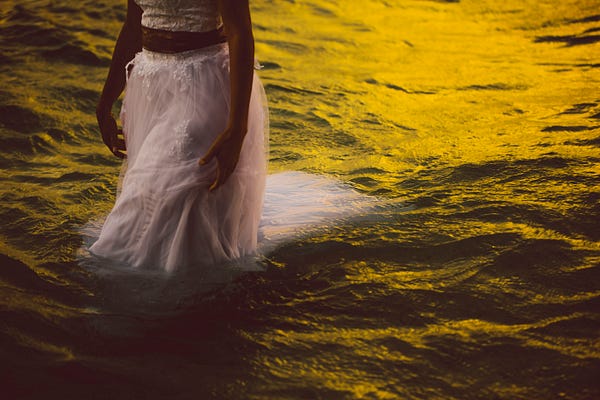
“A woman walking in the sea in a white dress, as the water reflects the Rarotonga sunset” by Luke Marshall on Unsplash

Sapphics, as you might guess, are named for the ancient Greek poet Sappho. The form follows a strict metrical pattern that does not come naturally to me. Former poet laureate Kay Ryan once said at a reading. “I am a slave to rhyme.” Well, I am a slave to the iamb, and the Sapphic meter seems weird.

But it seemed like the perfect form for a particular poem.

Sapphics are written in four-line stanzas. The contemporary Sapphic metrical pattern for poets who write in English sounds like this:

DUM da DUM da DUM da da DUM da DUM da

DUM da DUM da DUM da da DUM da DUM da

DUM da DUM da DUM da da DUM da DUM da

DUM da da DUM da

In contrast, the more common iambic pattern goes like this:

da DUM da DUM da DUM da DUM da DUM.

Why did I choose to write in an ancient Greek Sapphic form? It started with undergoing interferon treatment for hepatitis C. (Coincidentally the word “hepatitis” comes from the Greek.) The treatment gave me many nasty side effects, but the scariest one was that it wiped out the poetry part of my brain for a year.

Happily, a breakthrough came when I visited The Ringling Museum in Sarasota, Florida. This museum, in the lavish former home of the circus magnate, has a Renaissance-style sculpture garden with a number of colossal statues, including a replica of Michelangelo’s David.

But the colossal that struck me like a thunderbolt was a replica of the Rape of Proserpina (a/k/a Persephone) by the Italian sculptor Bernini. It depicts Pluto (a/k/a Hades), the god of the underworld, abducting the virgin Proserpina.

Looking up at the colossal statue, I was astonished to see that a paper wasp had made a nest in Proserpina’s crotch. A metaphor occurred to me — the first that had popped into my head in a year. But more amazingly, when I got home and started researching wasps, I learned that their Latin name is hymenoptera — after “hymen,” the tissue that is broken when a woman loses her virginity.

What a gift that was. The poem was originally published in the online journal Per Contra.

The Wasp Garden

A Sapphic verse on a copy of The Rape of Proserpina by Bernini at the
Ringling Museum, Sarasota, Florida

“Rape of Proserpine,” the colossus’s sign reads,
“Stone Variant,” on the theme “young girl some
God of Hell abducted became a queen.” Her
Rape is looming, yet

Here, she’s held aloft, as if ready to fly, with
Pluto’s arms her launch. See where haughty paper
Wasps, the Hymenoptera, built their nesting
Site between her not-

Yet-queen-thighs, a fortress of humming rapture,
Stingers sharpened, ready to shield them both from
Brutal injuries and regrets, to put an
End to myths like these.
Poetry in Form: Villanelle

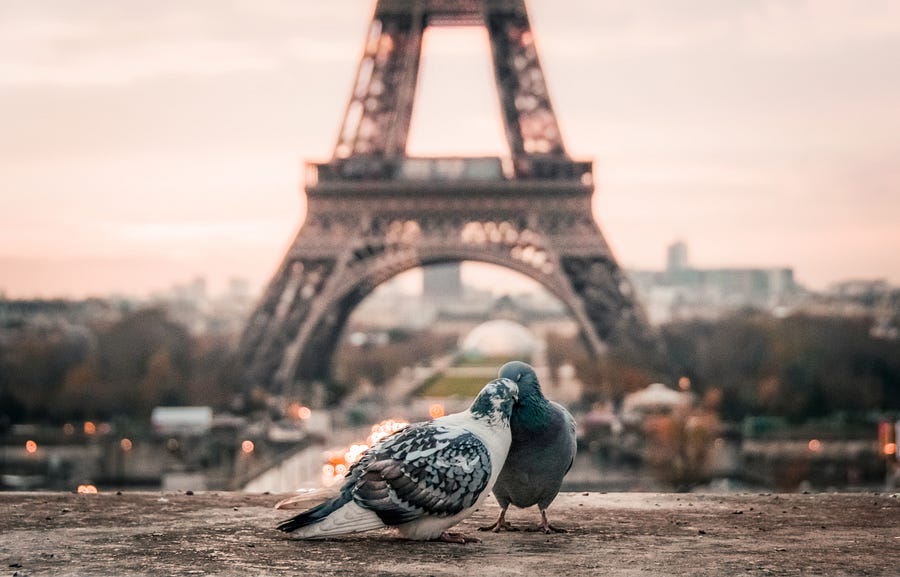
“Two pigeons nuzzle on a wall in the Trocadéro, the Eiffel Tower visible in the background” by Fabrizio Verrecchia on Unsplash
The word “villanelle” is from the French, although the form itself probably originated in Renaissance Italy. Originally, it was not a very structured form, but the villanelle we know today plays by a long list of rules.

It’s ironic that poets, who are so often iconoclasts, have been and continue to be drawn to the limits imposed by form.

Some poets say those limits free them from their mind’s repetitive patterns. I’m in that camp. For example, writing in form forces my brain away from the patterns it wants to follow. It forces me to find and choose words I might not otherwise use. Those two things alone will force me to come up with new ideas.

So instead of form and order being the enemy of the fresh and the new, the order imposed by form can actually push the brain out of its ruts into something entirely new.

The Academy of American Poets gives this complicated but thorough definition of the villanelle:

The highly structured villanelle is a nineteen-line poem with two repeating rhymes and two refrains. The form is made up of five tercets followed by a quatrain. The first and third lines of the opening tercet are repeated alternately in the last lines of the succeeding stanzas; then in the final stanza, the refrain serves as the poem’s two concluding lines. Using capitals for the refrains and lowercase letters for the rhymes, the form could be expressed as: A1 b A2 / a b A1 / a b A2 / a b A1 / a b A2 / a b A1 A2.

Oy vey. And yet, the interlocking nature of the villanelle is so like the obsessions we return to over and over again in our lives. Elizabeth Bishop’s villanelle “One Art” is perhaps the best example of how the form can illuminate — and acknowledge — obsession.

The villanelle below is an attempt to illuminate one or two of my obsessions. When performing it at a reading, I always introduce it as a gardening poem. But of course there’s another level. “Datura” was originally published in The Hypertexts, and also appears in my book, Back East.

Datura

I choose datura from the racks of seed
And nurture them with care, although they’ll grow
Up poisonous and beautiful. I need

Their syrup-scented trumpet-blooms. Their weed-
Like vigor cures me of the winter, so
I choose datura. From the racks of seed

I choose some others, too — the hearts that bleed
In spring, the columbine, and these will grow
Not poisonous, just beautiful. These need

A simpler kind of care; such flowers breed
With ease. I need the razor’s edge, and so
I choose datura from the racks of seed.

Surprise — their family, Nightshade, Jimsonweed
And Belladonna visit me. I grow
Accustomed to poisonous beauty, need

Hypnotics causing death or merely greed
For sleep, for nature’s death-defying show.
I chose datura from the racks of seed,
As poisonous and beautiful as need.

Poetry from Wordplay

Photo by Jelleke Vanooteghem on Unsplash
Maybe all poetry is all about word play — we bounce meter and rhyme, catch line breaks and stanza breaks, model concrete poems, imagine long abecedarian poems, play dress-up with erasure poems . . .

The most famous word-playing poet may be Lewis Carroll of Alice in Wonderland fame. His real name was Charles Lutwidge Dodson, and he was also a mathematician. Here are some lines from his poem “Jabberwocky”:


’Twas brillig, and the slithy toves
Did gyre and gimble in the wabe;
All mimsy were the borogoves,
And the mome raths outgrabe.

“Beware the Jabberwock, my son!
The jaws that bite, the claws that catch!
Beware the Jubjub bird, and shun
The frumious Bandersnatch!”

Play is creative; wordplay is no exception. In “Jabberwocky,” the nonsensical words somehow make a certain sense to our brains, perhaps because they are inserted into traditional syntax. We, the readers, create meaning out of nonsense. For example, we may make “slithy” into an adjective that describes the noun “toves.”

Erasure poems happen when poets play with a given text, erasing parts of the text to reveal and create a poem. One contemporary practitioner of erasure and other types of found poetry is E Kristin Anderson, who’s done some remarkable work with novels written by Stephen King.

The poem below, originally published in Hermeneutic Chaos (sadly, this beautiful journal is on hiatus), started out as a way of playing around with two different meanings of a Latin word.

Os

In ancient Latin, the word for bone — os —
was spelled the same as os, the word for mouth.

Once there was a mouth that shrank with age
to a pocket the size of a pea, with no more room

for food, or drink, or teeth, or even a tongue.
It grew smaller and smaller until it became

completely untethered: a small hole
floating in the night sky,

through which only bones spoke,
but only the bones of stars.

Poetry for Grief

Poetry for Grief

Photo by Mike Labrum on Unsplash

One form for expressing grief in poetry is the elegy. It started in the Classical period of Western history as a form using a metrical pattern called elegiac couplets: the first of two lines in dactylic hexameter and the second line in dactylic pentameter. The subject, originally, was not necessarily grief. To see an example, check out elegiac couplets in English by  John Donne .

Today, poets write poems they call elegies that do not follow any formal pattern. Formalists, of course, might say those poems are not elegies at all.

In deep grief, the arc of writing or reading a poem can be a way to come up for air. That is what I was looking for in this poem, originally published in Eclectica magazine.

Elegy for Christina

When you were seven, I took you out too far
into Ogeechee’s deep, seducing current
and swimming back, your bird-claw fingers choked
my neck. I stooped to prayer: 
please, God, no stupid
accident. We reached the riverbank. I laughed

as if there’d been no danger, so you could
keep on swimming. For years, you kept to the shoreline,
and grew to be the girl we thought would make
it, the one whose gentleness
we praised, the one whose un-

polluted urine her sisters brought
to their probation officers, the one
we thought immune from stupid accidents.
Some days, grief keeps me looking inward,
even when I hear the cranes’ migration,

and I dive back twenty years to swim the river
and hold you in the current, to stop
your transformation into a woman
overdosing, choking on her vomit.
It’s only now I can admit

we reached the riverbank so many years ago
as easily as windblown chaff
because we were the chaff.

The husk you left behind has burned and sent its smoke
into the atmosphere. Trumpets call me to look up.
I don’t expect the angels. Sandhill cranes
arrow over pine barrens toward the open prairie, lifted
on prevailing winds, following the one way clear to them.

Poetry and Chronic Pain

Poetry and Chronic Pain

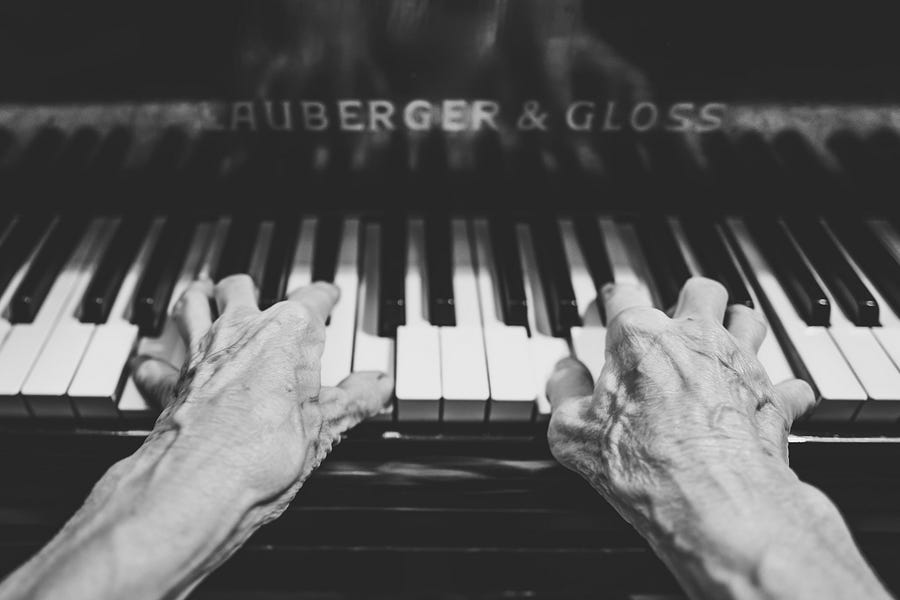
“A black-and-white shot of an elderly person’s hands playing a Lauberger & Gloss piano” by Lukas Budimaier on Unsplash
Wordsworth once defined poetry as “emotion recollected in tranquility.”

I like the idea of re-collecting feelings once they’ve passed, like gathering spent blossoms. It’s a bit gothic.

For me, writing on chronic pain is easier when I’m not actually experiencing it. When I’m in its grip, I’m cranky and selfish..

A research group in Lancaster, U.K. is soliciting poetry and personal narratives on chronic pain to better understand pain from those who experience it. The poem below was published there in 2018, and originally published in the print magazine Poet Lore.


Writing Memoir: Using Dream Images

“A silhouette of a man holding a smoke bomb on a deserted beach, with a pink sunset sky in the background” by Aziz Acharki on Unsplash
Do dreams have a place in nonfiction?

Since childhood, I’ve had occasional vivid dreams — the kind that are so weird, or colorful, or fantastic that they woke me up. When I started writing poetry (also as a kid), I thought those dreams and their images belonged in poems.

The dreams seemed so meaningful to me. So I wrote.

Later, more than one poetry teacher told me to ditch the dream poems — they didn’t mean anything to anyone but me. The teachers were right: without a context, dream images don’t translate very well for an audience. Of course, if you’re writing only for yourself, that’s different.

But dreams can work well for an audience in fiction and in creative nonfiction writing. They work as long as we make clear that they are, in fact dreams, and connect them to our stories and the people in our stories. I’m not a dream-interpreter, but when people reveal their dreams to me in real life, I feel as if I’ve gotten inside their heads a little. I feel I know them better.

Readers of both fiction and nonfiction want to know the people — or characters — in the stories they read. Reading a good book, we actually crave that knowledge, especially knowledge of a character’s motivations and how those motivations interact with plot. It’s why we stay up past our bedtimes and keep reading. We’re trying to figure out what will happen next.

Some literary theorists believe we read fiction to exercise the part of our brains that guesses at motivations, and that our brains have been programmed by evolution to want to guess at motivations.

Lisa Zunshine, in her book, Why We Read Fiction: Theory of Mind and the Novel, applies this idea specifically to novels, although I believe it can apply to any kind of writing that includes characters. She argues that understanding motivations, and then predicting behavior was an adaptive strategy for early humans seeking to survive and reproduce.

Zunshine’s theory is similar to Finnish psychologist Antti Revonsuo’s theory of dreams. Revonsuo believed that dreams were resulted from the brain practicing for flight-or-flight situations. In other words, our dreams are simulations of stressful situations we might face in real life.

Human beings have long believed dreams are powerful, either as predictors of the future, as revelations of past mysteries, as expressions of repressed wishes. They seem to come with a built-in significance.

For a writer of memoir or nonfiction, relating a dream can help to communicate something about motivation, or obsession, or desire. Instead of telling the reader “I felt trapped in my lifestyle,” I can show the reader how it felt by describing a dream related to that trapped feeling. Here’s an excerpt from one of my essays that attempts to do this:

Night after night, I dreamed of walking under streetlights in Boston, after the bars have closed, when the streets are deserted. I have trouble walking, but not the kind of trouble I had in the dreams of my twenties. In those dreams, my feet were as rigid and heavy as flatirons, and I couldn’t lift them to run away. In these new dreams, I’m drunk and wobbling. The busses have stopped running, and I stumble and curse, desperate to find a way out of Boston that will take me to the North Shore. I have to pee badly. I’m under the Southeast Expressway, surrounded by concrete Jersey barriers and I-beam steel, and there is no one to ask for directions, no taxis, no traffic. The city is silent. Should I walk up onto the expressway if I can find a ramp? Can I walk over the Mystic River Bridge because there are no cars? In the dream, I’m angry that the city is so hard to leave, and I never find the bridge.

In the context of the essay, this dream excerpt demonstrates, perhaps more vividly than reality could, how trapped I felt, and how frustrated. The dream itself may sound familiar to you — dreams about being lost and trying to find a way out of somewhere are common, as are dreams of trying to run with heavy feet. Perhaps they signal some common fear we share as human beings of being stuck in place.

What are some of your favorite examples of dreams in fiction or nonfiction? And what do you think about using dreams in your writing?

Writing Memoir: Finding (Making?) Time

Writing Memoir: Finding (Making?) Time

“A large heap of broken antique watches and clocks” by Heather Zabriskieon Unsplash
How do creative people find the time to write? Or do they “make” the time?

Years ago, someone asked me how I managed to do so much. “It’s easy,” I said. “I don’t have kids!” The people who amazed me with their productivity — and who still amaze me — were the ones who parented young children.

Writing a memoir, or even a stand-alone personal essay, requires a huge investment of time, especially for slow writers like me. If it took me less than 40 hours to write a ten page story, I’d be very surprised. This month, I’ve committed to finishing a coherent draft of my 80,000-word, rough memoir draft. How will I manage my time to insure I meet that goal?

Strategy 1: Getting on a Schedule

This was effective for me when I worked a full-time, 8:30 am to 4:00 pm job. I was already on a schedule, so creating another one for writing made sense. Off and on, for months at a time, I got up at 5:30 am and wrote for about 90 minutes.

Scheduled writing has been famously successful for authors like J.K. Rowling, who also had a day job when she began the Harry Potter series. If you are subject to an external schedule, whether it’s related to school or work or family responsibilities, a writing schedule may do the trick for you.

But once I resigned from the day job to work for myself, the external schedule that kept me on track disappeared and I found myself floundering.

Strategy 2: Figuring Out When You Write Best and Write Most

Although I’m not trying to lose weight because that ship has sailed, I know that food journals are an effective way for people to track calories. So I decided to keep a time tracker to see where I was spending my time.

Like many people, I squander time on social media, mindless eating, and passive entertainment. When I’ve squandered enough, I get resentful when those I love interrupt my thoughts about writing or the writing itself. As if those people (and dogs) are the cause of my fribbling.

Decades of working day jobs created a habit of writing at odd hours: early mornings, nights, and weekends. Breaking from that pattern has not been easy, even though I expected to have nights and weekends free once I was “just” writing. But I’ve been writing at odd hours still, and not making enough headway on the memoir to satisfy myself.

Data is powerful. The time tracker showed me I was working on my memoir early in the morning and late at night, for about 90 minutes at a time. Ugh. Old habits are hard to break. It also showed me that I was working on paying writing projects during the day, like that was a day job. Ugh, again.

3. State Your Writing Goals Publicly

This month, I’m writing about writing memoir every day. And I put it on my Medium profile.

Two popular month-long writing marathons, NANOWRIMO and NAPOWRIMO inspire many people to successfully find or make time to write novels and poetry, respectively. I participated in NAPOWRIMO this year in April. Thirty poems later, I think 4 or 5 of them are actually worthwhile.

But, I’m convinced that 30 days in a row of writing a poem, or at least a wannabe poem, was helpful exercise for the poetry part of my brain. I even continued the process through the first week of May. Now, I’m slacking off again.

I heard that you’re more likely to meet your goals if you announce them publicly. Oh wait, I also heard that announcing your goals publicly makes itless likely that you’ll meet those goals.

4. Going on a Writing Retreat

A retreat doesn’t have to be anywhere but your own home; it’s a big chunk of time (a day or more, preferably) devoted to writing. I’ve done stay-home retreats, and cheap motel retreats. Some writers go on organized writing retreats.

For me, these chunks of dedicated time seem to work best when I have a specific goal to meet. That’s especially true if I go somewhere besides my home, where I may be tempted to check out a new ice cream parlor. For this reason, I advise going on a retreat in a place that’s not very appealing to your interests.

But even on a stay-home retreat, I can be distracted by chores that suddenly must be done. I’m not talking about walking the dogs or watering the plants, which really must be done to keep everyone alive. I know I’ve hit rock bottom when I find myself scrubbing a toilet instead of writing.


The best piece of advice about finding or making time to write is to experiment to find out what works best for you. We’re all different, thankfully.

And if you’re wondering about the right time to begin a memoir, that’s something I’ve thought about this week because two former students got in touch to say they are thinking of writing memoir. They were both curious about “the right time” to start.

My response was “Now is the time.” When an idea about doing something creative pops up, that’s a hint from the part of yourself that’s smarter than the rest of you. Go with it.

For more tips on writing memoir, visit me on Medium.

Writing Memoir: Photographs and Images

The boundaries between genres are blurring.

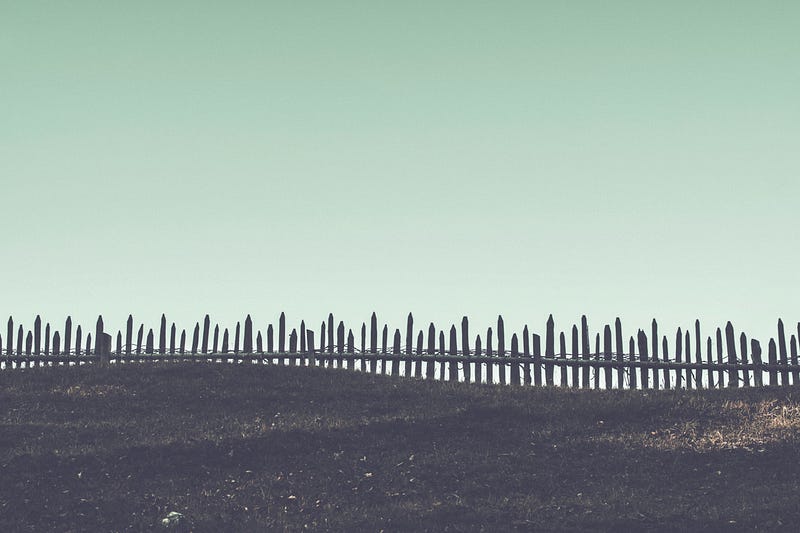
Fence. Photo by Simone Dalmeri on Unsplash

Why shouldn’t we include photographs in memoirs? The only reason I can think of is that some (maybe many) publishers don’t want the hassle. Publishing images is more complex, more expensive than publishing text only. Unless, of course, you’re publishing on the internet.

That damn internet. It’s changing everything.

Some publishers are welcoming work that combines text and image. Some of them are here on Medium. Many others can be found in this list of cross-genre publishers curated by New Pages.

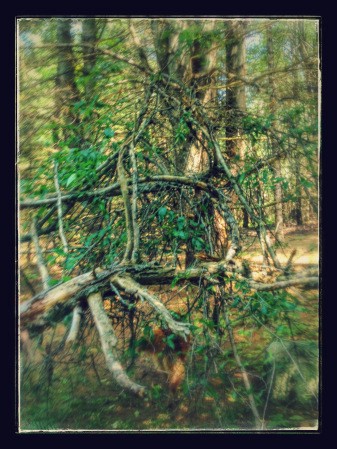
Here’s my attempt at a cross-genre piece combining photographs of trees with text about family trees.


Twisted branches. Photo credit: Michele Leavitt
Maybe it was me who doctored this photograph, trying to give it an heirloom appearance.

I see a “B” in this tree. Or maybe a “D,” or a sideways “A.”

Or a man, hanging face down with his arms extended, reaching for something on the ground.

Or a lizard with its tail curled up behind it. Or the predictable snake.

Or a tree, twisted by snow and ice, and the deaths of other trees, and by forces I cannot imagine, putting forth the predictable new growth in spring.

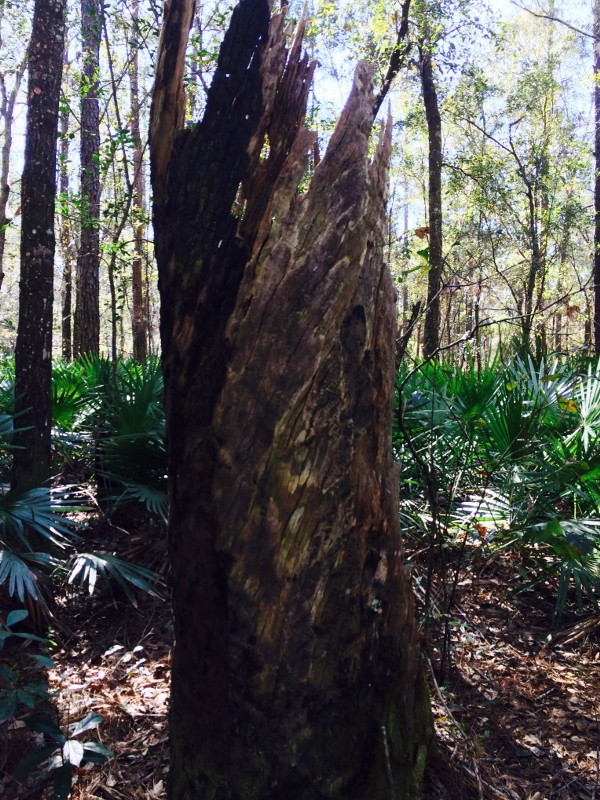
Unknown Dead Tree, North Central Florida

I leaned against trees, wrapped my arms around trees, swung from trees and hid in trees, and walked on limbs as if they were tightropes. I prayed to trees, I raged at trees. Far away, the half-brothers I now know cut trees down for very little pay.

In my private forest, which isn’t mine, but belongs to the town, I watch this tree, and the spiral of fungi around its trunk that curves around in question marks and other symbols. It might be my family tree: no hierarchy, no single ancestor, and certainly no single pattern.

Living Turkey Oak, fallen, North Central Florida. Photo credit: Michele Leavitt
This tree took the earth with it when it tipped over in a windthrow. It is the only tree in this quadrant that fell. Maybe another trauma, like heart rot fungus, affected its anchorage and prepared it to let go.The letting go starts a new creation story: a hole opens in the canopy, and sunlight pours down on the forest floor. Saplings stuck in the pole stage may wake up and start to grow gain.

New stories mean new names. The earth ripped up with the tree is now called a tip-up mound.

Dead Cypress, North Central Florida. Photo credit: Michele Leavitt
This tree has been dead for so long, you can see right through it in spots. How did that happen? I imagine the branches fell first, then the crown, and then the bark sloughed off like the skin of a snake, and then the core collapsed on itself. What’s left is a suggestion of the strong column it once was, a gesture toward how the column once spun upward in helix fashion.

What’s left of the tree has the pocked and scored look of the karst limestone under the ground around these parts. Maybe the tree has taken on some characteristics of the stone.

Even long dead, and even taking on other characteristics, the tree is still a tree.


For more tips on writing memoir, visit me on Medium.

Writing Memoir: Flashbacks and Braiding

Writing Memoir: Flashbacks and Braiding

Person standing still in front of a mural of a sneaker while cars zoom past. Photo by Ashim D’Silva on Unsplash

Real life happens chronologically, but memoirs and personal essays don’t have to. In fact, sometimes they shouldn’t if there’s some suspense or wisdom to be gained by juxtaposing events from various points in the past.

This technique is sometimes called using flashbacks. A more complex form of juxtaposing multiple times and threads is often called braiding.

Writers use several methods to alert readers to time changes in stories. The first involves simple signalling in phrases like “But ten years ago, I thought differently,” or “Two years before this event.”

A second method is to switch settings once you’ve already established a primary setting. An example might be found in a memoir about serving in the military in Vietnam. Whenever the writer flashes back to high school in America, we the readers will know that time has shifted too and that the high school is not in Vietnam.

Strong images or memorable characters associated with particular time periods can also serve as signals to the reader. A memoir that covers two marriages is one type of story that can use this technique, toggling back and forth between the two spouses or between two strong images like a granite fireplace in one marriage and a concrete swimming pool in another.

I’ve written a number of braided essays, and ironically that has made it difficult to compile them in my current memoir project, which is chronological. Maybe I should re-think that. But currently what I’m doing is chopping those essays up into their discrete times and threads in order to weave them back together in a chronological timeline.

One example of a braided essay that I’m currently chopping up is “Maternity Cave,” included in the March 2017 issue of Hippocampus. Like most of my publications, I worked on writing this piece for several years, and worked for even more years trying to figure out what the events in the story meant.

I don’t usually intend to braid different time periods, but it happens a lot. Every so often, a phrase or an image or a small event in daily life captures my attention as being connected to a phrase or image or event from the past. Those little a-ha moments are often the beginnings of my stories.

The maternity cave story begins in 2006 on a visit to a bat cave in Central Florida with my teenage niece Candi, where we saw thousands of little brown bats swirling up into the dusk, then it wiggles around in the 1990’s between my first marriage, my experience of infertility, and finding my birth family, and then it shoots ahead to a family picnic in 2016, when Candi is a grown woman with two children of her own. There was a moment at that picnic that lit up the past for me.

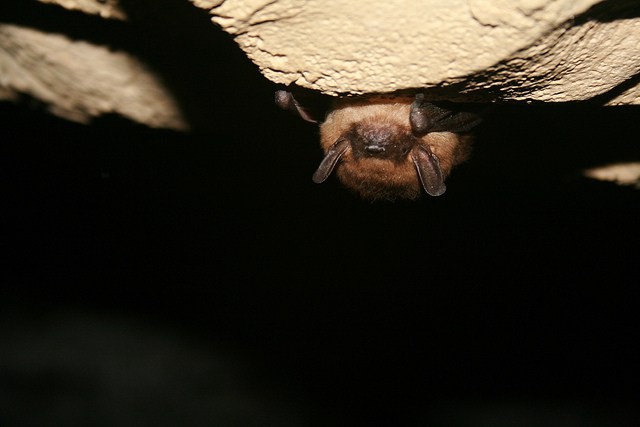
A bat hanging upside down in a cave. Photo credit  http://www.hippocampusmagazine.com/2017/03/maternity-cave-by-michele-leavitt/
The story doesn’t follow linear time, and I’ve been thinking lately that’s one of the benefits of being a reader of personal essays: we get to experience hard-earned wisdom in a way that isn’t tied to chronology. We get to look back, be in the present, and jump ahead to the future in less time than it takes to bake a cake. There’s no undo or do-over button because truth doesn’t change, but at least we get to see truth’s trail.

Memoirs and personal essays are time capsules, freezing us in a series of moments. But they can be time machines, too, taking us forward and backward, allowing us to grab on to the hindsight and foresight in someone else’s experiences, even when that sort of wisdom escapes us in our own lives.

For more tips on writing memoir, visit me on Medium.