Writing Memoir: Flashbacks and Braiding

Writing Memoir: Flashbacks and Braiding

Person standing still in front of a mural of a sneaker while cars zoom past. Photo by Ashim D’Silva on Unsplash

Real life happens chronologically, but memoirs and personal essays don’t have to. In fact, sometimes they shouldn’t if there’s some suspense or wisdom to be gained by juxtaposing events from various points in the past.

This technique is sometimes called using flashbacks. A more complex form of juxtaposing multiple times and threads is often called braiding.

Writers use several methods to alert readers to time changes in stories. The first involves simple signalling in phrases like “But ten years ago, I thought differently,” or “Two years before this event.”

A second method is to switch settings once you’ve already established a primary setting. An example might be found in a memoir about serving in the military in Vietnam. Whenever the writer flashes back to high school in America, we the readers will know that time has shifted too and that the high school is not in Vietnam.

Strong images or memorable characters associated with particular time periods can also serve as signals to the reader. A memoir that covers two marriages is one type of story that can use this technique, toggling back and forth between the two spouses or between two strong images like a granite fireplace in one marriage and a concrete swimming pool in another.

I’ve written a number of braided essays, and ironically that has made it difficult to compile them in my current memoir project, which is chronological. Maybe I should re-think that. But currently what I’m doing is chopping those essays up into their discrete times and threads in order to weave them back together in a chronological timeline.

One example of a braided essay that I’m currently chopping up is “Maternity Cave,” included in the March 2017 issue of Hippocampus. Like most of my publications, I worked on writing this piece for several years, and worked for even more years trying to figure out what the events in the story meant.

I don’t usually intend to braid different time periods, but it happens a lot. Every so often, a phrase or an image or a small event in daily life captures my attention as being connected to a phrase or image or event from the past. Those little a-ha moments are often the beginnings of my stories.

The maternity cave story begins in 2006 on a visit to a bat cave in Central Florida with my teenage niece Candi, where we saw thousands of little brown bats swirling up into the dusk, then it wiggles around in the 1990’s between my first marriage, my experience of infertility, and finding my birth family, and then it shoots ahead to a family picnic in 2016, when Candi is a grown woman with two children of her own. There was a moment at that picnic that lit up the past for me.
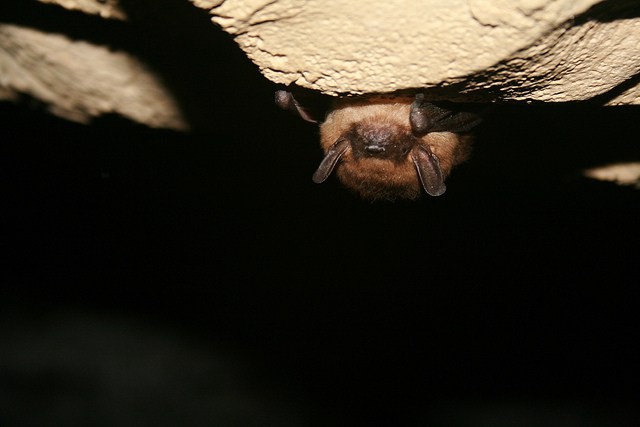
A bat hanging upside down in a cave. Photo credit  http://www.hippocampusmagazine.com/2017/03/maternity-cave-by-michele-leavitt/
The story doesn’t follow linear time, and I’ve been thinking lately that’s one of the benefits of being a reader of personal essays: we get to experience hard-earned wisdom in a way that isn’t tied to chronology. We get to look back, be in the present, and jump ahead to the future in less time than it takes to bake a cake. There’s no undo or do-over button because truth doesn’t change, but at least we get to see truth’s trail.

Memoirs and personal essays are time capsules, freezing us in a series of moments. But they can be time machines, too, taking us forward and backward, allowing us to grab on to the hindsight and foresight in someone else’s experiences, even when that sort of wisdom escapes us in our own lives.

For more tips on writing memoir, visit me on Medium.

I must miss teaching . . .

In the works – a series of articles with practical, concrete tips on getting your work published in literary journals and magazines. I’ll share them here and on Medium  I’m excited about this project, and just realized why – I must miss teaching!

Teaching has a been a part of my life since 1990 when I taught my first college composition class for Salem State College (now University). Then in 1995, I gave up my law practice and started teaching full-time. Up until January, I was engaged in teaching in one form or another so that’s more than 20 years of my life. No wonder I miss it!

Teaching is a very happy job because you get to be around people who are reaching for knowledge and striving to improve themselves. Although I took a leap in January to devote myself full-time to writing, I think it’s okay for me for me to indulge my love for teaching as long as I do it in writing. So here’s my first stab at that. Click on the image to read the full article.

A Sample Cover Letter to Help Get You Published

The cover letter strategies here have worked for me with literary journals including North American Review and Catapult, and with more general interest publications including O, the Oprah Magazine, and Guernica. Feel free to adapt the sample for your purposes, or use the outline method explained below.

While it’s important to observe publishing etiquette, you don’t want anxiety over submitting your work to get in the way of why you write in the first place — to express your creativity. I’ve found it best to automate the submission process as much as possible so I can spend more time on creative writing than on administrative writing. Once you have a solid cover letter drafted, you can recycle or adapt it again and again.

Editors are busy folks, too, and in the world of literary journals, many work as volunteers. They will appreciate you making their lives easier with a concise cover letter, and it doesn’t hurt to have an editor read your work while you’ve put them in a good mood. Some things most editors want to know:

Where you heard about their publication

A little about you

Where you’ve been published before

IMHO, one sentence for each of these does the trick. There are exceptions, of course. A few publications don’t want a cover letter at all, and a few want specific information about you. For example, some publications ask about your demographics to help them keep track of how well they are doing with their outreach to writers who aren’t young, hetereosexual cis white men with MFA degrees. My demographic statement is “I’m an old, 97% white lady.” Always read submission guidelines carefully to make sure you are giving the editors what they have asked for.

So, how do you write that “a little about you”?

Click here for the full article. And happy writing!