Writing Memoir: Touch the Love

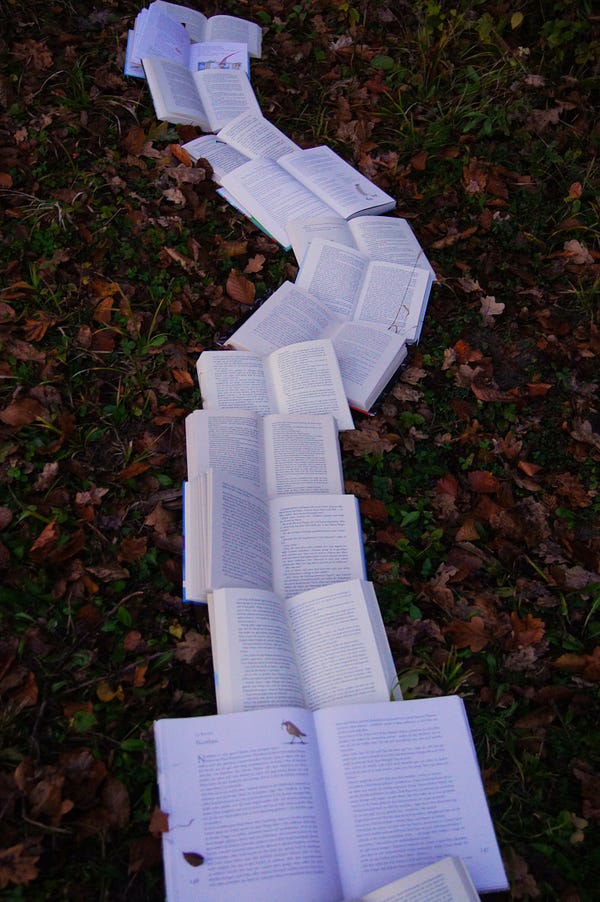
Photo by Anna Kolosyuk on Unsplash

So often, memoir includes writing about other people in our lives. How do we make those others come alive to readers?

I’ve mentioned elsewhere that in writing memoir, we should try to see ourselves as characters who have strengths, weaknesses, motivations. And that’s true for writing about others in our lives, too.

But if you’re like me, not everyone you write about in your memoir is a person you have only good feelings toward. In fact, we might feel resentment, rage, disappointment or even hate toward certain people who appear in our stories.

In my experience, it’s difficult to write well while experiencing negative emotions.

Also, if we write our negative feelings into these unpleasant other characters, two unfortunate things can happen to the memoir:

  • We, the writers, begin to sound unpleasant at best, or full of resentment at worst, both of which will turn most readers off.
  • The unpleasant others come across as one-dimensional, which is boring, especially if they occupy more than a very minor role in the story.

One solution to this difficulty of writing about unpleasant, disappointing, or toxic people is simply this: do not write about them. Cut them out of your story, just as you may have wished to cut them out of your life. You have the power. It’s your story, and no one else’s.

Another solution is to get in touch with the love you feel or felt for the person. See that person in your mind’s eye and imagine your heart opening. See the person as he was as a child. See the person as she was when you loved her most. See the person as a fellow struggler against suffering and despair.

Human relationships are so very complicated, and it’s so very possible to feel both love and hate for one person, even at the same time. And that is never boring.

When I reunited with my birth family nearly thirty years ago, I found I had five brothers and a sister. My brothers all suffered from addiction, and if you know anything about addiction, you know that it’s a family disease. Everyone in the family suffers. My feelings for my brothers were a mix of love, frustration, and even rage, especially when their addictions damaged their children.

Are you feeling bored yet? If not yet, you would become bored soon if I kept on in this vein. And you wouldn’t see my brothers as individuals; they’d become stereotypes.

My youngest brother, David, was the most severely addicted one. Here’s a scene I wrote while trying to touch the love I felt for him, even while he was at his weakest. In the scene, my sister Belinda and I are visiting him in the nursing home he’d been sent to when he was thirty-eight years old.

David’s nursing home allowed patients to smoke in one common room, and in a chain link fenced yard, so we’d bring him cigarettes, too. There was no point in denying him anything he wanted as his life inched toward its certain end, although we didn’t know how quickly that end would come.

I can still see him now in the chain link yard where we went to escape the air conditioning that was too much for all three of us. Wrapped in a thick sweater, he sat beside me and Belinda in his wheelchair with a lit cigarette in one hand, while pawing at Belinda’s arm with his other hand, saying, “Give me a cigarette, Belinda.”

The only thing left besides his restless cravings was his love for his sisters, and his daughter Brandi, and the rest of the family. The diabetes, the heart disease, and the years of active addiction had whittled him hollow, from the inside out.

Other men and women like David inhabited the nursing home, people who should have been in the prime of their lives, but whose brains and muscles and bones and nervous systems had been decimated by chronic drug use and the violence that so often comes with it. I’d expected beds full of frail little old great-grandmas and great-grandpas.

But instead, there were vacant-eyed people in their thirties and forties prowling the hallways like zombies. The man who’d lost a leg to an infection caused when he’d tried too hard to open up a collapsed vein to shoot heroin. The woman whose head had been bashed in by a john when she was out tricking for money for crack. The semi-comatose overdose victims.

An orderly was stationed in the smoking room to prevent fights, and to stop the stronger patients from taking advantage of the weaker ones like David. Belinda worried constantly, and I did too, but this place had been the only one that would take our brother.

When Brandi met us there one day with her newborn daughter Paris, she passed her baby to her father without any wariness. David held his granddaughter, looking at us all with a new wonder in his eyes, stronger than what he greeted me and Belinda with each time we visited as if to say “You came for me, for me, for me.” He cradled the baby gently as his muscle memory resurrected itself and all the fatherly tenderness he’d showered on Brandi returned.

Something in his peripheral vision distracted him, and he reached toward Belinda with one hand while still protecting Paris with his other arm. “I want a grape soda from the machine, Belinda, a grape soda.”

Sugar, and alcohol, and pain pills, and crack cocaine. Love had been enough to relieve him of his cravings for months at a time in the past, to keep him focused on his daughter without falling prey to distractions. But now, love didn’t work for but a few minutes.

Writing Memoir: Self as Character

Photo by Grace Madeline on Unsplash
Why should you write about yourself as if you’re a character in a story?

Memoir is story, it just happens to be a story that’s true. And one thing that’s easy to forget when writing memoir is that your readers want to get to know you. And to them, you’re a character.

Just as in real life, that getting-to-know you happens gradually, through what you wear, where you hang out, what you say, where you work, who your friends and family are.

In any story, we expect main characters to grow and change. Readers want to know who you are when the story begins, who you become when the story’s conflicts arise, and who you are when the story ends.

Readers want to know who you are when the story begins, who you become when the story’s conflicts arise, and who you are when the story ends.

Currently, I’m reading Chuck Wendig’s craft book Damn Fine Story. It’s stuffed with clear and practical advice for writing stories that sweep readers off their feet and glue them into the comfy chair, or bed, or where ever the reader prefers to read.

Wendig is primarily a novelist and screenplay writer. So far, I haven’t seen him mention memoir, but IMHO, advice about writing stories (and that’s his focus) apply to memoir as well as fiction. I anticipate quoting from him often in this series about writing memoir.

Anyways, here are some points he makes about character development:

  • Characters are their problems. For example, in my adoption reunion story, my problem is that I don’t know where I came from.
  • Characters face internal and external complications. We’re talking about conflicts. In my story, my internal resistance to dependence on others was further complicated by my birth family’s external expectation that I would depend on them for love.
  • Characters create a story by interrupting the baseline, the status quo.Every story begins with a static situation and goes from there. Even if the original static situation is chaotic, it’s still the baseline from which the story begins. No interruption in the baseline = no story.
  • The best characters end a story changed. And isn’t that what memoir is about? How we, the writers, have been changed by a particular series of events?

So how do you turn yourself into a character? One way is to imagine readers are meeting you for the first time. Show them a picture (in words) of the person you are at the beginning of your story, and use plenty of concrete, sensory details. Here’s a current paragraph from my memoir draft that tries to do that work:

To ease my anxiety at the prospect of meeting my family for the first time, I’d spent the twenty-two-hour train ride from Boston to Savannah reviewing case files from my law practice. Born in the South, but adopted into a family from the North, I spent my childhood feeling as if I were wearing a flour sack when everyone around me was in silk. My adoptive father was fond of calling me an “enigma,” a word I had to look up the first time he said it, when I was a twelve-year-old drug user toting around a worn copy of Dostoevsky’s The Idiot. The nineteenth-century novels a librarian had recommended to me did as much for my sense of well-being as the Librium my pediatrician prescribed when I rebelled against my parents, and the codeine-heavy cough syrup I started drinking directly from the bottle at age nine.

The bold-faced words are, of course, those sensory details. The reader will know I’m a lawyer, I’m willing to take a long train ride, and as a twelve-year-old child, I was a bookworm and a drug user. But, I notice, there’s nothing in this paragraph that says what I look like.

Straight physical descriptions (I was short, plump, and had dark hair) can sound forced, or boring, or both. Some writers think that physical descriptions are unnecessary for main characters because readers like to visualize them on their own.

But if I tie a physical description of myself to an action or emotion, that might work. Let’s see.

Anxious at the prospect of meeting my family for the first time, I’d twisted a section of my dark brown hair around one finger until it formed a spiral curl. To distract myself, I spent much of the twenty-two-hour train ride from Boston to Savannah reviewing case files from my law practice. Balancing a folder on my ample lap, I paged through it with my skinny little chicken fingers.

Better? Maybe so. Let me know if you feel so inclined. Here’s an example from a better writer, Marilynne Robinson, from her novel Housekeeping.

… in the last years she continued to settle and began to shrink. Her mouth bowed forward and her brow sloped back, and her skull shone pink and speckled within a mere haze of hair, which hovered about her head like the remembered shape of an altered thing. She looked as if the nimbus of humanity were fading away and she were turning monkey. Tendrils grew from her eyebrows and coarse white hairs sprouted on her lip and chin. When she put on an old dress the bosom hung empty and the hem swept the floor. Old hats fell down over her eyes. Sometimes she put her hand over her mouth and laughed, her eyes closed and her shoulder shaking.

Notice how each characteristic is paired with a verb and given an action.

Ways other than action to describe yourself as a character are:

  • Let other characters describe you. “Her friend turned to me and said ‘Your sister says you’re bizarre, but your brother-in-law says you’re merely eccentric.’”
  • Describe objects near and dear to yourself. “I held my teddy bear, which I’d received on my first birthday.”

Any other ideas?

Write on.

Memoir Writing: Tie Your Story to a Significant Issue

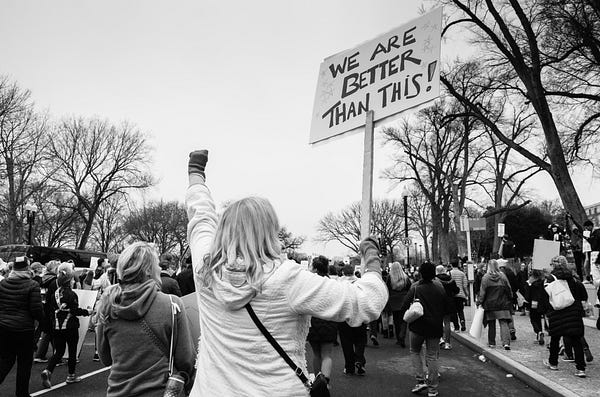
“Black and white photograph of the back view of street protesters in a rally in Washington.” by Jerry Kiesewetter on Unsplash

Why have so many memoirs of recovering from addiction been published in the last fifteen years? I’d say it’s because addiction and recovery are significant issues for many contemporary families. In other words, those memoirs are personal stories touching on a big-picture issue. As such, they become more relatable for people who are concerned about those issues.

In the same way, memoirs about people who survive a serious or chronic illness can give hope to people who are experiencing health-related challenges, or whose loved ones are suffering.

People read memoirs to identify and clarify their own stories, as well as for the beauty of language, the pull of story, or the memorable characters. Touching on significant issues in the context of a personal story helps to alleviate any “me, me, me, it’s all about me!” in a memoir, and it also makes the personal more universal. Or, to quote the second-wave feminist movements, it shows us that the personal is political.

Currently, I’ve divided my memoir draft in three sections. The bigger issue in the first section of my memoir is family separation and reunification. In the second section, it’s addiction’s impact on families. I haven’t figured out what it is in the third section, which so far covers the deaths of many family members, DNA testing, what happens when kids who were in foster care have kids of their own, and mass incarceration in the American prison system, among other things.

Maybe that’s a heads up for me that I’m covering too much ground in that third section.

Or maybe if I choose one significant issue, that can become my organizing principle for the third section.

But because I’ve had editors tell me (sometimes) that I sound like a bossypants, I know there’s a danger for me in deliberately exploring a significant issue in a memoir.

The danger in tying your story to a bigger issue is that you might fall into didacticism, better known as being a bossypants.

And no one likes a bossypants. So let’s say I decide the third section of my memoir is connected to the issue of mass incarceration. It’s tempting for me to haul out my old lawyer identity to argue against mass incarceration using evidence like studies showing how expensive it is, or international comparison statistics.

But my memoir is a personal story, not an editorial. Instead of taking the easy way out by arguing the evidence against mass incarceration, I have to rely on the details of the story.

So let’s see — how am I doing? What are your thoughts about the prison I describe in this scene from an essay about visiting my niece BeeBee at a women’s prison in Florida? Am I being a bossypants?

It was no place like home, but it was a place for families. They sat on metal benches in the processing room, waiting for their loved ones, hoping the next face would be the one they’d longed to see. As if to extend the suspense, the guards released inmates one by one through a gate in a chain-link cage. My niece BeeBee strutted out in a yellow t-shirt and chinos, and I stood up to hug her. 


Like every woman I’ve ever known who’s done time, BeeBee had put on weight. This is usually a good thing; most women who get sentenced to prison have worked their bodies to the bone for drugs. When our hug ended, she stepped back and bounced on the balls of her feet like an athlete. Her thighs were thick with muscle and her arms were round, but her waist was still trim. When she lived on the outside, she’d made a living selling drugs and dancing in strip clubs; in prison, she made her way by winning dance challenges, and by winning fights.


We walked outside to the visiting area in the prison yard. Concrete tables squatted under a roof for shelter from the rain or the hot sun, but we didn’t need protection that day. The sky was clear, and the air was warming, but I already felt locked in and ready to leave.

Across the yard, on the other side of a barbed-wire fence, a massive concrete block building was going up, a construction project that wasn’t visible from the road. BeeBee told me it would be an addition to this women’s prison, and it looked as if it would be ten times as big as the current facility. The grapefruit I had for breakfast congealed in my gut, rose up, and burned my throat, as if I already knew that once construction was completed on this monster, it would rank as the largest women’s prison in the entire country.


Then she started talking about the times when I used to rent a beach house on Tybee Island, near Savannah, Georgia, and our whole family stayed together for a week. In those years, my nieces and nephews — eleven of them — were all children, running wild on the sand, rampaging through the ice cream parlor, and tearing up the rental house. I’d sometimes get the middle-class heebie-jeebies when they were too loud in a restaurant, or too daredevil on a playground, but mostly I sat back and admired their untamed joy.

How about you? What bigger issues do you grapple with in your memoir, whether it’s written or planned or somewhere inbetween?

Writing Memoir: Essay by Essay

Photo by Laura Kapfer on Unsplash
Should you begin writing a memoir as a book-length story, or essay by essay?

After my first memoir was published as a Kindle Single, I reflected a bit about how I wrote it. Originally, that memoir was about my time as a teenage runaway and abuse survivor plus my time as a trial attorney representing a woman who’d survived being shot in the head. First, it was chronological; later, it was braided, alternating between deep past and more recent past.

An Amazon editor saw an essay I’d published in Guernica about my birth family. She asked me if I had anything longer. I sent her the teenage runaway/shooting manuscript. She felt the teenage runaway story was more dramatic than the shot-in-the-head story. Go figure.

She encouraged me to send her a draft of only that story. So, of course, I did.

It had taken me about five years to write that memoir. While that manuscript moved through the editing and publication process, I started imagining a quicker process for writing a full-length memoir about reuniting with my very colorful family. Maybe, I thought, it would be faster to do it in two steps.

First, write individual essays, get them published, and second, slap them together into a book-length memoir. An added benefit of this method was getting pieces of the memoir out in the world right away. Agents and editors like to bet on known quantities — writers who’ve already been published — and I wanted this next memoir published, too.

I was successful with step one; a dozen of those essays have been published in venues including The RumpusNarratively, and Sycamore Review. The very first one to be published found a home three years ago  on Medium in the original incarnation of Human Parts.

But uh-oh. Guess what? It’s been way harder than I thought it would be to mash those essays together into a coherent story. What’s missing is continuity, the glue that holds a story together. But more importantly, in writing those essays, I hadn’t even begun to think about stuff like narrative arc and character development and overarching themes in a book-length story.

If that sounds like a fiction writer’s talk, well, I admit it is. Great memoirs, those that grab a reader and won’t let go, are written like great fiction. IMHO, of course. They focus on story.

Call me a traditionalist: I like a beginning, a middle, and an end. I’ve read some wonderful essay collections, like Leslie Jamison’s The Empathy Exams, that have more than a hint of memoir about them. But I could pick that book up, and put it down, and pick it up again months later.

For me, the most enjoyable reading experiences are the ones that immerse me in a different world with a conflict that begins on page one, gets complicated as I fly through the pages, and comes to a satisfying (or maybe shocking) conclusion near the end.

Now, I’ve got just over 75,000 words of that second memoir written, and I’ve taken a vow to complete the first draft of the whole shooting match by the end of this May. As part of that goal, I plan to blog here every day about some element of memoir craft — especially those elements I need to master.

For me, writing a memoir step by step, one essay at a time, may not have been the time-saver I hoped for. But for other writers, the process has worked quite well, and it might work for you.

We writers are all different, but all writers benefit from knowing their options.

If you’re interested in a thorough discussion of memoir development options and a detailed, diverse analyses of distinctions between essay and memoir and story, I recommend Colin Hosten’s article that includes interviews with some of the top writers and editors in the field.

Write on.

Writing Memoir: Using Dream Images

“A silhouette of a man holding a smoke bomb on a deserted beach, with a pink sunset sky in the background” by Aziz Acharki on Unsplash
Do dreams have a place in nonfiction?

Since childhood, I’ve had occasional vivid dreams — the kind that are so weird, or colorful, or fantastic that they woke me up. When I started writing poetry (also as a kid), I thought those dreams and their images belonged in poems.

The dreams seemed so meaningful to me. So I wrote.

Later, more than one poetry teacher told me to ditch the dream poems — they didn’t mean anything to anyone but me. The teachers were right: without a context, dream images don’t translate very well for an audience. Of course, if you’re writing only for yourself, that’s different.

But dreams can work well for an audience in fiction and in creative nonfiction writing. They work as long as we make clear that they are, in fact dreams, and connect them to our stories and the people in our stories. I’m not a dream-interpreter, but when people reveal their dreams to me in real life, I feel as if I’ve gotten inside their heads a little. I feel I know them better.

Readers of both fiction and nonfiction want to know the people — or characters — in the stories they read. Reading a good book, we actually crave that knowledge, especially knowledge of a character’s motivations and how those motivations interact with plot. It’s why we stay up past our bedtimes and keep reading. We’re trying to figure out what will happen next.

Some literary theorists believe we read fiction to exercise the part of our brains that guesses at motivations, and that our brains have been programmed by evolution to want to guess at motivations.

Lisa Zunshine, in her book, Why We Read Fiction: Theory of Mind and the Novel, applies this idea specifically to novels, although I believe it can apply to any kind of writing that includes characters. She argues that understanding motivations, and then predicting behavior was an adaptive strategy for early humans seeking to survive and reproduce.

Zunshine’s theory is similar to Finnish psychologist Antti Revonsuo’s theory of dreams. Revonsuo believed that dreams were resulted from the brain practicing for flight-or-flight situations. In other words, our dreams are simulations of stressful situations we might face in real life.

Human beings have long believed dreams are powerful, either as predictors of the future, as revelations of past mysteries, as expressions of repressed wishes. They seem to come with a built-in significance.

For a writer of memoir or nonfiction, relating a dream can help to communicate something about motivation, or obsession, or desire. Instead of telling the reader “I felt trapped in my lifestyle,” I can show the reader how it felt by describing a dream related to that trapped feeling. Here’s an excerpt from one of my essays that attempts to do this:

Night after night, I dreamed of walking under streetlights in Boston, after the bars have closed, when the streets are deserted. I have trouble walking, but not the kind of trouble I had in the dreams of my twenties. In those dreams, my feet were as rigid and heavy as flatirons, and I couldn’t lift them to run away. In these new dreams, I’m drunk and wobbling. The busses have stopped running, and I stumble and curse, desperate to find a way out of Boston that will take me to the North Shore. I have to pee badly. I’m under the Southeast Expressway, surrounded by concrete Jersey barriers and I-beam steel, and there is no one to ask for directions, no taxis, no traffic. The city is silent. Should I walk up onto the expressway if I can find a ramp? Can I walk over the Mystic River Bridge because there are no cars? In the dream, I’m angry that the city is so hard to leave, and I never find the bridge.

In the context of the essay, this dream excerpt demonstrates, perhaps more vividly than reality could, how trapped I felt, and how frustrated. The dream itself may sound familiar to you — dreams about being lost and trying to find a way out of somewhere are common, as are dreams of trying to run with heavy feet. Perhaps they signal some common fear we share as human beings of being stuck in place.

What are some of your favorite examples of dreams in fiction or nonfiction? And what do you think about using dreams in your writing?

Writing Memoir: Saving Your Life

Writing Memoir: Saving Your Life

“A fountain pen on an open journal” by Aaron Burden on Unsplash
You’ve heard it before: Writing saved my life.

If you’ve wondered about the truth of that, I’m happy to report that there’s a boatload of science behind that saying.

In 2005, for example, British researchers found that short periods of “expressive writing” resulted in better physical and psychological health.

Writing about traumatic, stressful or emotional events has been found to result in improvements in both physical and psychological health, in non-clinical and clinical populations.

It makes intuitive sense to me that writing about our tragedies and triumphs can improve our emotional health or bring us peace of mind. But I was surprised at the number of studies showing an impact on physical conditions including rheumatoid arthritisEpstein-Barr virus, and hypertension.

Most of these studies focused on short, guided periods of expressive writing or guided, written disclosures of trauma. The writing practices were standardized as much as possible in order to achieve some measure of reliability for the studies.

But what is meant by “expressive writing”? In an article for Psychology Today, Dr. John F Evans provides a definition:

It is personal and emotional writing without regard to form or other writing conventions, like spelling, punctuation, and verb agreement. Expressive writing pays no attention to propriety: it simply expresses what is on your mind and in your heart.

This, to me, sounds a lot like the “free writing” technique put forth by teachers from New Age guru Natalie Goldberg to university professor Peter Elbow . Not to mention the thousands (or more) college writing teachers like me who advocated free writing in their classrooms.

The idea behind free writing is that inexperienced writers, or writers who’ve been criticized harshly for things like spelling errors, can sometimes be paralyzed by fear of making mistakes. They can be so fearful that their writing muscles cramp up, or they feel they have “writer’s block.”

The free writing technique aims to remove those fears by de-valuing mechanics like spelling, punctuation, and grammar. The goal in free writing is only for the writer to move thoughts from the brain to the page. And that, after all, is the goal of all writing: translating our thoughts into words.

For writers of memoir or personal essays, putting aside fears of being judged can be the first challenge to overcome. Many turn to free writing as a way of silencing the internal editor — at least temporarily.

Expressive writing may be beneficial to psychological and health, but is it more beneficial to brain health than other kinds of writing? Is there a neurobiological reason why translating thoughts into words, in a judgment-free zone, has a therapeutic effect?

Maybe, but it’s probably related to writing by hand as opposed to typing. The studies I referred to at the beginning of this post don’t mention whether the writing was done by hand or by keyboard. Other studies have shown, though, that writing by hand improves memory and other cognitive functions.

And, a recent study based in India demonstrated that adults learning to read and write (by hand) rewired their brains.

By the end of the study, the team saw significant changes in the brains of the people who had learned to read and write. These individuals showed an increase in brain activity in the cortex, the outermost layer of the brain, which is involved in learning.

Learning to read also seemed to change brain regions that aren’t typically involved in reading, writing or learning. Two regions deep in the brain, in particular, appeared more active after training — portions of the thalamus and the brainstem.

These two regions are known to coordinate information from our senses and our movement, among other things. Both areas made stronger connections to the part of the brain that processes vision after learning to read. The most dramatic changes were seen in those people who progressed the most in their reading and writing skills.

I’ve heard many writers say that writing has saved their lives. Maybe it’s even saved mine. But one thing is certain: our brains need exercise to be healthy, and writing provides it.

Writing Memoir: Using Journals & Diaries

Writing Memoir: Using Journals & Diaries

Two old journals with blue covers. Photo credit: Michele Leavitt

Old journals and diaries kept during a time in your life you want to write about now can provide raw material for more formal, refined writing.

But even if you weren’t in the habit of spilling your guts out on the page when you kept a journal, a journal can still be useful for detecting certain elements about the character you were in the past, and the settings you inhabited.

Never throw away anything you’ve written” is advice I’ve given elsewhere. It’s good advice for journals, too, even though they may be an embarrassment.

When I was in my twenties, I destroyed part of a journal written at seventeen.

It embarrassed me. Not because of actions or emotions I confessed in the journal. Because of the voice. I remember thinking it arrogant and overwrought. But I can’t know for sure if the voice was arrogant and overwrought, and I can’t reproduce that voice now because those pages no longer exist.

The most obvious use of a journal or diary for a memoir writer is that a journal can help you fill the blank spots in your memory with details, the sights and sounds of past events in your life. Physical artifacts — the notebooks we used to record our doings — can also spark memories of details. Look at your old handwriting on an old page, feel the smooth paper with your fingertips, and open your mind to memory.

But even for those of us whose old journals are boring and repetitive, finding value in them for a memoir is still possible. An old journal can give you a sense of your voice during the time in question. Were you using youthful slang or professional jargon that you no longer use? Longer or shorter sentences? Odd punctuation like a row of exclamation points or, heaven forbid, a little heart in place of a dot over your “i”? Did you scratch things out, or underline? All these can be keys to your character in the past, and your voice.

The style of the notebook you used can also be telling. It may say something about style or popular colors during the period in question, or it may say something about your personal style back in the day. As an artifact, it can provide a cultural context for your past life.

The two journals in the photo above are from the 1980’s, a time of shoulder pads and cinched waists for women, mullets and Jheri curls for men, glass skyscrapers, glass-top tables, and lots of teal and pink. But these two journals are very plain. In this case, plain didn’t mean cheap; I remember buying the journals at a bookstore near Harvard University. They were quite expensive, and I’ve always been, well, “frugal.” Those two journals-as-artifacts say something about who I was back then, and they also give me a cultural context, even if it’s really an anti-context.

Finally, a third use for old journals and diaries is to find a sensory door in to a larger story. Why did I want that pair of sneakers so badly? Why did my friend and I construct piles of ketchup and salt to dip our french fries in? When that person held my hand too tightly, how did I react?

You may find mysteries, too, like events you wrote about but cannot recall. Yet there they are, in black and white. Or purple and ivory if you had an individual aesthetic.

Being unsure of reality every so often is refreshing. Every mystery is a lesson in human fallibility, something we writers and artists can’t be reminded of too often as we create and re-create reality.

Writing Memoir: Finding (Making?) Time

Writing Memoir: Finding (Making?) Time

“A large heap of broken antique watches and clocks” by Heather Zabriskieon Unsplash
How do creative people find the time to write? Or do they “make” the time?

Years ago, someone asked me how I managed to do so much. “It’s easy,” I said. “I don’t have kids!” The people who amazed me with their productivity — and who still amaze me — were the ones who parented young children.

Writing a memoir, or even a stand-alone personal essay, requires a huge investment of time, especially for slow writers like me. If it took me less than 40 hours to write a ten page story, I’d be very surprised. This month, I’ve committed to finishing a coherent draft of my 80,000-word, rough memoir draft. How will I manage my time to insure I meet that goal?

Strategy 1: Getting on a Schedule

This was effective for me when I worked a full-time, 8:30 am to 4:00 pm job. I was already on a schedule, so creating another one for writing made sense. Off and on, for months at a time, I got up at 5:30 am and wrote for about 90 minutes.

Scheduled writing has been famously successful for authors like J.K. Rowling, who also had a day job when she began the Harry Potter series. If you are subject to an external schedule, whether it’s related to school or work or family responsibilities, a writing schedule may do the trick for you.

But once I resigned from the day job to work for myself, the external schedule that kept me on track disappeared and I found myself floundering.

Strategy 2: Figuring Out When You Write Best and Write Most

Although I’m not trying to lose weight because that ship has sailed, I know that food journals are an effective way for people to track calories. So I decided to keep a time tracker to see where I was spending my time.

Like many people, I squander time on social media, mindless eating, and passive entertainment. When I’ve squandered enough, I get resentful when those I love interrupt my thoughts about writing or the writing itself. As if those people (and dogs) are the cause of my fribbling.

Decades of working day jobs created a habit of writing at odd hours: early mornings, nights, and weekends. Breaking from that pattern has not been easy, even though I expected to have nights and weekends free once I was “just” writing. But I’ve been writing at odd hours still, and not making enough headway on the memoir to satisfy myself.

Data is powerful. The time tracker showed me I was working on my memoir early in the morning and late at night, for about 90 minutes at a time. Ugh. Old habits are hard to break. It also showed me that I was working on paying writing projects during the day, like that was a day job. Ugh, again.

3. State Your Writing Goals Publicly

This month, I’m writing about writing memoir every day. And I put it on my Medium profile.

Two popular month-long writing marathons, NANOWRIMO and NAPOWRIMO inspire many people to successfully find or make time to write novels and poetry, respectively. I participated in NAPOWRIMO this year in April. Thirty poems later, I think 4 or 5 of them are actually worthwhile.

But, I’m convinced that 30 days in a row of writing a poem, or at least a wannabe poem, was helpful exercise for the poetry part of my brain. I even continued the process through the first week of May. Now, I’m slacking off again.

I heard that you’re more likely to meet your goals if you announce them publicly. Oh wait, I also heard that announcing your goals publicly makes itless likely that you’ll meet those goals.

4. Going on a Writing Retreat

A retreat doesn’t have to be anywhere but your own home; it’s a big chunk of time (a day or more, preferably) devoted to writing. I’ve done stay-home retreats, and cheap motel retreats. Some writers go on organized writing retreats.

For me, these chunks of dedicated time seem to work best when I have a specific goal to meet. That’s especially true if I go somewhere besides my home, where I may be tempted to check out a new ice cream parlor. For this reason, I advise going on a retreat in a place that’s not very appealing to your interests.

But even on a stay-home retreat, I can be distracted by chores that suddenly must be done. I’m not talking about walking the dogs or watering the plants, which really must be done to keep everyone alive. I know I’ve hit rock bottom when I find myself scrubbing a toilet instead of writing.


The best piece of advice about finding or making time to write is to experiment to find out what works best for you. We’re all different, thankfully.

And if you’re wondering about the right time to begin a memoir, that’s something I’ve thought about this week because two former students got in touch to say they are thinking of writing memoir. They were both curious about “the right time” to start.

My response was “Now is the time.” When an idea about doing something creative pops up, that’s a hint from the part of yourself that’s smarter than the rest of you. Go with it.

For more tips on writing memoir, visit me on Medium.

Writing Memoir: Photographs and Images

The boundaries between genres are blurring.

Fence. Photo by Simone Dalmeri on Unsplash

Why shouldn’t we include photographs in memoirs? The only reason I can think of is that some (maybe many) publishers don’t want the hassle. Publishing images is more complex, more expensive than publishing text only. Unless, of course, you’re publishing on the internet.

That damn internet. It’s changing everything.

Some publishers are welcoming work that combines text and image. Some of them are here on Medium. Many others can be found in this list of cross-genre publishers curated by New Pages.

Here’s my attempt at a cross-genre piece combining photographs of trees with text about family trees.


Twisted branches. Photo credit: Michele Leavitt
Maybe it was me who doctored this photograph, trying to give it an heirloom appearance.

I see a “B” in this tree. Or maybe a “D,” or a sideways “A.”

Or a man, hanging face down with his arms extended, reaching for something on the ground.

Or a lizard with its tail curled up behind it. Or the predictable snake.

Or a tree, twisted by snow and ice, and the deaths of other trees, and by forces I cannot imagine, putting forth the predictable new growth in spring.

Unknown Dead Tree, North Central Florida

I leaned against trees, wrapped my arms around trees, swung from trees and hid in trees, and walked on limbs as if they were tightropes. I prayed to trees, I raged at trees. Far away, the half-brothers I now know cut trees down for very little pay.

In my private forest, which isn’t mine, but belongs to the town, I watch this tree, and the spiral of fungi around its trunk that curves around in question marks and other symbols. It might be my family tree: no hierarchy, no single ancestor, and certainly no single pattern.

Living Turkey Oak, fallen, North Central Florida. Photo credit: Michele Leavitt
This tree took the earth with it when it tipped over in a windthrow. It is the only tree in this quadrant that fell. Maybe another trauma, like heart rot fungus, affected its anchorage and prepared it to let go.The letting go starts a new creation story: a hole opens in the canopy, and sunlight pours down on the forest floor. Saplings stuck in the pole stage may wake up and start to grow gain.

New stories mean new names. The earth ripped up with the tree is now called a tip-up mound.

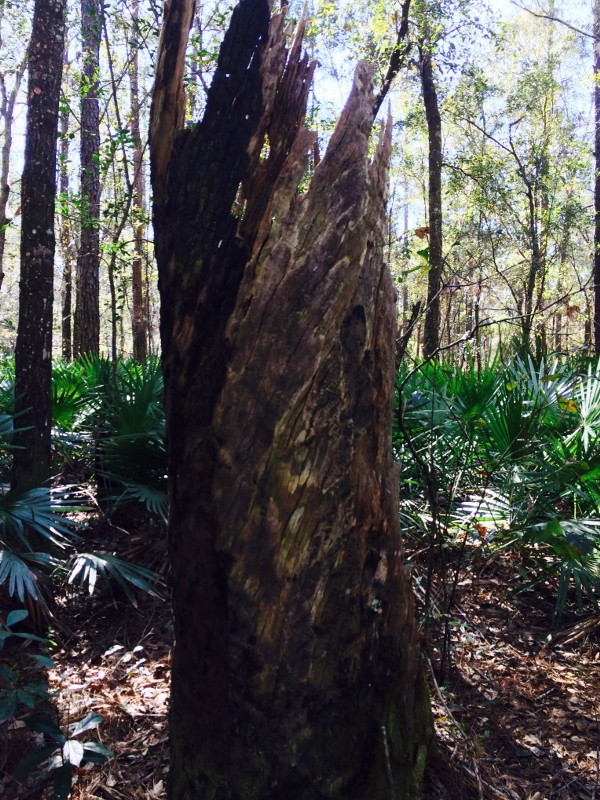
Dead Cypress, North Central Florida. Photo credit: Michele Leavitt
This tree has been dead for so long, you can see right through it in spots. How did that happen? I imagine the branches fell first, then the crown, and then the bark sloughed off like the skin of a snake, and then the core collapsed on itself. What’s left is a suggestion of the strong column it once was, a gesture toward how the column once spun upward in helix fashion.

What’s left of the tree has the pocked and scored look of the karst limestone under the ground around these parts. Maybe the tree has taken on some characteristics of the stone.

Even long dead, and even taking on other characteristics, the tree is still a tree.


For more tips on writing memoir, visit me on Medium.