Publishing with Kindle Singles

kindle singlesUntil December of 2015, I’d never heard of Kindle Singles even though I’m a regular consumer of e-books from Amazon. Six months later, I’m a Kindle Singles author.

If the format is new to you, too, Amazon’s tag line for the Kindle Singles genre might help: “Compelling Ideas Expressed at Their Natural Length.” As a format, it’s been called a vibrant new genre, and credited with saving long-form journalism. Although some literary critics have described the Singles platform as operating “much like a traditional publishing house,” I’m experiencing it as a hybrid between self-publishing and traditional publishing. That’s not a bad thing.

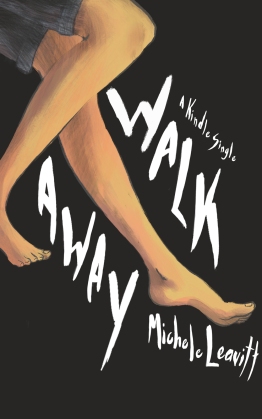
My Kindle Singles memoir, Walk Away, was published on July 6th. It’s almost one month old, and so far, so good. With over 100 sales plus another 100 Kindle Unlimited readers, it’s off to a good start, especially if I compare it with my last book, a poetry collection published by a small press. And Walk Away gets the benefit of Amazon’s marketing experience as well as the benefit of being promoted via Amazon’s email lists and targeted advertising to its existing customers.

Kindle Singles editors, like editors at traditional publishing houses, solicit work and review submissions for publication. After an essay of mine was published in Guernica last fall, an editor contacted me. I sent her a 30K word manuscript, and we had some back and forth communication about revisions. From there, the manuscript went to a copy writer, and then to a cover designer. Everyone I worked with was professional and pleasant, and also (compared to me) quite young.

When the manuscript was ready, I uploaded it to KDP (Kindle Direct Publishing), and Amazon promoted it from there. This is where the self-publishing piece comes in — KDP is Amazon’s self-publishing arm. What that means for me, as an author, is that I have the ultimate control over the book. I can re-publish it as a hard cover book. I can, with some limitations, un-publish it. It also means that the book could be stigmatized as self-published, although the class line between traditional publishing and self-publishing seems to become more blurry by the day.

From my initial contact with the editor, it took about 6 months for the manuscript to be published. Would I do it again? I’m already working on another 30K word story, and I hope Kindle Singles will pick up. It’s about my last major case, when I represented a woman who survived being shot in the head with a Boston Police detective’s gun.


 

Guest blog at Marilyn’s Mutterings

My friend Marilyn Moss from Maine (all those yummy M’s!) asked me to write a little bit in response to her “Why Create?” Project.  She’s asking that huge question of a wide variety of artists, including writers and visual artists and musicians. I’m thrilled to be part of the conversation — check out her blog!

Why create

Kitten Sack

rooming houseKitten Sack

Originally published February 2, 2013 at Hippocampus, now a part of my Kindle Singles memoir, WALK AWAY.

Our rooming house hovered over an abandoned storefront, a second-floor dimension not everyone could touch or see. Sometimes police officers stood at the bottom of the oak staircase and shouted up names of people who were wanted, but the officers must have questioned the stability of the staircase or the substance of the second floor, because they never came up those stairs. They shouted, and no one responded to them, except to yell meaningless obscenities. But on Sundays, old Jehovah’s Witnesses ladies climbed the stairs in their pumps and stockings, because the invisible was real enough to them. They knocked on doors, looking for tenants who were desperate enough to accept Jesus as a personal savior, and we hid in our rooms, terrified.

One day, our landlady woke at two in the afternoon to a sack of kittens. The door to her two-and-a-half rooms had been left unlocked in the night, and someone had left a crisp brown grocery sack beside her bed. She’d stepped upon a corner of the sack as she got up, and when the sole of her foot felt the warmth of wriggling flesh beneath the brown paper, she screamed. Those of us who were awake when she screamed rushed from our rooms to hers, keen for a new drama to distract us. The betrayals of the previous night that had finally put us all to bed, angry and cussing, were dim trails back to darkness in the afternoon haze. Awake, we became anxious for the revelry to ramp up again, and it began that day with this sack of kittens.

Who toted those kittens up the stairs? No one knew, though we all wondered if it might have been one of us. Memories were often hazy, so arguments often broke out over what had really happened in regard to an incident. The kittens, though, were a warm, soft miracle, so, rather than argument, there was speculation about whether the kittens had been found like that, swarming, nearly blind in a paper sack, or if they had been collected from an alleyway and placed in the sack for easy transport. The landlady, who never left the rooming house, sent Billy to the store for her red port wine and for a half-pint of milk, too, and then she took a seat in the wing chair beside her bed, as her tenants settled to the floor. No one had yet touched the kittens, and the landlady forbade us to, as they might have fleas, so talk turned to speculations about what had happened the previous night, and from there to remorse, and from there to promises that whatever had happened would certainly never happen again.

When Billy returned, the landlady poured the half-pint of milk into an ashtray and set it on the floor beside the sack. Some of the kittens continued to doze contentedly, snuggled against each other like rags, but others began to mew and fuss. Could the kittens get out of the sack by themselves? No one knew, but soon two of the kittens became boisterous, stepping on their sleeping siblings, trying to claw their way up the high walls of the paper sack. They were too light, only a few ounces of nearly newborn flesh and fur, to collapse the sturdy paper of the sack, but the scent of milk enticed them. We urged the two brave kittens on, creating names for them — Spook for the gray tabby and Scat for the money cat — and soon small bets for cigarettes and beers were being placed about who would get out first.

“Look,” cried the landlady from her seat. “Spook is going to make it!” The little gray tabby had learned to leap, and kept jumping against the side of the bag, rocking it a bit so that the tipping seemed inevitable. “He’s tough,” one of us declared. “A survivor,” said another. “Not some candy-ass,” said a third.

The sleeping kittens were dismissed by all of us as losers, and soon Spook had indeed tipped the bag enough to crawl over the edge, topple to the floor, and make his way to the solace of the milk. And all of us praised him as one of our own, lifting our bottles and plastic cups in tribute to him as he lapped at the milk, harking back to memories of our own cleverness in escaping some dead-end job or unsuitable spouse or misbehaving child and finding freedom, and we praised Scat in turn when he, too, escaped from the sack, as a survivor, a winner. The other kittens were forgotten as the afternoon darkened into evening, and someone, maybe me, kicked the sack under the landlady’s bed during a squabble that broke out over stolen cigarettes during the business of finding solace from our unworthiness in the rooming house that hovered over an abandoned storefront, a second-floor dimension not everyone could touch or see.

Memoir, Bravery, and Facebook

Last week, Kindle Singles published Walk Away, my memoir of surviving violence. An adopted child, raised in a violent home, I went on to a fucked-up teenage love affair with a violent high school classmate, and then ran away with him across the country in 1974.

Back then, I kept my problems, my black eyes, and my welts to myself, and I felt pretty brave about that. Now, I don’t have much of a filter, or much shame. I’ve been publishing poetry and nonfiction here and there for twenty years, and “You’re so brave to share that!” is a comment I’ve heard often enough. It baffles me.

But this is the first time, thanks to Facebook, that women I knew back in high school are messaging me about my story like this:

“I’m just sorry I wasn’t wise or sensitive enough to be a better friend to you when you were hurting.”

“ I wished I could have been there for you back in the year that you left.”

If these women knew someone they cared about who was being abused today, they would certainly be those wiser, more sensitive, better friends. But no one had enough language to describe or understand partner and family violence back in the 1970’s. Even if I hadn’t been a frightened, love-struck, fist-struck girl, the words to talk about my experience wouldn’t have come to me.

On a timeline of the history of domestic violence, one item for 1974 is The term “battered women” is still not a part of the public’s vocabulary.

Now, we all have the words. Intimate partner violence, batterer, safe house, shelter, PTSD.

Is it brave to tell a story about how I was beaten by someone I loved? Or about my own mistakes? Or about how I integrated the teenage girl with the woman I am today?

For me, bravery has nothing to do with it.

Telling my story is possible not because of bravery, but because I have the words to tell that story now. Because today’s girls have those words too, they can and do tell friends if they are being abused, and they can be and are wise and sensitive friends. And if they want to join support groups, there are so many options for them — in real life, and on Facebook.

It’s the dark secrets that hurt us, that keep us afraid and ashamed, and even brave. But there are no dark secrets if we don’t keep them in the dark.

“For, while the tale of how we suffer, and how we are delighted, and how we may triumph is never new, it must always be heard. There isn’t any other tale to tell, it’s the only light we have in all this darkness.”
– James Baldwin, “Sonny’s Blues”

Three days old

WALK AWAY is three days old! Time to thank sister writers Mary Clearman Blew, Brittney Carman, Joy Cathey Passanante, Kathrin Seitz, Rochelle Smith, who offered feedback on early drafts, and Sandra Lambert who critiqued the whole messy manuscript.

Thanks also to the journals where parts of the book were first published – Hippocampus (Pamela Ramos Langley), The Journal, The Humanist. And to Kelly Sundberg, who re-published one of those excerpts on her blog.Fullscreen capture 792016 100728 AM


Today’s the day

Walk Away meets the world. Here’s the blurb from Kindle Singles:

“Walk Away is the unflinching and inspiring story of how author Michele Leavitt lived through the violence of her adolescence, how that violence haunted her through her escape to college and law school, and how she ultimately came to rise out of it to a place of possibility. It begins with lessons in self-defense from convicted killers, as well as a piece of advice: Do whatever it takes to be the one who walks away. Hard-edged but motivating, this is a story about overcoming the bleakest of obstacles.”

Go, little book, go!

Cover Reveal for WALK AWAY

                                                                                                           Walk-Away-Cover-Final

I’m freakin’ out, like we used to say back in the day.

Any moment now, this little baby will be public, thanks to the editors at Kindle Singles.

Meanwhile, I want to thank you for reading this blog by sending  you a free, free, free PDF copy of my 2013 poetry collection, BACK EAST.

Just email me at michelejleavitt <at> gmail <dot> com, and I’ll pop it right out to you.

Maybe too much with the baby metaphors?


New Poem in North American Review

FullSizeRender (2)


NAR cover

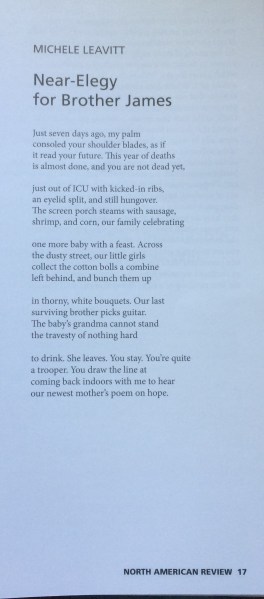
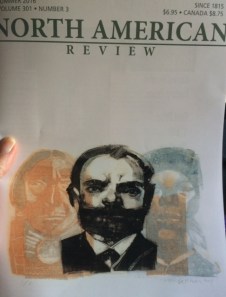
For a long time, I’ve wanted to be published in NorthAmerican Review — and it finally happened! The Summer Issue (Volume 301, #3 because it’s the  oldest literary journal in the country) arrived in my mailbox today with my near-elegy for my brother James, who is thankfully still alive. Stay tuned – I’ll have a post on the NAR blog soon about the process of writing this poem.