My dear friend Sandra Lambert planned a birthday party for her wife, Pam, and the date arrived shortly after the 2025 Lammy Awards were announced. At the party, I was still thrilling from the news that Sandra’s essay collection WON A FUCKING LAMMY. The party felt like an episode of the Twilight Zone because no one was talking about her big win. Early on, when only a few guests had arrived, my self-control evaporated and I jumped up and down, yelling SANDRA WON A FUCKING LAMMY!
During the rest of my time at the party, I talked about what other people were talking about: the lack of rain, camping, Lucy, the cute middle-aged chihuahua that Sandra and Pam were fostering-to-adopt, and Andrew Fabian, Pomeranian, who is in this photo and is my current super-senior foster dog. He’s also called “Benzo” for his calming effect on humans. He nicely snuggled on my lap part of the time.
Chronic illness and advancing introversion makes parties uncomfortable for me. By the time celebrations were in full swing, it was time for home, sweet home.
But still, no one was talking about Sandra’s Lammy Award. I opened the door to leave quietly, but then shouted “Let me say one thing before I leave: SANDRA WON A FUCKING LAMMY!” Shutting the door, I saw glasses raised and heard universal cheers for Sandra. Finally. Sheesh.
One description that’s been applied to me all my life, in theory as a compliment, is “You’re so laid back.” It’s never set that well with me. Laid back in the grave? Laid back like a pillow princess? Maybe chronic illness has made me appear flat. Inside, I’m a roiling stew of eccentric thoughts, bizarre ideas, and chunks of beloved books.
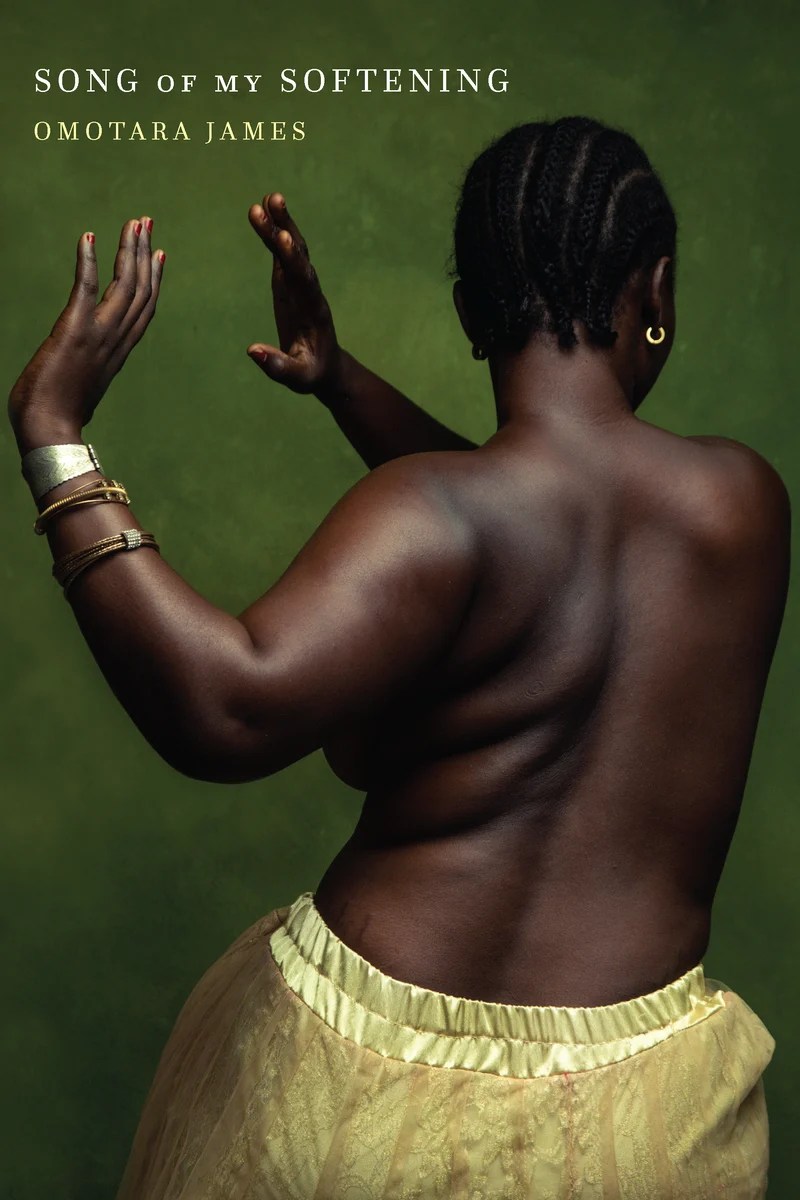
Please celebrate with me! Sandra’s book, My Withered Legs and Other Essayswon first place in lesbian memoir/biography, and Omotara James’ poetry collection, Song of My Softening, won first place in lesbian poetry. I know Omotara from social media and have followed her work for a few years. If I’d been at her wife’s birthday party and no one was talking about her Lammy, I’d have been the same mouthy bitch.
I began this year’s Sealy Challenge inspired by poet friend Linda Cue who engages with the challenge every year. Although reading a whole book of poetry in a day is clearly too much for me, the challenge has made me read more poetry than I usually do, and that’s to the good for my mind and heart.
Re-reading is my preference when it comes to poetry.
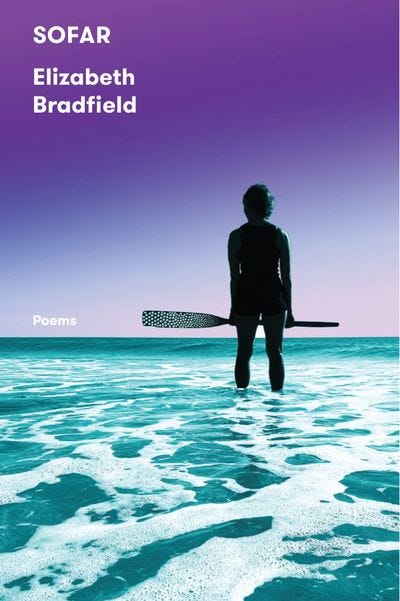
One book that I read and re-read in August is the newly released collection SOFAR by Elizabeth Bradfield. This expansive collection teems with the panoply of life on Earth, spreading the news that attentiveness to the “more than human” world offers relief from bland fascist notions of uniformity and extraction.
Moments of intense joy come from such attentiveness. But moments of stunning grief come from attentiveness as well, and in some poems, attentiveness brings both joy and grief. “Dispatch from this Summer,” with its hermit crab form is one of these. The crab makes a house for its soft body in a discarded shell; in the form, one narrative holds the other, but the form is not a comparison giving one story ascendancy.
The “house” narrative concerns the invasive gypsy moths’ decimations of trees by “unrelenting mastication” that results in a rain of “a constant heavy frass.” Still, the forest holds beauty
. . . If you can stand to walk a narrow path through the leafless forest, you can arrive at a circle of water that will allow your body to be beautifully held, whoever you are. It’s true, you’ll have to return
by the same path . . .
The body held in this poem’s house is a host of vulnerable bodies, the “Florida dancers,” who were killed in the 2016 mass murder at Orlando’s Pulse nightclub, the dozens more who were injured, and the community who witnessed. The naturalist notes that taking the journey to be “beautifully held” means traveling back through the “apocalyptic trees.” In other words, through a shit storm.
“Dispatch from this Summer,” and this book, and Bradfield’s work as a queer poet and naturalist, all have an urgent significance to me. We live in dangerous times, where gross homophobia is pushing its way onto national, state, and local levels, even into my beloved Florida’s liberal enclaves, like Orlando, where a rainbow crosswalk adjacent to the Pulse Memorial was erased overnight. In Gainesville, my home town, city councilors voted unanimously to obey the state’s order to erase our rainbow crosswalks. Fuck that noise.
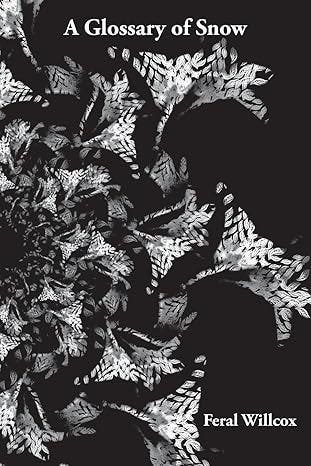
Next up, a book that allowed me to further indulge my re-reading habit: A Glossary of Snowby Feral Wilcox. The collection is a true glossary that defines emergent terms for the diversity of snow.
Feral and I have been friends for twenty years, and so I’ve had the pleasure of reading her imaginative yet sensual work in various incarnations. These poems are some of her most musical, making excellent use of all the sensory strategies she is intimate with as a poet, musician, and visual artist.
Even in the collection’s prose poems, the music is dense and fecund. From the first stanza of “Daughter of Pearl”
daughter of pearl a hard snow born from a harder snow, under the hard shell of a dull grey sky
In an era of hollow dolls lost in warspell, sororities of the pearled-up poor, glamour girls pushed from great depressions into chorus lines, high kicks and cattle calls of drunken flesh swirled in a syrupy cocktail of dresses, pleats and flounces, cleavages, pearlescent romances, crooning juniors of blue-blood seniors, shills of swindlers, big brass boards of hidden hitlers melting their hot silver spoons into shrapnel kisses milked from winter skies uddered with promises, falling, falling as tin cups filled with snow rattle off into the steaming rubble of true love, I’ll be waiting for you, dear, with home appliances and recipes, the basics of home-economics, the rich give a gift to the poor, another war.
Part indulgence, part politics, part fortune-telling, and all art, A Glossary of Snow is another queer book of the present moment.
Thanks for reading So many books, so little time! Subscribe for free to receive new posts and support my work.
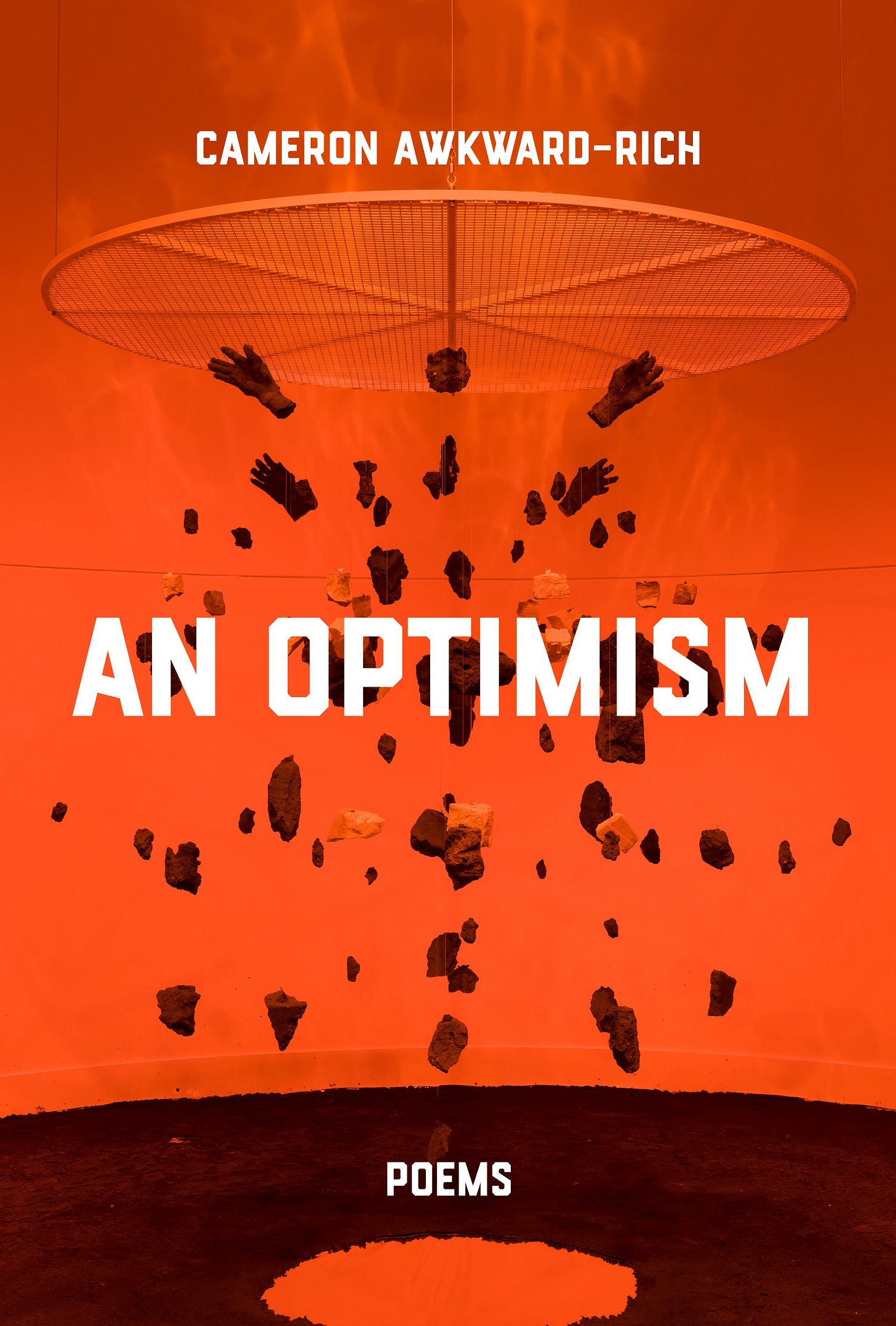
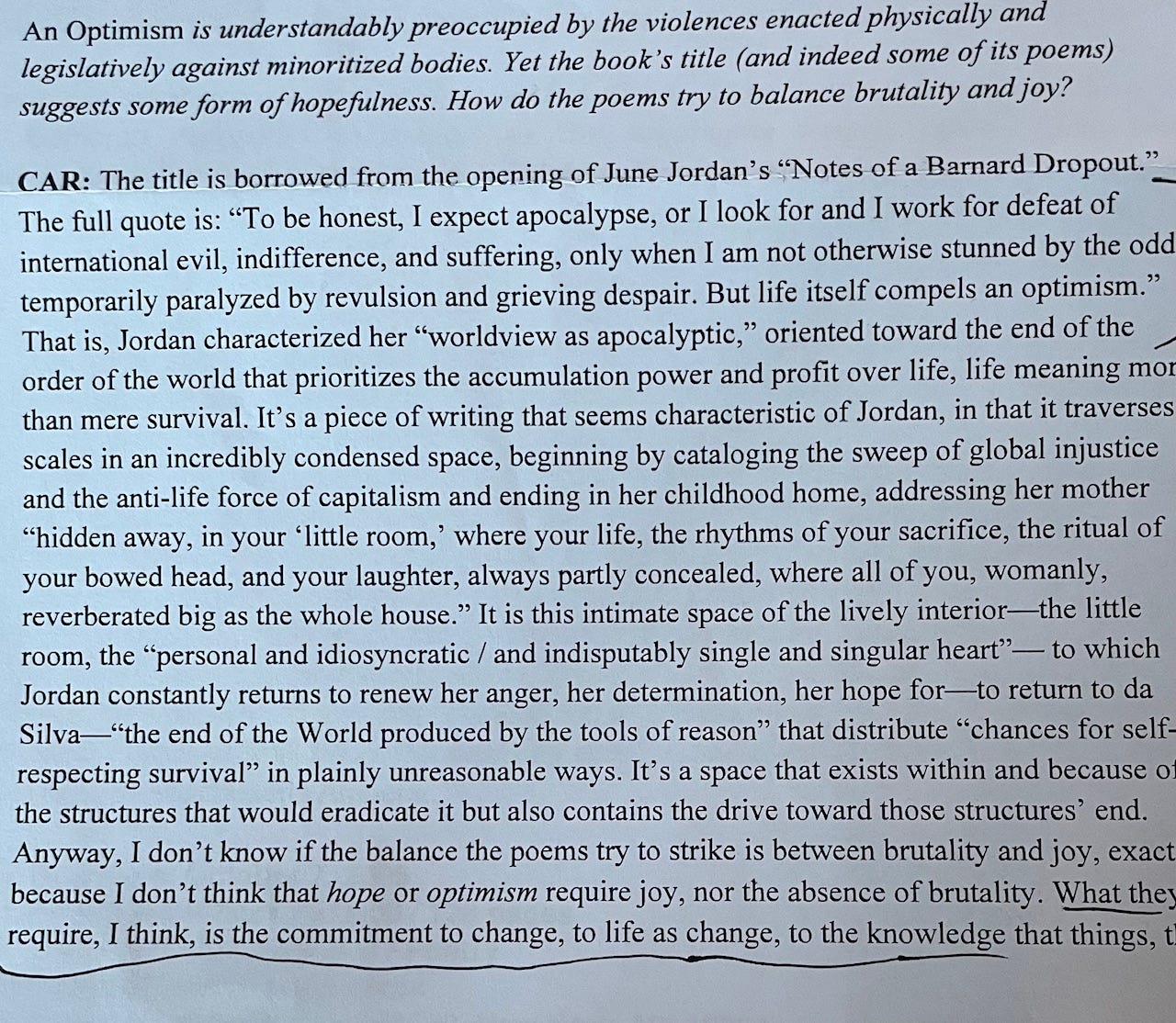
Cameron Awkward-Rich’s book, An Optimism, is thrillingly intellectual while being achingly emotional. Quite a feat. Big thanks to Gabriel Fried over at Persea Books for the ARC (Advance Reading Copy), which included a transcription of an interview with the poet. I read the interview first; in it, Awkward-Rich mines his experience teaching an undergrad class, “Poetry in/as Black Feminist Thought” along with his cultural criticism work for exemplars of his ideas. Here’s a screenshot from that fortunately long interview, where he explains the title of his book as borrowed from a line of June Jordan’s:
The poems enact the idea of cultural criticism, using disparate texts ranging, for example, from the work of Pauli Murray, to Neverland and Peter Pan, to the opening sentence of Charles Dickens’ A Tale of Two Cities as subjects. Often, there’s a young speaker who longs for mirroring: to see someone like himself.
One surprising-to-me trope is the character of Odo from Star Trek: Deep Space Nine, who is “trapped between forms.” In his natural state, he’s a gelatinous mass, but he is a shape-shifter who assumes the appearance of anyone and anything. Change is Odo’s baseline. Even I, a cis woman, can see parallels here to trans experiences in a transphobic world.
From one of several poems titled “It Was the Best of Times, It Was the Worst of Times”:
I didn’t know yet that it was possible, to be, like that, unmade
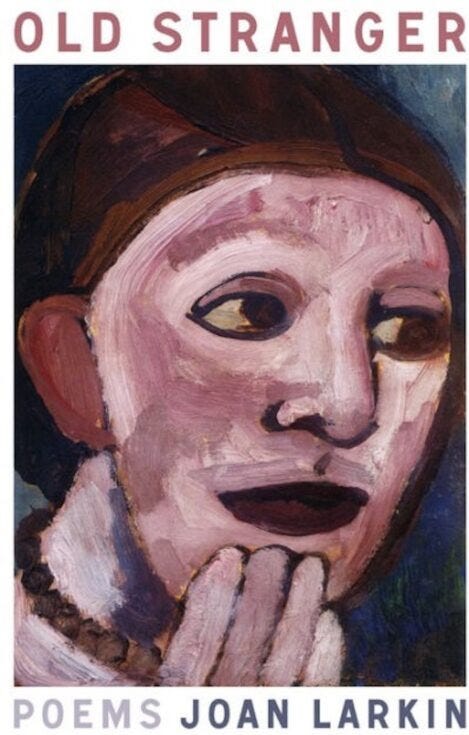
Does the the brevity of lyric poetry appeal to Millennial and Gen Z readers? The turns from narrative to lyric modes in Joan Larkin’s new poetry collection Old Stranger may be attractive to them then, but the poems will also resonate with readers who’ve attained longevity. An octogenarian, Larkin has been celebrated for blending lyric and narrative elements in her work and for nudging her poems toward resolution and epiphany. Her reliance on the lyric mode in Old Stranger intensifies as the collection progresses, while not entirely abandoning narrative. The superseding of narrative by lyric elements tends to form its own arc in a story about aging through perceptions of time and the past.
Larkin was born in Boston, a few months before the 1939 invasion of Poland that set off World War II. Eighteen years older than I, she is a writer I’ve respected as an elder who is always a generation ahead of me in experience, and in the wisdom that may come from it. I’ve followed her work for decades, beginning in the 1970’s at New Words Bookstore in Cambridge, Massachusetts, where I began seeking out queer and feminist literature as a teen. Now, almost 50 years later, Larkin’s poetry continues to create beauty and delight while offering wisdom as I enter my elderhood.
It’s uncommon for poets to have 50-year publishing careers, even now that life expectancy has grown over the past century. If a poet’s early work establishes their personal mythology, as Larkin’s did, what happens to that mythology over a lifetime? Does it grow stale, or get reassessed, or reinforced, or even abandoned? In Old Stranger, the subjects of Larkin’s foundational narratives – rape, abortion, miscarriage, coming out as lesbian, getting sober – are often reshaped through the lens of lyric, which emphasizes the distillation of seemingly truthful perceptions rather than the arc toward them. This turn to the lyric is a Swedish death cleaning of sorts that sweeps events to the side and prioritizes images of insight and emotional truth.
Of course, neither lyric nor narrative modes exist in separate bubbles. There’s a term in poetic discourse for combining them: the lyric-narrative poem. During the first months of an MFA program in the 1990’s, where I was struck by how much I did not know about poetry, “lyric-narrative poetry” especially confused me. Any initial recognition of ignorance may often play a part of the narrative arc of achieving wisdom, but I did not achieve any lasting wisdom on this point. Thirty years later, Old Stranger has revived my old confusion, especially in its poems treating narrative time as both rigid and flexible. Now, though, I can at least see the assumptions that stand in my way: that the lyric exists outside of time, but that narrative relies on time to be understood, and time relies on narrative to be parsed.
A disregard of narrative time first appears in the book’s fourth poem, “The Body Inside My Body,” where a second body, belonging to the speaker, asserts its power. This body wants “the breath it lost trying to escape / that afternoon in Hell’s Kitchen.” With short, declarative sentences establishing her authority, Larkin convinces me this alter-body can get that breath back. The poem offers hope to anyone with traumatic memories who, like the second body, “[h]as had it up to here with the scalding” and “wants the whole carcass unburied.” But the uncovering and implied dissection of the carcass of the past is just the beginning. The carcass’ obliteration is what this alter-body is after, as it wakes in a gothic setting that “any body wants,” where vultures “hiss in the low branches,” ready to do what vultures do. Who wouldn’t want painful events and their sequelae picked apart, swallowed, and annihilated by a vulture’s acid-bath gut?


 Michele Sharpe