Writing Memoir: Going on Retreat

Thanks to the generosity of my friend Corky who shared her house for the weekend, I went on a writing retreat with three friends. We all write poetry, and some of us write prose, too.

When we all arrived, we talked about our goals for the weekend, and then we set up a schedule for the day. It’s a good thing some of us are task-oriented, unlike me, the scatter-brain.

Today’s schedule started with private writing time for three hours on projects of our choice. After this, we came together to talk about how that went. Hearing everyone’s thoughts on what they’d accomplished helped me to see what I’d accomplished, and it helped us all to create another set of goals for the next round of writing later in the day.

Other activities in our schedule include reading poems aloud for inspiration, using a prompt to create lines for a collaborative poem, and a formal feedback session where we’ll share some work we produce here.

Writing retreats can be very productive times, especially for people working on particular projects, like a memoir. Without the distractions of my home, my garden, my husband, my dogs, I have no excuse not to write.

For some people, being in a beautiful place is inspiring. For others, it can be distracting. Corky is lucky to live on a small lake in North Central Florida, so the view is inspiring for me. I love North Florida more than I love jelly donuts. But because I live in this area too, it’s not so unfamiliar to me that I feel I have to get out and explore.

Writing retreats can take many forms. I’ve done the “staycation” retreat when my husband is out of town, hunkering down by myself in my home with a writing goal in mind. Those have not always been as successful as I’d hoped in terms of production. Those darn distractions. I know I’ve hit rock bottom when I find myself cleaning the bathroom instead of writing.

Writing retreats taken away from home can eliminate those distractions. One year, I went to a motel with my friend Sandra. We had separate rooms, and we got together for lunch and dinner, again to discuss our progress and goals. Having a time to meet with another writer gave me a sense of accountability.

Some of my writing friends have gone on retreats that are managed by writing teachers or coaches. These sometimes include workshops or seminars on particular topics. An example of that is the Iota conference retreat that focuses on very short nonfiction. It’s held in the beautiful downeast region of Maine.

Of course, you have to be able to afford those professionally managed retreats, or get a scholarship to attend one. If you can’t, going off with a few friends seems to be a good solution. You can have time to write, accountability, inspiration, and positive feedback and camaraderie.

Some elements of a successful group writing retreat include:

  • Private time for writing
  • Time for reading inspirational work, either in a group or individually
  • Using prompts to create new work
  • Formal feedback sessions to share work produced on the retreat
  • Comfortable accommodations, either at home or away
  • Accountability

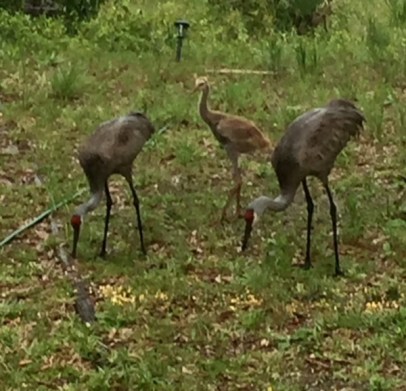
Food and drink are required too, of course. If possible, it’s also helpful to have a mascot to bring good luck, or a familiar, or a spirit companion. We’ve been fortunate to be visited by these sandhill cranes.

Writing Memoir: Fact or Fiction?

A doll with a cracked face. Photo by Aimee Vogelsang on Unsplash
Do you remember the popular memoir, A Million Little Pieces? Written by James Frey, it was a national best seller. Then, it was revealed that Frey had made up many of the book’s juiciest parts.

The book became a literary sensation. Originally an Oprah’s Book Club selection, Oprah brough Frey back on her TV show where he confessed.

Today, the book is still listed as nonfiction in most libraries and bookstores, even though Frey and his publishers acknowledged that Frey fabricated numerous events in the book, including a criminal record. Admissions about the fabrications were included in subsequent editions of the book, which continued to sell well. Frey’s statement, in part:

“People cope with adversity in many different ways, ways that are deeply personal. […] My mistake […] is writing about the person I created in my mind to help me cope, and not the person who went through the experience.”

Since then, the question of truth in memoir has been raised by readers, writers and publishers everywhere. Answers have varied.

For memoirists who strive for honesty, one issue has to do with composite characters. About ten years ago, I was in face-to-face writing group with other English faculty at a university in the Pacific Northwest region of America. One of the nonfiction pieces I brought to the group for critique ran for about 6,000 words, and 8 different people appeared in it. A colleague suggested that there were too many people in the story, and that I could combine several people into one character to avoid confusion. She called this creating a “composite character.”

I was astonished. I was writing nonfiction, and to me, the very definition of that was, well, non-fiction — true to life and not made up. But others in the group assured me that the emotional truth of the piece was truth enough, and that tweaking the facts a bit for ease of reading was okeedokee.

I knew, of course, that art, and writing, are not the same as real life, which bumbles along without any particular order. Art, and writing, require selection: we select scenes and images and dialogue from reality to include in our memoirs and essays, and we don’t select other scenes and images and dialogue.

There, in my opinion, is the problem with composite characters: in selecting material for our memoir and other nonfiction, we need to draw from the well of what really happened and who was really there.

But maybe I’m not as self-righteous when it comes to reproducing dialogue in memoir. I remember conversations, maybe not word for word, but I remember them. When I can’t recall exactly what someone said, I will, sometimes fill in the blanks.

Now I feel hypocritical.

Memory is not perfect, and different people will remember events differently, or not at all. As memoirists, we have to do our best to relate the truth as we remember it.

Where do you draw the line in your own nonfiction writing?

Writing Memoir: Starting Small

Photo by John Moeses Bauan on Unsplash

Lots of people start writing memoir as a book length project, but there are benefits to starting small with personal essays and “flash” memoir.

Essays are usually 2,000–8,000 words, while flash or micro-essays are under 2,000 words. The excellent online magazine Brevity, looks for flash nonfiction pieces (or “micro essays”) under 750 words.

One benefit to starting small is getting our work published quickly, whether on Medium or elsewhere. A book-length manuscript can take over a year, or more, to wend its way through a publisher’s many departments.

Having short pieces published can create an audience for our work, and it can help us become “known.” Book publishers and agents are often leery of “unknown” authors, and even when a writer appears to have sprung from nowhere on to a bestsellers list, that writer usually has a history of publishing short work.

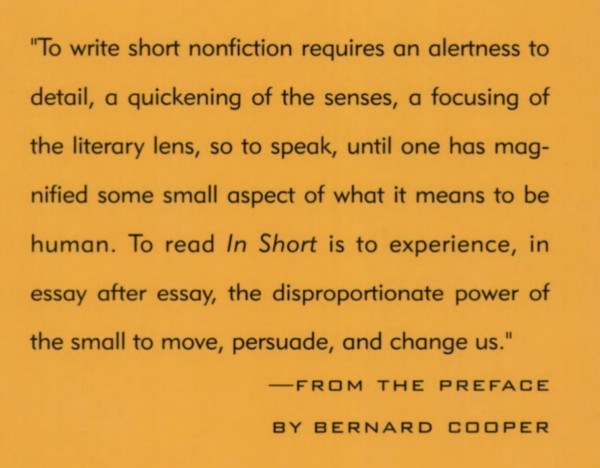
In terms of craft, starting small can also be of benefit. It allows, or even forces us to focus on precise details and images. For folks who are unfamiliar with short nonfiction and micr-memoir, the aforementioned Brevity is a good place to get acquainted. Local libraries have anthologies of short creative nonfiction like In Short: A Collection of Brief Creative Nonfiction. These books will often provide observations about the genre and the craft, like this excerpt from In Short.

Zeroing in on a small moment is manageable in a way that a book length manuscript is not. But it also provides excellent practice for writing longer works, which also require attention to physical and emotional details.

In short (hahahaha), the small details can, or perhaps must, be interesting. That doesn’t necessarily mean pretty, although it certainly can. As an Asian history major in college, I came across this curse from Imperial China: May you live in interesting times. As in times of famine, flood, political upheaval, drought, and all the plagues suffered by the people of that vast country.

If you’ve read any of my personal essays, you know I and my family have had interesting lives, which has been both a blessing and a curse. Last year, I had a micro-memoir published (originally in Grist and then on Medium’s HumanParts) about a selfie posted by one of my beloved nieces.

As mentioned in another post, we like to get to know characters in fiction or memoir in the same way we get to know people in real life: by an accumulation of details.

My niece’s selfie included details that made me fear she was using drugs. Those details sent me back to her childhood when she had a scab below one eye that she picked at nervously. The scab looked like one of those teardrop tattoos you see on guys who’ve spent time in prison.

A scab is not a pretty detail, but in this situation it was interesting, and it revealed something about my niece’s character. The micro-memoir about the selfie and the scab doesn’t end happily. But a year after it was published, my niece read it aloud to her cohort as she graduated from a drug treatment program.

And that’s another benefit of starting small — kids these days! And adults. We’re all influenced by online interactions to read short works.

Write on. And read on, too.

Writing Memoir: Sending to Publishers

Woman wearing a t-shirt saying “SEND IT.” Photo by Drew Farwell on Unsplash

Submitting work to journals and contests and publishers (lions and tigers and bears) is one big pain in the butt. It’s also a time-tested way of opening yourself up for rejection. More on the rejection part later in this post.

Once your work is safe for human consumption, the first step is to locate journals or publishers or agents that are a good match for your work. For memoir excerpts and personal essays, my go-to spots for info are:

Another effective way to match your work with a publisher is to read widelyin your sub-genre. When you’ve read something you admire that’s got elements in common with your own work, consider submitting to that journal or magazine — or that agent. Writers will often thank their agents in the acknowledgements section of a book.

Following other writers and writing coaches who post about publication opportunities can also give you valuable information about where to submit your work. One of my favorite bloggers to follow is Erica Verrillo, who writes here on Medium.

Once you’ve found places to submit your work, then come the tasks like record-keeping and filling out online forms. What makes submitting easier? Two things come to my mind: a system and some sisters. Or brothers, colleagues, a network, whatever face-to-face or online communities appeal to you.

Some writers use Duotrope as a system to keep track of their submissions. Many of my writer friends use Duotrope and love it. I’m too cheap to pay the $5.00 per month fee. If you submit only to publishers who use Submittable, that can be a complete (and free) tracking system. And some writers use their own record-keeping systems.

New online communities for writers seem to pop up daily. I’m drawn to those that are created by and for women, like Women Who Submit on Twitter, which offers info on open submissions and “submission parties,” both F2F and virtual.

Other online communities exist on Facebook. Most are “closed groups,” which means you must request membership. This process helps to insure that all members are real people with an interest in writing. If you see a group that looks interesting, ask to join it. You can always leave a Facebook group if it doesn’t work out.

The rejection part: Kim Liao’s post about aiming for 100 rejections a year says it all, and says it so well that it went viral. The gist of Liao’s argument is that aiming for 100 rejections means you are sending your work out. And goals are important.

“Collect rejections. Set rejection goals. I know someone who shoots for one hundred rejections in a year, because if you work that hard to get so many rejections, you’re sure to get a few acceptances, too.”

Where do you go for information and strategies on sending out your work? Help us out here, so we can get back to the fun part — the writing.

Writing Memoir: Flashbacks and Braiding

Person standing still in front of a mural of a sneaker while cars zoom past. Photo by Ashim D’Silva on Unsplash

Real life happens chronologically, but memoirs and personal essays don’t have to. In fact, sometimes they shouldn’t if there’s some suspense or wisdom to be gained by juxtaposing events from various points in the past.

This technique is sometimes called using flashbacks. A more complex form of juxtaposing multiple times and threads is often called braiding.

Writers use several methods to alert readers to time changes in stories. The first involves simple signalling in phrases like “But ten years ago, I thought differently,” or “Two years before this event.”

A second method is to switch settings once you’ve already established a primary setting. An example might be found in a memoir about serving in the military in Vietnam. Whenever the writer flashes back to high school in America, we the readers will know that time has shifted too and that the high school is not in Vietnam.

Strong images or memorable characters associated with particular time periods can also serve as signals to the reader. A memoir that covers two marriages is one type of story that can use this technique, toggling back and forth between the two spouses or between two strong images like a granite fireplace in one marriage and a concrete swimming pool in another.

I’ve written a number of braided essays, and ironically that has made it difficult to compile them in my current memoir project, which is chronological. Maybe I should re-think that. But currently what I’m doing is chopping those essays up into their discrete times and threads in order to weave them back together in a chronological timeline.

One example of a braided essay that I’m currently chopping up is “Maternity Cave,” included in the March 2017 issue of Hippocampus. Like most of my publications, I worked on writing this piece for several years, and worked for even more years trying to figure out what the events in the story meant.

I don’t usually intend to braid different time periods, but it happens a lot. Every so often, a phrase or an image or a small event in daily life captures my attention as being connected to a phrase or image or event from the past. Those little a-ha moments are often the beginnings of my stories.

The maternity cave story begins in 2006 on a visit to a bat cave in Central Florida with my teenage niece Candi, where we saw thousands of little brown bats swirling up into the dusk, then it wiggles around in the 1990’s between my first marriage, my experience of infertility, and finding my birth family, and then it shoots ahead to a family picnic in 2016, when Candi is a grown woman with two children of her own. There was a moment at that picnic that lit up the past for me.

A bat hanging upside down in a cave. Photo credit http://www.hippocampusmagazine.com/2017/03/maternity-cave-by-michele-leavitt/
The story doesn’t follow linear time, and I’ve been thinking lately that’s one of the benefits of being a reader of personal essays: we get to experience hard-earned wisdom in a way that isn’t tied to chronology. We get to look back, be in the present, and jump ahead to the future in less time than it takes to bake a cake. There’s no undo or do-over button because truth doesn’t change, but at least we get to see truth’s trail.

Memoirs and personal essays are time capsules, freezing us in a series of moments. But they can be time machines, too, taking us forward and backward, allowing us to grab on to the hindsight and foresight in someone else’s experiences, even when that sort of wisdom escapes us in our own lives.

Writing Memoir: Photographs and Images

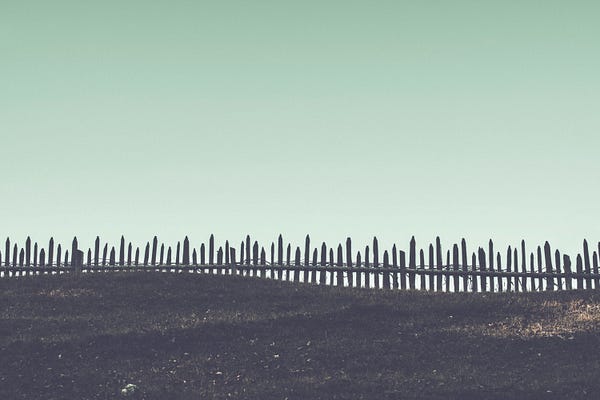
Fence. Photo by Simone Dalmeri on Unsplash

The boundaries between genres are blurring.

Why shouldn’t we include photographs in memoirs? The only reason I can think of is that some (maybe many) publishers don’t want the hassle. Publishing images is more complex, more expensive than publishing text only. Unless, of course, you’re publishing on the internet.

That damn internet. It’s changing everything.

Some publishers are welcoming work that combines text and image. Some can be found in this list of cross-genre publishers curated by New Pages.

Here’s my attempt at a cross-genre piece combining photographs I took of trees with text about family trees.


Twisted branches, Unity, Maine

Maybe it was me who doctored this photograph, trying to give it an heirloom appearance.

I see a “B” in this tree. Or maybe a “D,” or a sideways “A.”

Or a man, hanging face down with his arms extended, reaching for something on the ground.

Or a lizard with its tail curled up behind it. Or the predictable snake.

Or a tree, twisted by snow and ice, and the deaths of other trees, and by forces I cannot imagine, putting forth the predictable new growth in spring.

Unknown dead tree, North Central Florida

I leaned against trees, wrapped my arms around trees, swung from trees and hid in trees, and walked on limbs as if they were tightropes. I prayed to trees, I raged at trees. Far away, the half-brothers I now know cut trees down for very little pay.

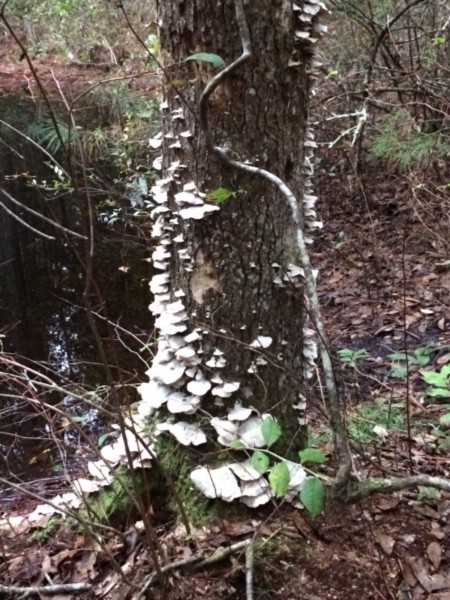
In my private forest, which isn’t mine, but belongs to the town, I watch this tree, and the spiral of fungi around its trunk that curves around in question marks and other symbols. It might be my family tree: no hierarchy, no single ancestor, and certainly no single pattern.

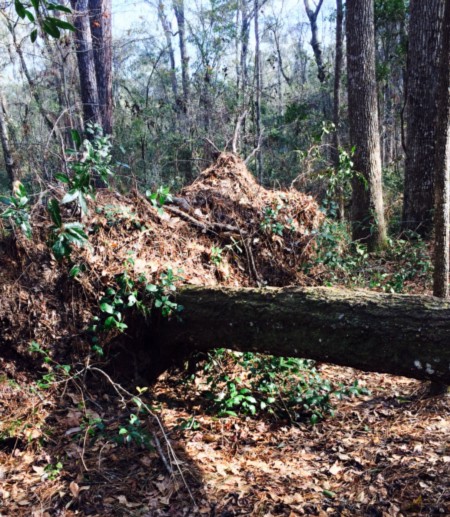
Living Turkey Oak, fallen, North Central Florida.

This tree took the earth with it when it tipped over in a windthrow. It is the only tree in this quadrant that fell. Maybe another trauma, like heart rot fungus, affected its anchorage and prepared it to let go.The letting go starts a new creation story: a hole opens in the canopy, and sunlight pours down on the forest floor. Saplings stuck in the pole stage may wake up and start to grow gain.

New stories mean new names. The earth ripped up with the tree is now called a tip-up mound.

Dead Cypress, North Central Florida. 

This tree has been dead for so long, you can see right through it in spots. How did that happen? I imagine the branches fell first, then the crown, and then the bark sloughed off like the skin of a snake, and then the core collapsed on itself. What’s left is a suggestion of the strong column it once was, a gesture toward how the column once spun upward in helix fashion.

What’s left of the tree has the pocked and scored look of the karst limestone under the ground around these parts. Maybe the tree has taken on some characteristics of the stone.

Even long dead, and even taking on other characteristics, the tree is still a tree.

Writing Memoir: Finding (Making?) Time

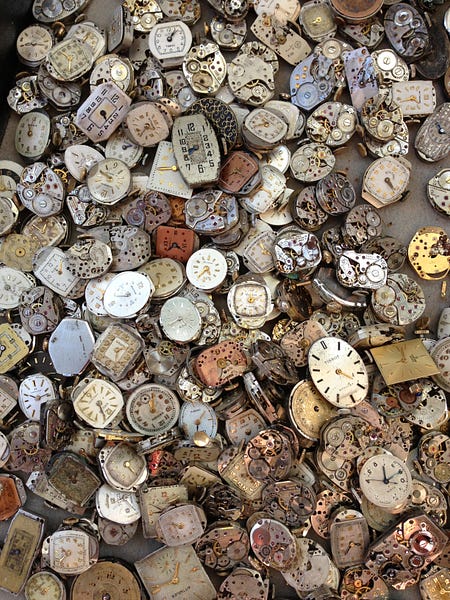
“A large heap of broken antique watches and clocks” by Heather Zabriskieon Unsplash

How do creative people find the time to write? Or do they “make” the time?

Years ago, someone asked me how I managed to do so much. “It’s easy,” I said. “I don’t have kids!” The people who amazed me with their productivity — and who still amaze me — were the ones who parented young children.

Writing a memoir, or even a stand-alone personal essay, requires a huge investment of time, especially for slow writers like me. If it took me less than 40 hours to write a ten page story, I’d be very surprised. This month, I’ve committed to finishing a coherent draft of my 80,000-word, rough memoir draft. How will I manage my time to insure I meet that goal?

Strategy 1: Getting on a Schedule

This was effective for me when I worked a full-time, 8:30 am to 4:30 pm job. I was already on a schedule, so creating another one for writing made sense. Off and on, for months at a time, I got up at 5:30 am and wrote for about 90 minutes.

Scheduled writing has been famously successful for authors like J.K. Rowling, who also had a day job when she began the Harry Potter series. If you are subject to an external schedule, whether it’s related to school or work or family responsibilities, a writing schedule may do the trick for you.

But once I resigned from the day job to work for myself, the external schedule that kept me on track disappeared and I found myself floundering.

Strategy 2: Figuring Out When You Write Best and Write Most

Although I’m not trying to lose weight because that ship has sailed, I know that food journals are an effective way for people to track calories. So I decided to keep a time tracker to see where I was spending my time.

Like many people, I squander time on social media, mindless eating, and passive entertainment. When I’ve squandered enough, I get resentful when those I love interrupt my thoughts about writing or the writing itself. As if those people (and dogs) are the cause of my fribbling.

Decades of working day jobs created a habit of writing at odd hours: early mornings, nights, and weekends. Breaking from that pattern has not been easy, even though I expected to have nights and weekends free once I was “just” writing. But I’ve been writing at odd hours still, and not making enough headway on the memoir to satisfy myself.

Data is powerful. The time tracker showed me I was working on my memoir early in the morning and late at night, for about 90 minutes at a time. Ugh. Old habits are hard to break. It also showed me that I was working on paying writing projects during the day, like that was a day job. Ugh, again.

3. State Your Writing Goals Publicly

This month, I’m writing about writing memoir every day. And I put it on my Medium profile.

Two popular month-long writing marathons, NANOWRIMO and NAPOWRIMO inspire many people to successfully find or make time to write novels and poetry, respectively. I participated in NAPOWRIMO this year in April. Thirty poems later, I think 4 or 5 of them are actually worthwhile.

But, I’m convinced that 30 days in a row of writing a poem, or at least a wannabe poem, was helpful exercise for the poetry part of my brain. I even continued the process through the first week of May. Now, I’m slacking off again.

I heard that you’re more likely to meet your goals if you announce them publicly. Oh wait, I also heard that announcing your goals publicly makes itless likely that you’ll meet those goals.

4. Going on a Writing Retreat

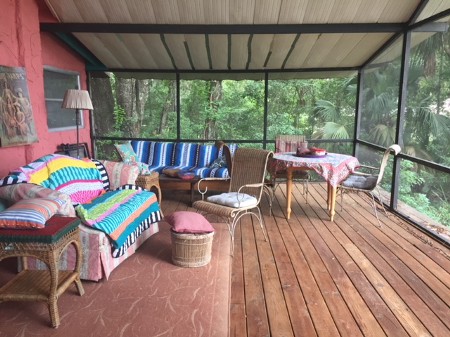
A retreat doesn’t have to be anywhere but your own home; it’s a big chunk of time (a day or more, preferably) devoted to writing. I’ve done stay-home retreats, and cheap motel retreats. Some writers go on organized writing retreats.

For me, these chunks of dedicated time seem to work best when I have a specific goal to meet. That’s especially true if I go somewhere besides my home, where I may be tempted to check out a new ice cream parlor. For this reason, I advise going on a retreat in a place that’s not very appealing to your interests.

But even on a stay-home retreat, I can be distracted by chores that suddenly must be done. I’m not talking about walking the dogs or watering the plants, which really must be done to keep everyone alive. I know I’ve hit rock bottom when I find myself scrubbing a toilet instead of writing.

The best piece of advice about finding or making time to write is to experiment to find out what works best for you. We’re all different, thankfully.

And if you’re wondering about the right time to begin a memoir, that’s something I’ve thought about this week because two former students got in touch to say they are thinking of writing memoir. They were both curious about “the right time” to start.

My response was “Now is the time.” When an idea about doing something creative pops up, that’s a hint from the part of yourself that’s smarter than the rest of you. Go with it.

Writing Memoir: Using Journals and Diaries

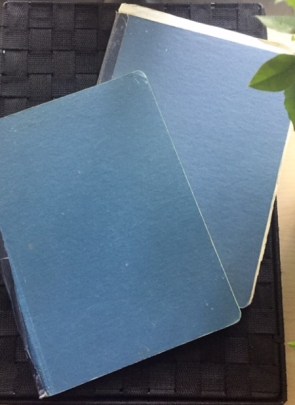
Two of my old journals

Old journals and diaries kept during a time in your life you want to write about can provide raw material for more formal, refined writing. But even if you weren’t in the habit of spilling your guts out on the page when you kept a journal, a journal can still be useful for detecting certain elements about the character you were in the past, and the settings you inhabited.

“Never throw away anything you’ve written” is advice I’ve given elsewhere. It’s good advice for journals, too, even though they may be an embarrassment.

When I was in my twenties, I destroyed part of a journal written at seventeen.

It embarrassed me. Not because of actions or emotions I confessed in the journal. Because of the voice. I remember thinking it arrogant and overwrought. But I can’t know for sure if the voice was arrogant and overwrought, and I can’t reproduce that voice now because those pages no longer exist.

The most obvious use of a journal or diary for a memoir writer is that a journal can help you fill the blank spots in your memory with details, the sights and sounds of past events in your life. Physical artifacts — the notebooks we used to record our doings — can also spark memories of details. Look at your old handwriting on an old page, feel the smooth paper with your fingertips, and open your mind to memory.

But even for those of us whose old journals are boring and repetitive, finding value in them for a memoir is still possible. An old journal can give you a sense of your voice during the time in question. Were you using youthful slang or professional jargon that you no longer use? Longer or shorter sentences? Odd punctuation like a row of exclamation points or, heaven forbid, a little heart in place of a dot over your “i”? Did you scratch things out, or underline? All these can be keys to your character in the past, and your voice.

The style of the notebook you used can also be telling. It may say something about style or popular colors during the period in question, or it may say something about your personal style back in the day. As an artifact, it can provide a cultural context for your past life.

The two journals in the photo above are from the 1980’s, a time of shoulder pads and cinched waists for women, mullets and Jheri curls for men, glass skyscrapers, glass-top tables, and lots of teal and pink. But these two journals are very plain. In this case, plain didn’t mean cheap; I remember buying the journals at a bookstore near Harvard University. They were quite expensive, and I’ve always been, well, “frugal.” Those two journals-as-artifacts say something about who I was back then, and they also give me a cultural context, even if it’s really an anti-context.

Finally, a third use for old journals and diaries is to find a sensory door in to a larger story. Why did I want that pair of sneakers so badly? Why did my friend and I construct piles of ketchup and salt to dip our french fries in? When that person held my hand too tightly, how did I react?

You may find mysteries, too, like events you wrote about but cannot recall. Yet there they are, in black and white. Or purple and ivory if you had an individual aesthetic.

Being unsure of reality every so often is refreshing. Every mystery is a lesson in human fallibility, something we writers and artists can’t be reminded of too often as we create and re-create reality.

Writing Memoir: Saving Your Life

“A fountain pen on an open journal” by Aaron Burden on Unsplash

You’ve heard it before: Writing saved my life.

If you’ve wondered about the truth of that, I’m happy to report that there’s a boatload of science behind that saying.

In 2005, for example, British researchers found that short periods of “expressive writing” resulted in better physical and psychological health.

Writing about traumatic, stressful or emotional events has been found to result in improvements in both physical and psychological health, in non-clinical and clinical populations.

It makes intuitive sense to me that writing about our tragedies and triumphs can improve our emotional health or bring us peace of mind. But I was surprised at the number of studies showing an impact on physical conditions including rheumatoid arthritisEpstein-Barr virus, and hypertension.

Most of these studies focused on short, guided periods of expressive writing or guided, written disclosures of trauma. The writing practices were standardized as much as possible in order to achieve some measure of reliability for the studies.

But what is meant by “expressive writing”? In an article for Psychology Today, Dr. John F Evans provides a definition:

It is personal and emotional writing without regard to form or other writing conventions, like spelling, punctuation, and verb agreement. Expressive writing pays no attention to propriety: it simply expresses what is on your mind and in your heart.

This, to me, sounds a lot like the “free writing” technique put forth by teachers from New Age guru Natalie Goldberg to university professor Peter Elbow . Not to mention the thousands (or more) college writing teachers like me who advocated free writing in their classrooms.

The idea behind free writing is that inexperienced writers, or writers who’ve been criticized harshly for things like spelling errors, can sometimes be paralyzed by fear of making mistakes. They can be so fearful that their writing muscles cramp up, or they feel they have “writer’s block.”

The free writing technique aims to remove those fears by de-valuing mechanics like spelling, punctuation, and grammar. The goal in free writing is only for the writer to move thoughts from the brain to the page. And that, after all, is the goal of all writing: translating our thoughts into words.

For writers of memoir or personal essays, putting aside fears of being judged can be the first challenge to overcome. Many turn to free writing as a way of silencing the internal editor — at least temporarily.

Expressive writing may be beneficial to psychological and health, but is it more beneficial to brain health than other kinds of writing? Is there a neurobiological reason why translating thoughts into words, in a judgment-free zone, has a therapeutic effect?

Maybe, but it’s probably related to writing by hand as opposed to typing. The studies I referred to at the beginning of this post don’t mention whether the writing was done by hand or by keyboard. Other studies have shown, though, that writing by hand improves memory and other cognitive functions.

And, a recent study based in India demonstrated that adults learning to read and write (by hand) rewired their brains.

By the end of the study, the team saw significant changes in the brains of the people who had learned to read and write. These individuals showed an increase in brain activity in the cortex, the outermost layer of the brain, which is involved in learning.

Learning to read also seemed to change brain regions that aren’t typically involved in reading, writing or learning. Two regions deep in the brain, in particular, appeared more active after training — portions of the thalamus and the brainstem.

These two regions are known to coordinate information from our senses and our movement, among other things. Both areas made stronger connections to the part of the brain that processes vision after learning to read. The most dramatic changes were seen in those people who progressed the most in their reading and writing skills.

I’ve heard many writers say that writing has saved their lives. Maybe it’s even saved mine. But one thing is certain: our brains need exercise to be healthy, and writing provides it.