SOFAR is “a thriving catalog of poems spreading good news: Attentiveness to each other and to the “more than human” world offers relief from fascist insistence on bland uniformity.”
My dear friend Sandra Lambert planned a birthday party for her wife, Pam, and the date arrived shortly after the 2025 Lammy Awards were announced. At the party, I was still thrilling from the news that Sandra’s essay collection WON A FUCKING LAMMY. The party felt like an episode of the Twilight Zone because no one was talking about her big win. Early on, when only a few guests had arrived, my self-control evaporated and I jumped up and down, yelling SANDRA WON A FUCKING LAMMY!
During the rest of my time at the party, I talked about what other people were talking about: the lack of rain, camping, Lucy, the cute middle-aged chihuahua that Sandra and Pam were fostering-to-adopt, and Andrew Fabian, Pomeranian, who is in this photo and is my current super-senior foster dog. He’s also called “Benzo” for his calming effect on humans. He nicely snuggled on my lap part of the time.
Chronic illness and advancing introversion makes parties uncomfortable for me. By the time celebrations were in full swing, it was time for home, sweet home.
But still, no one was talking about Sandra’s Lammy Award. I opened the door to leave quietly, but then shouted “Let me say one thing before I leave: SANDRA WON A FUCKING LAMMY!” Shutting the door, I saw glasses raised and heard universal cheers for Sandra. Finally. Sheesh.
One description that’s been applied to me all my life, in theory as a compliment, is “You’re so laid back.” It’s never set that well with me. Laid back in the grave? Laid back like a pillow princess? Maybe chronic illness has made me appear flat. Inside, I’m a roiling stew of eccentric thoughts, bizarre ideas, and chunks of beloved books.
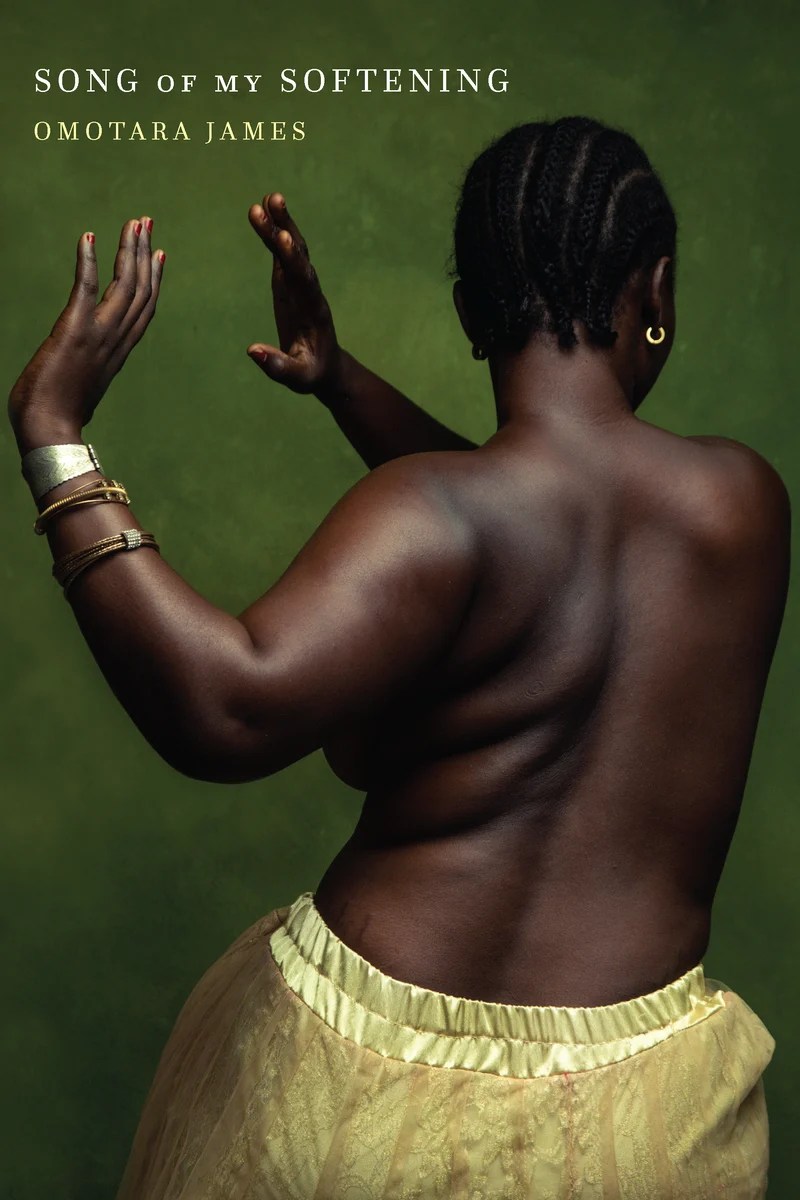
Please celebrate with me! Sandra’s book, My Withered Legs and Other Essayswon first place in lesbian memoir/biography, and Omotara James’ poetry collection, Song of My Softening, won first place in lesbian poetry. I know Omotara from social media and have followed her work for a few years. If I’d been at her wife’s birthday party and no one was talking about her Lammy, I’d have been the same mouthy bitch.
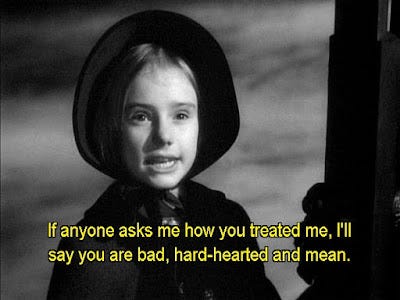
Still shot from 1943 film adaptation of Jane Eyre with text, “If anyone asks me how you treated me, I’ll say you are bad, hard-hearted and mean.”
Down some internet rabbit hole, I saw the title Praying with Jane Eyre: Reflections on Reading as a Sacred Practice. I will read almost anything about Jane Eyre, and when a quick browse revealed that Praying with Jane Eyre was written by Vanessa Zoltan, a Jewish atheist, I was relieved. Fundamentalist religion pasted on top of literature irritates me. On to my library’s database!
I first held Jane Eyre as a chronically ill child confined to bed, a girl who’d read every book in the house and whined for more. My adoptive mother drove to the local library. There, she asked for help from a miraculous but anonymous-to-me librarian who ended up having the most lasting and positive influence on my childhood.
[Please thank a librarian today, especially if you live in a state that’s under pressure from self-righteous book-banning organizations.]
Cover of Praying with Jane Eyre
Praying with Jane Eyre is a combination of memoir, sermon, and literary criticism. I couldn’t stop reading it, even though there’s a bit too much concrete spirituality for me in it, and I disagree with some of Zoltan’s opinions about the novel (the Reeds never deliberately tortured Jane? Please). Still, it’s Jane-adjacent, which I cannot resist, and Zoltan make many meaningful observations about Judaism, Atheism, the epigenetic impacts of the Holocaust (all four of her grandparents were Holocaust survivors), and the process of re-reading. Believing that re-reading can be a sacred act, she has this to say about faith and re-reading:
“what I came to mean by faith was that . . . the more time you spent with the text, the more gifts it would give you.” Even when “you realized it was racist and patriarchal in ways you hadn’t noticed when you were fifteen or twenty or twenty-five, you were still spending sacred time with the book.”
Honestly, I’m not clear on the idea of sacred time. Is it like when I take to the bed all day with a book? Is it like Mary Oliver paying close attention during her morning walks? Or is it about repetition? Or all of these?
Is sacred time forgiveness time? Is it a deliberate disregard for perfection? Most, maybe all, nineteenth century European literature is racist and patriarchal. Charlotte Brontë was not a feminist saint. But her most famous book is more than the sum of her writerly parts, maybe because she trusted in the magic of her unconscious. If she was stuck, as a writer, she asked her own dreams for help and illumination before falling asleep at night.
That’s the quality I most admired about Jane when first reading the book: she trusted her own mind, both the conscious and the unconscious parts. She was self-reliant.
Since childhood, I’ve re-read Jane Eyre yearly. There must have been skipped years, but since my obsession began at eight years old and I’m now sixty-six, I’ve probably read it fifty times. With each re-reading, the world of the novel is somehow made at once new and familiar.
How is it made new? Partly by what I notice. Children are the ultimate underdogs, and as a child, I noticed my own powerlessness as bitterly as Jane notices her powerlessness in the novel. As a teenager in a Karl Marx phase, I noticed the novel’s class struggles. In my early twenties, a second wave feminism phase, I noticed the caging of Bertha Mason.
Time can make a book new, too, if one’s well of compassion for others varies. Imagine my shock during my last re-reading when I felt compassion for the odious Mrs. Reed, that bad, hard-hearted, and mean substitute parent. Before that, even when my beloved Jane insisted on compassion for Mrs. Reed, I’d resisted. A year has passed, only a year, but I feel exponentially older and crabbier. I expect to have the pleasure of detesting Mrs. Reed again soon. It’s time.
In 2024, I’ll be joining a slow-read re-reading of War and Peace, a book I haven’t read for . . . let’s just say decades since I can’t recall exactly. Organized and hosted by Simon Haisell on Footnotes and Tangents, this will be my first experience of a slow-read and a communal internet read.
Maybe next summer I’ll host a slow read of Jane Eyre. Meanwhile I recommend the Rosenbach Museum’s free and streaming series “Sundays with Jane Eyre,” which covers satisfying chunks of the novel via discussions with Eyreheads from around the world.
I’ve been intrigued by the connections Summer Brennan makes between prosody and prose in The Essay Series #1: The Essay as Energy. I experimented with some of these connections in a revision of a “5 Things” draft that came out of my participation in her Essay Camp this month.
The questions that fascinated me most are: What happens to prose when short sentences come in a series? When short sentences alternate with sentences of moderate length or sentences that meander like stream of consciousness work? What about repetition in prose? What about actual meter?
The Driveway Writing Retreat
One year ago, I got a popup camper, a 10.5 foot box so tiny I can tow it with my 2012 minivan. It doesn’t have room for anyone but 5 foot 2 inch me and my 15 pound dog. It’s a perfect getaway vehicle for me, even if I don’t go anywhere in it.
Losing my train of thought in reaction to sudden, loud noises is now my default fault. Here’s a word problem: I have two dogs, one husband. Two are loud. I won’t say who. Every month, I take my tiny camper to a state or county park with the quiet dog.
My plan for November is escaping to the camper in the driveway where it’s parked. Today is my first driveway day. And also the next day. Do Catholic priests say, “Peace be with you,” so you’ll say, “And also with you” to the priests? Peace be with you.
Sudden loud noises aren’t my sole distraction. Inside my house, I distract myself. Houseplants need watering. Laundry needs doing. Dinner needs cooking. Bathroom needs cleaning. I’ve loved writing for over fifty years. I’ll do anything to avoid it.
I’ve been a woman for over fifty years, too. In the tiny camper, there’s no houseplants, no laundry, no cooking, no bathroom. No reflex to meet a need. I wish to be as unresponsive as weather. Some much needed rain has fallen in the past two days.
The tiny camper is a triangular aluminum can. The drizzle pings it. The drip from overhanging trees pongs it. The wind throws twigs at it. None of this distracts me. I have wanted to be alone all my life, all my life, all my life. It’s not about the noise.
July, the month when the Americans with Disabilities Act, or ADA, was passed, is Disability Pride Month. Today, it’s not July, but every month is an opportunity to honor the history, achievements, experiences, and struggles of the disability community. Things many of us expect (sort of) now, like accessible public buildings and public transportation, only came about thanks to the tenacious activism of people with disabilities and their allies.
Sandra’s memoir, A Certain Loneliness, published by University of Nebraska, is a classic text about growing up disabled. As an “old polio,” a person who contracted polio during the mid-twentieth century epidemic, growing into her adult identity as a disabled lesbian, she learns how disability can become more complex as we age. With the focus on the body personal and the body politic you might anticipate in a book from Sandra if you’ve read any of her fine essays, this memoir resonates with joy, even as it sometimes burrows into pain and frustration with forces that work against community. It contains some of the most eloquent, visceral descriptions of chronic pain I’ve ever read. Having access to her rendering of her arm and shoulder pain (think of hauling yourself around on crutches for decades) and the deadening fatigue of continuing to work as a book seller through that pain was analgesic for me when I struggled with chronic pain while working a desk job.
But wait, there’s more! Sandra recently published an environmental thriller on her Substack and as an ebook. The Sacrifice Zoneis a wholly original page-turner that’s kept me up past my bedtime. Set in Georgia and Florida, the main character, Vicky Jean to her family and Vic to others, is a journalist who comes from a family attached to their coastal Florida environment in deep and sometimes disturbing ways. When a nuclear plant near her family home explodes, releasing a deadly toxin, Vic is in Washington DC in her first media job out of college. Told that her whole family has been wiped off the map, she doubles down on investigating the explosion, the toxin, and the chaos that follows. Something isn’t right, and it never was.
And still more! In March, 2024, University of Georgia will publish Sandra’s essay collection, My Withered Legs. The title, in case you’re wondering, is both ironic and sarcastic; it was a phrase tossed at Sandra by a long ago editor who thought she needed to describe how her legs look. The editor didn’t know what Sandra’s legs looked like, but still felt free to offer the phrase “withered legs,” a description the editor imagined on their own. Well, some people think they know what it’s like to be other people without even asking.
Thank the stars for reading, which does allow us to experience at least a smidgen of another person’s life if we can forego varnishing it with our own expectations. My Withered Legs is now available for pre-order from the University of Georgia press, and online outlets including Barnes & Noble and Amazon.
Have there always been mean girls, or was that an invention of the 1990’s? Based on my reading habits, I’d say the mean girls have been with us for centuries, from Becky Sharp (no relation!) to the Heathers in Daniel Waters’ film of the same name to Regina George in Tina Fey’s film, Mean Girls.
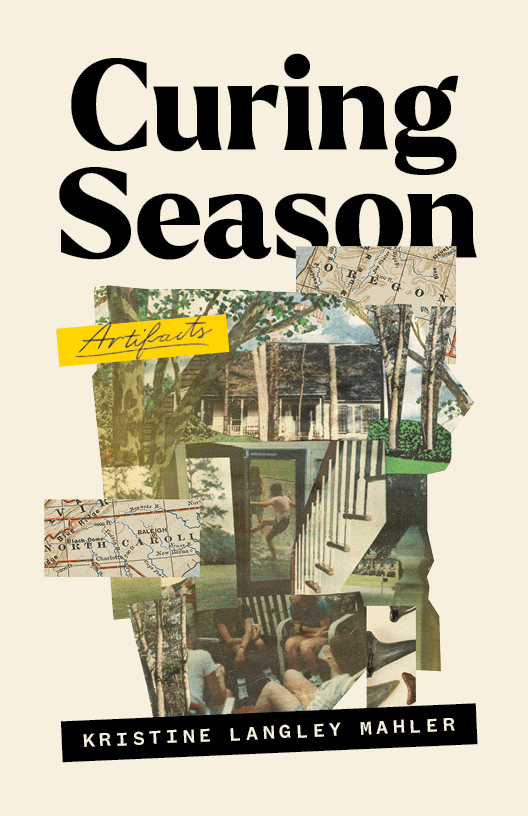
Kristine Langley Mahler’s essay collection, Curing Season: Artifacts offers an exhumation, an exorcism, and a bit of anodyne in response to questions of whether people can recover from toxic, obsessive friendships, and whether those of us who’ve felt out of place can find ourselves at home.
Forced to move with her parents from an idealized Oregon to the foreign country of the Deep South, Kristine’s journey through adolescence is complicated by the difficulty of breaking into an established brood of upper middle class, middle school girls. Worse, on visits back to Oregon, her old friends have changed. Some people don’t remember her, but she remembers her life, past and present, in shining and precise detail.
This skill (or inborn talent) ends up giving her the tools she needs to write these essays: a deep understanding of how details fit together to form meaning, of how artifacts reinforce memory and reality, of how relationships, and the stories we tell ourselves about them, both leave marks.
Praised for its masterful inventions in essay form, Curing Season is often as intriguing in its formatting as it is in its narrative. It’s written in such a diversity of forms, the figuring out of each essay’s pattern is as pleasurable as solving a puzzle. The essay “Creepsake” employs my favorite form of the collection: making up a word, and then writing narrative definitions of the word. So cool and inventive! Here’s an excerpt:
Creepsake
a memento growing along a wall, like a vine
I left things behind, fetishes tied around the fences I wanted to infiltrate. I pushed my copy of The Baby-Sitters Club Super Special #1 under the dust ruffle of Heather’s bed after a sleepover . . . I thought my “misplaced” belongings would be magnets, inexorably pulling relationships back to me . . .
Available from the publisher, WVU Press and the usual suspects.
A sloth hanging out in a tree, probably just being a sloth and not procrastinating at all. Photo by Javier Mazzeo on Unsplash
Sloths get a bad name. They move slowly, it’s true, but they’re animals, for goodness sake. They don’t have deadlines or to-do lists.
I’m big on deadlines and lists when it comes to my writing. Although I don’t always live up to the goals I set down, my production would no doubt be lower without them.
Because writers love to write, just plunking down in front of the notebook or computer and getting a few words written is often enough to set the process in motion. The writer’s brain wants to write, like the runner’s body wants to run.
Setting precise goals has helped me overcome procrastination because they jump-start me. Most people who write do so because they love to write. It’s head-games like insecurity, fear of facing some truth, and impostor syndrome that make us procrastinate when we’re otherwise healthy and able to write.
Setting goals that are in tune with the current stage of writing is key. Stages of writing a memoir can include:
generating,
revising,
seeking feedback, and
submitting for publication.
The ambitious goal of “I’m going to write a memoir” can be overwhelming. It’s far more manageable when broken down into goals for the first stage: generating. Some general goals for that stage might be:
Setting aside time and space to write
Collecting materials like journals, diaries, letters
Enlisting the support of loved ones
Resolving to write for a short time each day.
Some writing coaches believe that writing at the same time every day can condition your brain and spirit to be ready at that time. And if procrastination is a habit, it stands to reason that a new habit can replace it.
Breaking my goals up into smaller goals — what some people call “chunking” has been helpful. For example, instead of swearing to “finish my memoir by X date” (although I do that, too), I’ve set goals about how many words to write in a day.
The words-a-day goal is great when generating new material. But since revision can and often should include cutting material, words-a-day doesn’t work well for the revision stage.
In the revision stage, I’ve turned to a minutes-a-day goal, and for me, that’s been 90 minutes, which is not terribly ambitious. On a few days, I’ve spent less time, but on many days, I’ve spent more than 90 minutes.
[Note: I quit my day a year ago and don’t have childcare or elder care responsibilities.]
I’ve written elsewhere about using a time tracker for accountability and for figuring out when I write best. When procrastination threatens me, though, I’m ready to chase it off with my goals.
Just 500 words now, I tell myself, or Just 30 minutes now. Usually, I end up becoming absorbed and plod past my goal — because I really do love writing.
This memoir excerpt about discovering I was adopted was coincidentally published during November, which is National Adoption Awareness Month. The piece is also about the “secret mission” my adoptive father went on when I was ten years old.
If you’re reading this as an adult, you may already guess that the secret mission was not the heroic event I believed in as a child, but a story fabricated by adults to cover up a shame. Much as some adoptive parents (ncluding my own) kept adoptions secret to cover their shame at infertility or some other perceived inadequacy, the secret mission was a way of explaining a long absence. Hint: it invovled the FBI.
If you’re a writer who aims to be published, take heart from the publication of this essay. It was rejected at least 40 times before finally finding a home at Signal Mountain Review. From the time I first drafted it out in 2010 to this month’s publication, it went through many, many revisions. To some extent, getting published is about being tenacious and walking the fine line between believing in your own work and being willing to consider criticism.
“A little figure toy sitting in front of a window on a rainy day in Indonesia” by Rhendi Rukmana on Unsplash
In fresh grief, writing can bring a sense of calm, and order, and even, for a time, a sense of closure. It can help us navigate different stages of grief: denial, anger, bargaining, depression and acceptance.
In the midst of fresh grief, or in the memory of grief, writing can be a way to move inward, and it can also be a way to come up for air.
Grief informs many memoirs, whether the writer is grieving the loss of a loved one, or the loss of health, or a lost innocence or a lost opportunity. In my current memoir project, the central grief is the loss of my mother, or, more accurately, the loss of the opportunity to meet my mother. We were separated by adoption when I was an infant, and she passed away just a year before I was able to find my family.
This past spring, the goal I set for myself was to finish a first-but-coherent draft of my memoir of reuniting with my birth family. It took an extra month for me to finish that draft, and the rest of the summer to revise it. It’s a bit over 80,000 words, most of which has been published as stand-alone essays.
My biggest challenge in combining these essays has been to locate the narrative arcs between the conflicts and the resolutions. Today, while working on revisions, I began to see the arc of my grief for my mother, which first cut into me when I learned I was adopted, and has never really ended.
Grief has an arc, but like most complex emotions, it often has more than one arc, and sometimes, one arc repeats in a story, over and over again. In writing about my family and how I fit with them, I learned that as each of my five brothers passed away, I relived all the regrets I had about not searching for my mother before she died. Those regrets, which began with my inaction or procrastination, sometimes resolved when I took a positive action. Sometimes they resolved in acceptance. And sometimes, a regret stuck, and didn’t resolve. These are all possible arcs.
But the main arc of my grief is my search for a ghost-woman who held me as a secret and who died young. I’ve found bits of her in the gestures and expressions I share with my siblings, in my own laughter, which they say mirrors hers, in the physical characteristics I see repeated in her grandchildren, and in our family’s legacy of addiction.
Will I ever find enough pieces of her to feel my search is complete? Probably not. I think this searching arc will keep repeating. Whenever I feel that I’ve found her, she slips away. Whenever I accept that we’ll never meet, I find myself denying that I ever missed her.
Maybe grief is an emotion that resists a narrative arc with a beginning, a middle, and an end.









 Michele Sharpe