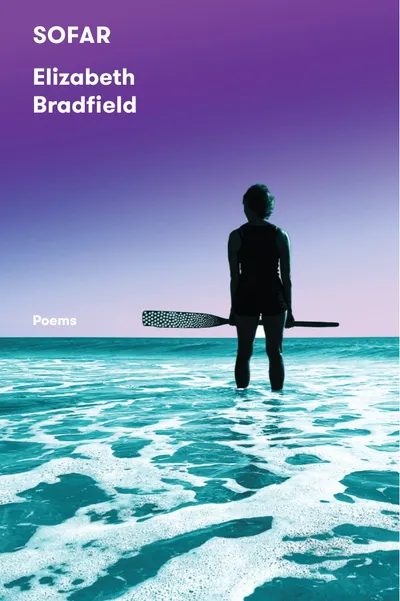
SOFAR is “a thriving catalog of poems spreading good news: Attentiveness to each other and to the “more than human” world offers relief from fascist insistence on bland uniformity.”
I began this year’s Sealy Challenge inspired by poet friend Linda Cue who engages with the challenge every year. Although reading a whole book of poetry in a day is clearly too much for me, the challenge has made me read more poetry than I usually do, and that’s to the good for my mind and heart.
Re-reading is my preference when it comes to poetry.
One book that I read and re-read in August is the newly released collection SOFAR by Elizabeth Bradfield. This expansive collection teems with the panoply of life on Earth, spreading the news that attentiveness to the “more than human” world offers relief from bland fascist notions of uniformity and extraction.
Moments of intense joy come from such attentiveness. But moments of stunning grief come from attentiveness as well, and in some poems, attentiveness brings both joy and grief. “Dispatch from this Summer,” with its hermit crab form is one of these. The crab makes a house for its soft body in a discarded shell; in the form, one narrative holds the other, but the form is not a comparison giving one story ascendancy.
The “house” narrative concerns the invasive gypsy moths’ decimations of trees by “unrelenting mastication” that results in a rain of “a constant heavy frass.” Still, the forest holds beauty
. . . If you can stand to walk a narrow path through the leafless forest, you can arrive at a circle of water that will allow your body to be beautifully held, whoever you are. It’s true, you’ll have to return
by the same path . . .
The body held in this poem’s house is a host of vulnerable bodies, the “Florida dancers,” who were killed in the 2016 mass murder at Orlando’s Pulse nightclub, the dozens more who were injured, and the community who witnessed. The naturalist notes that taking the journey to be “beautifully held” means traveling back through the “apocalyptic trees.” In other words, through a shit storm.
“Dispatch from this Summer,” and this book, and Bradfield’s work as a queer poet and naturalist, all have an urgent significance to me. We live in dangerous times, where gross homophobia is pushing its way onto national, state, and local levels, even into my beloved Florida’s liberal enclaves, like Orlando, where a rainbow crosswalk adjacent to the Pulse Memorial was erased overnight. In Gainesville, my home town, city councilors voted unanimously to obey the state’s order to erase our rainbow crosswalks. Fuck that noise.
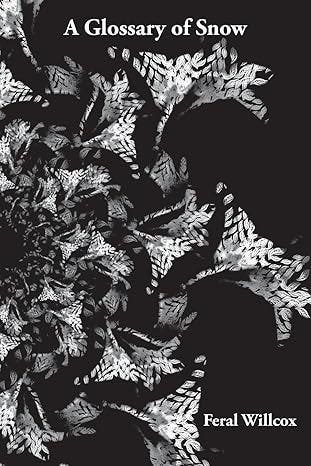
Next up, a book that allowed me to further indulge my re-reading habit: A Glossary of Snowby Feral Wilcox. The collection is a true glossary that defines emergent terms for the diversity of snow.
Feral and I have been friends for twenty years, and so I’ve had the pleasure of reading her imaginative yet sensual work in various incarnations. These poems are some of her most musical, making excellent use of all the sensory strategies she is intimate with as a poet, musician, and visual artist.
Even in the collection’s prose poems, the music is dense and fecund. From the first stanza of “Daughter of Pearl”
daughter of pearl a hard snow born from a harder snow, under the hard shell of a dull grey sky
In an era of hollow dolls lost in warspell, sororities of the pearled-up poor, glamour girls pushed from great depressions into chorus lines, high kicks and cattle calls of drunken flesh swirled in a syrupy cocktail of dresses, pleats and flounces, cleavages, pearlescent romances, crooning juniors of blue-blood seniors, shills of swindlers, big brass boards of hidden hitlers melting their hot silver spoons into shrapnel kisses milked from winter skies uddered with promises, falling, falling as tin cups filled with snow rattle off into the steaming rubble of true love, I’ll be waiting for you, dear, with home appliances and recipes, the basics of home-economics, the rich give a gift to the poor, another war.
Part indulgence, part politics, part fortune-telling, and all art, A Glossary of Snow is another queer book of the present moment.
Thanks for reading So many books, so little time! Subscribe for free to receive new posts and support my work.
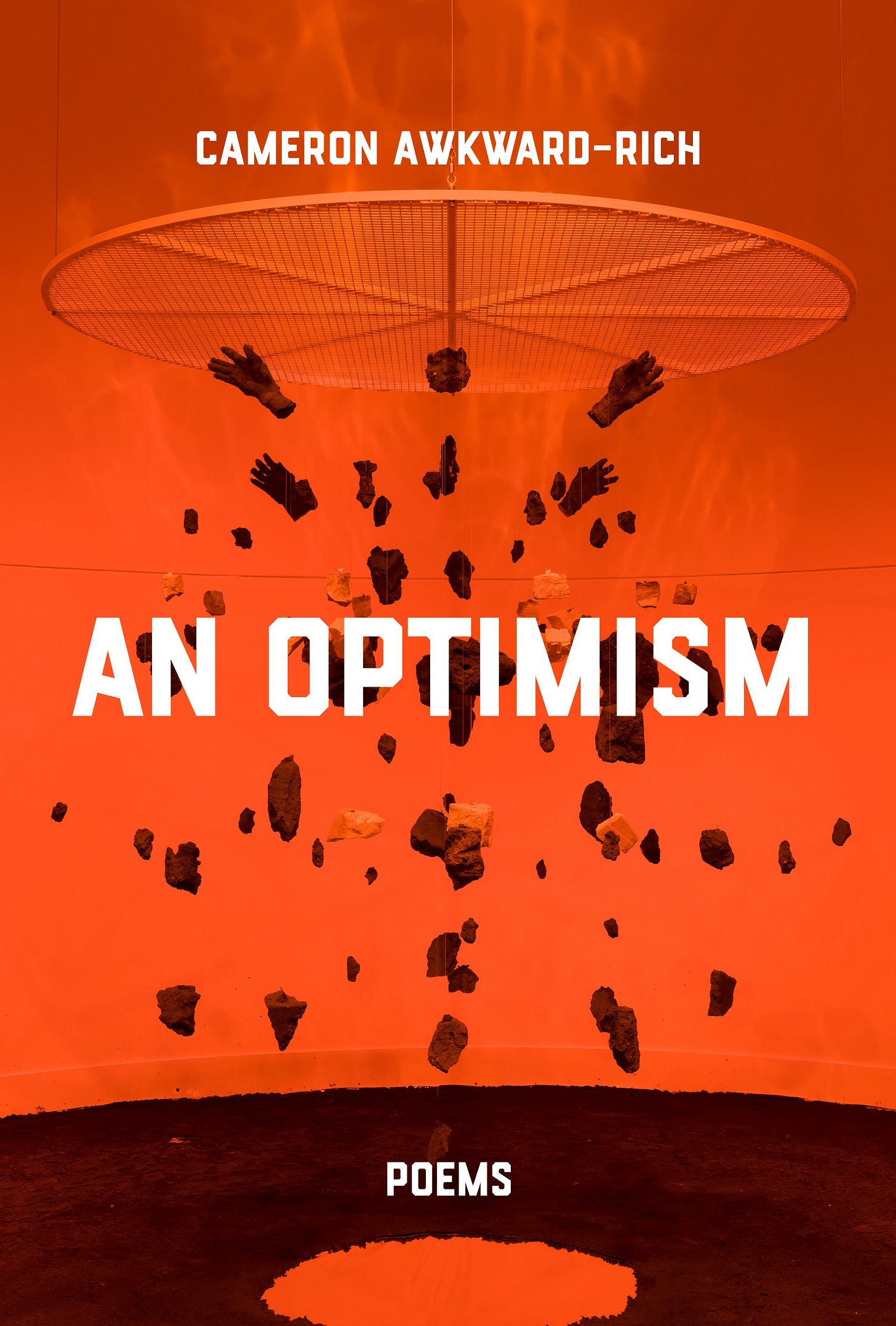
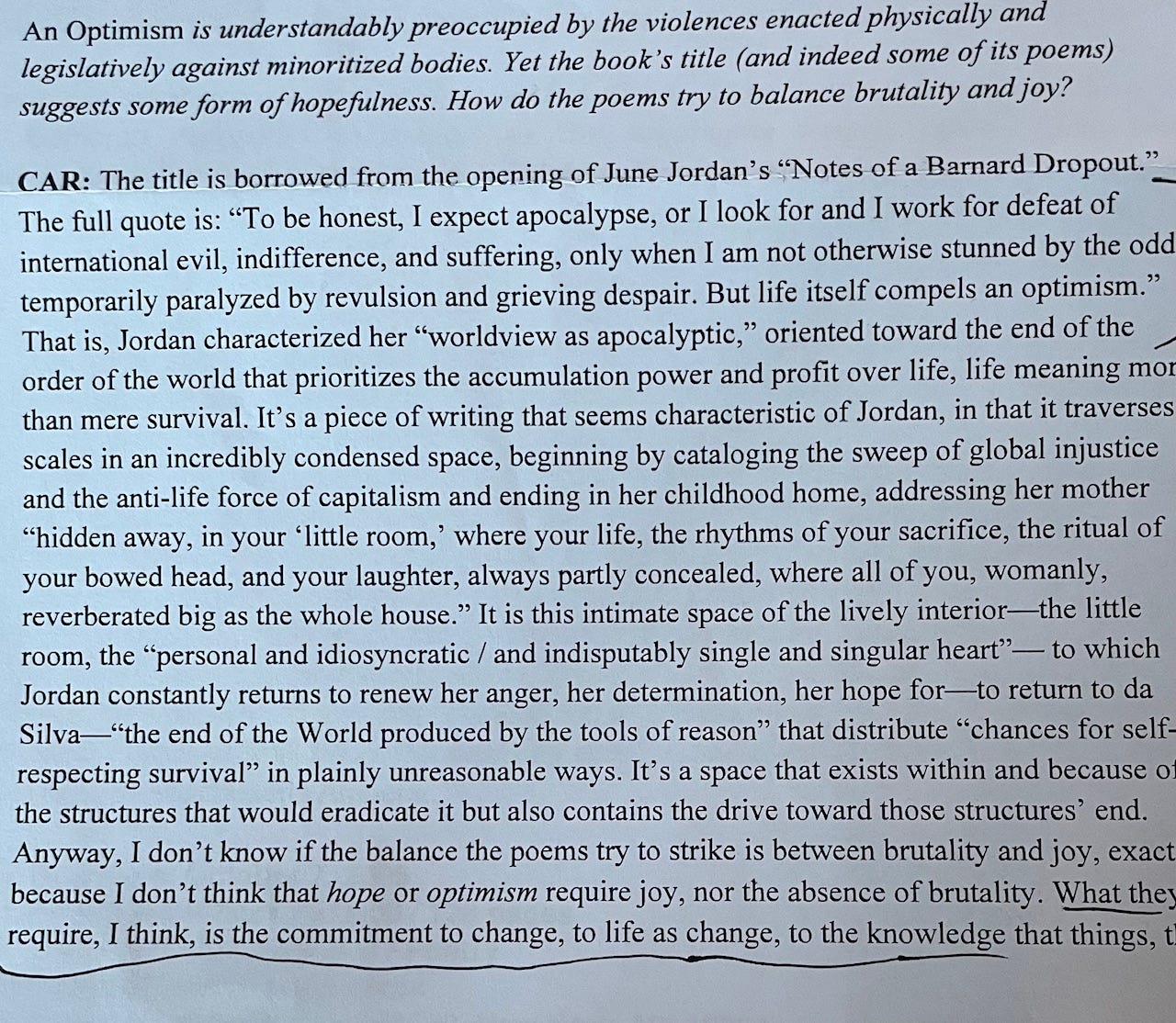
Cameron Awkward-Rich’s book, An Optimism, is thrillingly intellectual while being achingly emotional. Quite a feat. Big thanks to Gabriel Fried over at Persea Books for the ARC (Advance Reading Copy), which included a transcription of an interview with the poet. I read the interview first; in it, Awkward-Rich mines his experience teaching an undergrad class, “Poetry in/as Black Feminist Thought” along with his cultural criticism work for exemplars of his ideas. Here’s a screenshot from that fortunately long interview, where he explains the title of his book as borrowed from a line of June Jordan’s:
The poems enact the idea of cultural criticism, using disparate texts ranging, for example, from the work of Pauli Murray, to Neverland and Peter Pan, to the opening sentence of Charles Dickens’ A Tale of Two Cities as subjects. Often, there’s a young speaker who longs for mirroring: to see someone like himself.
One surprising-to-me trope is the character of Odo from Star Trek: Deep Space Nine, who is “trapped between forms.” In his natural state, he’s a gelatinous mass, but he is a shape-shifter who assumes the appearance of anyone and anything. Change is Odo’s baseline. Even I, a cis woman, can see parallels here to trans experiences in a transphobic world.
From one of several poems titled “It Was the Best of Times, It Was the Worst of Times”:
I didn’t know yet that it was possible, to be, like that, unmade
Every day is a good day to celebrate and envision equality for all, like my little dog Pilot here. In 2023, our Pride celebrations and activism have urgent significance, so this week I’ve chosen three books that celebrate queer survival and joy.
Didn’t Nobody Give a Shit about Carlotta by James Hannaham is set in and out of an upstate prison and Brooklyn in the 1980’s. The book opens as Carlotta, a trans woman, is about to go for a parole hearing after serving most of a 25-year sentence in a men’s prison. Parole is granted and she heads home on a bus. Arriving at the house where she grew up, she walks into an exuberant party with all the food, music, drinks, and dancing anyone could want. But the party isn’t for her homecoming — it’s for a dead man. Carlotta dismisses this mistake, at least on the surface, just as she dismisses any mention of her dead name as she grabs all the life she can on her first day out.
In a brilliant move, Hannaham ditches conventional punctuation and dialogue tags and blends first person and third person narration, allowing Carlotta’s thoughts and perspective to mesh with the voice of a cagey omniscient narrator.
The story and setting brought me back to my time as a public defender who was so often astonished by my clients’ reckless enthusiasm for life, even when life had shat upon them relentlessly. Carlotta is unforgettable.
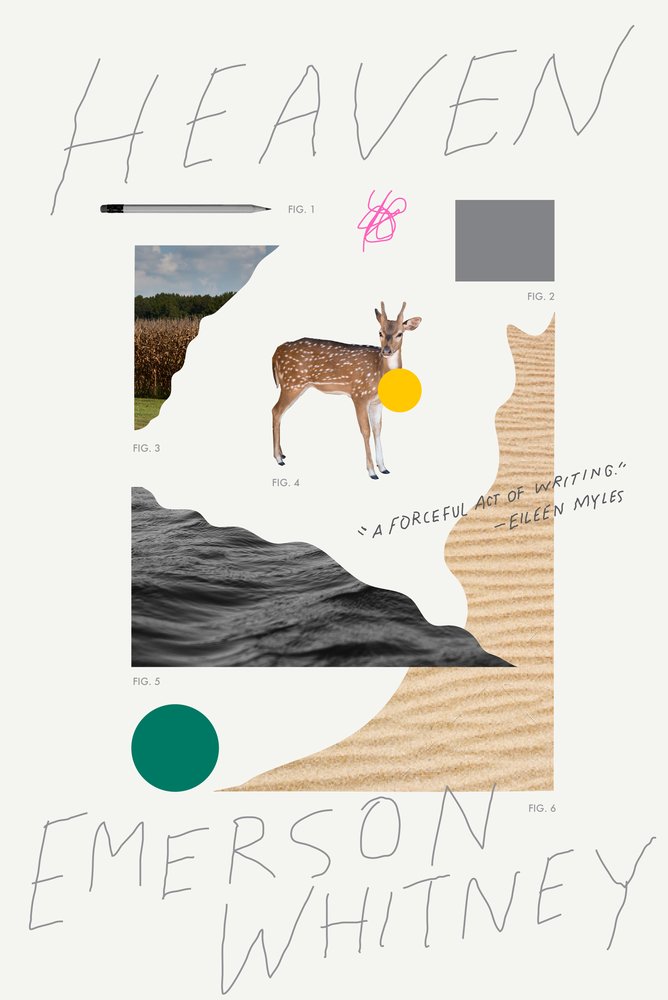
I came to this book because I needed more of Emerson Whitney’s writing after reading an advance review copy of their soon-to-be-published memoir, Daddy Boy, which becomes available June 27, 2023. Both books are from the McSweeney’s imprint, and both are literary excursions that draw on queer theory, art theory, and personal experience.
Heaven diagrams Whitney’s complex relationships with their family’s women. The book opens with Whitney re-remembering a story she’d been told about one of their mother’s near-death experiences of getting sober. The two, mother and child, are estranged, but Whitney isn’t here to judge. On the contrary: “Everything I fear in her lives hot inside of me.” Just look at how “hot,” one little word in a little sentence, opens up meaning. This is a short book, but one where you’ll probably highlight or copy down a zillion phrases or sentences. The writing is that good.
When the beloved grandmother asks “do you think you’re like this because your mother loved your brothers more?” Whitney notes that “No one asks about the root causes of heterosexuality or cisgenderism.” This questioning of underlying assumptions is the sort of thing I live for, along with relentless logic. The book is rich in both.
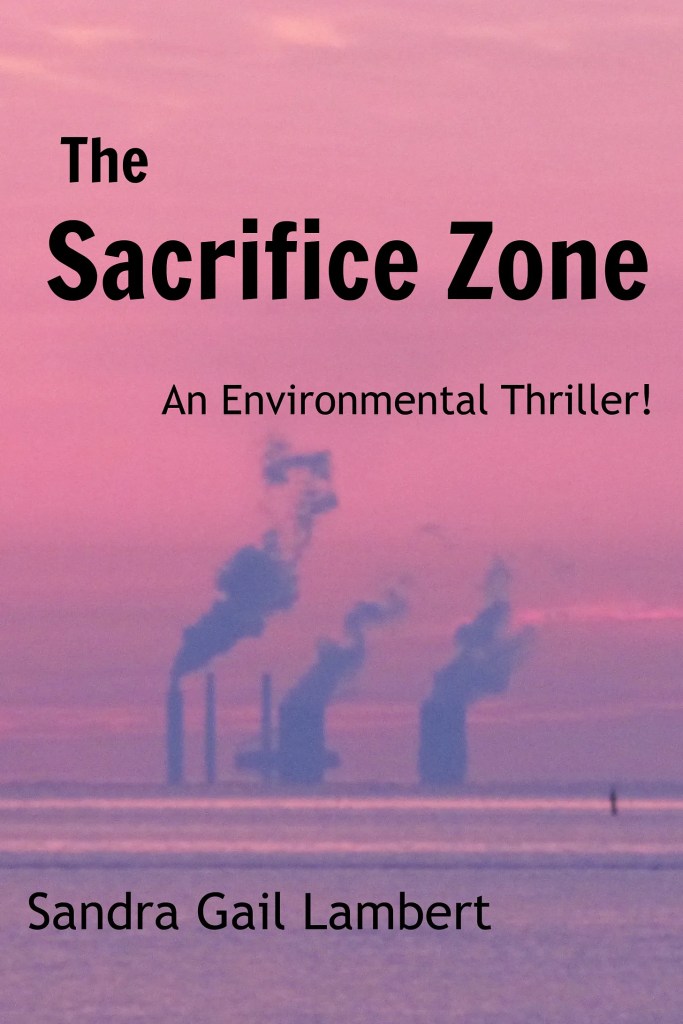
Saving the best for last — and fessing up, up front, that author Sandra Lambert is my friend — is The Sacrifice Zone, a cli-fi, sci-fi environmental thriller with wholly unique elements, like one family’s sticky bond with the land they live on between the Gulf of Mexico and a nuclear power plant. Some think it’s a jealous, malevolent bond, one that makes it impossible for the family to leave.
A worldwide environmental disaster unfolds as Vic, the main character, is interning at a newsroom. She’s one of the few members of her family who can tolerate being away from home for long, and she’s different from them in other ways, too. A polio survivor, she uses braces and crutches to propel her through the world, and she’s a visibly butch lesbian.
At her newsroom, she hears and feels a siren going off hundreds of miles away. There’s been an explosion at the nuclear plant near her home, where a new device, “World’s Ease,” was being tested. This new technology, touted as civilization’s great energy solution, turns out to be a weapon. Vic leans into the horror that will change her family, her homeland, and the world, as she and her cameraman inch closer and closer to the truth.
Avalailable as an e-book, or the serialized version on Substack. Oh, and I have three FREE (no credit card required) one-month subscriptions to Lambert’s Substack to give out, which means you can read AND listen to The Sacrifice Zone in addition to her other witty and insightful essays about writing, queerness, disability, publishing, and aging. Send me an email if you want one of those free subscriptions: michelejsharpe (at) gmail


 Michele Sharpe