SOFAR is “a thriving catalog of poems spreading good news: Attentiveness to each other and to the “more than human” world offers relief from fascist insistence on bland uniformity.”
My dear friend Sandra Lambert planned a birthday party for her wife, Pam, and the date arrived shortly after the 2025 Lammy Awards were announced. At the party, I was still thrilling from the news that Sandra’s essay collection WON A FUCKING LAMMY. The party felt like an episode of the Twilight Zone because no one was talking about her big win. Early on, when only a few guests had arrived, my self-control evaporated and I jumped up and down, yelling SANDRA WON A FUCKING LAMMY!
During the rest of my time at the party, I talked about what other people were talking about: the lack of rain, camping, Lucy, the cute middle-aged chihuahua that Sandra and Pam were fostering-to-adopt, and Andrew Fabian, Pomeranian, who is in this photo and is my current super-senior foster dog. He’s also called “Benzo” for his calming effect on humans. He nicely snuggled on my lap part of the time.
Chronic illness and advancing introversion makes parties uncomfortable for me. By the time celebrations were in full swing, it was time for home, sweet home.
But still, no one was talking about Sandra’s Lammy Award. I opened the door to leave quietly, but then shouted “Let me say one thing before I leave: SANDRA WON A FUCKING LAMMY!” Shutting the door, I saw glasses raised and heard universal cheers for Sandra. Finally. Sheesh.
One description that’s been applied to me all my life, in theory as a compliment, is “You’re so laid back.” It’s never set that well with me. Laid back in the grave? Laid back like a pillow princess? Maybe chronic illness has made me appear flat. Inside, I’m a roiling stew of eccentric thoughts, bizarre ideas, and chunks of beloved books.
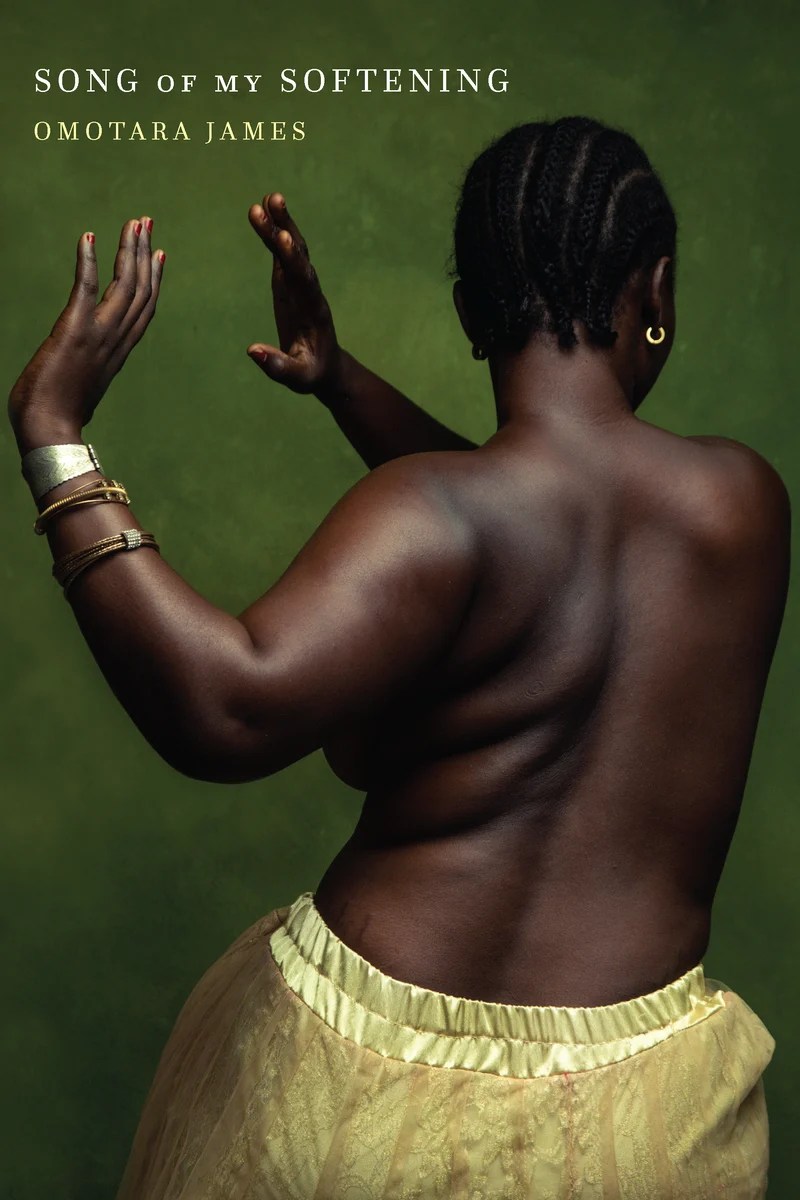
Please celebrate with me! Sandra’s book, My Withered Legs and Other Essayswon first place in lesbian memoir/biography, and Omotara James’ poetry collection, Song of My Softening, won first place in lesbian poetry. I know Omotara from social media and have followed her work for a few years. If I’d been at her wife’s birthday party and no one was talking about her Lammy, I’d have been the same mouthy bitch.
I began this year’s Sealy Challenge inspired by poet friend Linda Cue who engages with the challenge every year. Although reading a whole book of poetry in a day is clearly too much for me, the challenge has made me read more poetry than I usually do, and that’s to the good for my mind and heart.
Re-reading is my preference when it comes to poetry.
One book that I read and re-read in August is the newly released collection SOFAR by Elizabeth Bradfield. This expansive collection teems with the panoply of life on Earth, spreading the news that attentiveness to the “more than human” world offers relief from bland fascist notions of uniformity and extraction.
Moments of intense joy come from such attentiveness. But moments of stunning grief come from attentiveness as well, and in some poems, attentiveness brings both joy and grief. “Dispatch from this Summer,” with its hermit crab form is one of these. The crab makes a house for its soft body in a discarded shell; in the form, one narrative holds the other, but the form is not a comparison giving one story ascendancy.
The “house” narrative concerns the invasive gypsy moths’ decimations of trees by “unrelenting mastication” that results in a rain of “a constant heavy frass.” Still, the forest holds beauty
. . . If you can stand to walk a narrow path through the leafless forest, you can arrive at a circle of water that will allow your body to be beautifully held, whoever you are. It’s true, you’ll have to return
by the same path . . .
The body held in this poem’s house is a host of vulnerable bodies, the “Florida dancers,” who were killed in the 2016 mass murder at Orlando’s Pulse nightclub, the dozens more who were injured, and the community who witnessed. The naturalist notes that taking the journey to be “beautifully held” means traveling back through the “apocalyptic trees.” In other words, through a shit storm.
“Dispatch from this Summer,” and this book, and Bradfield’s work as a queer poet and naturalist, all have an urgent significance to me. We live in dangerous times, where gross homophobia is pushing its way onto national, state, and local levels, even into my beloved Florida’s liberal enclaves, like Orlando, where a rainbow crosswalk adjacent to the Pulse Memorial was erased overnight. In Gainesville, my home town, city councilors voted unanimously to obey the state’s order to erase our rainbow crosswalks. Fuck that noise.
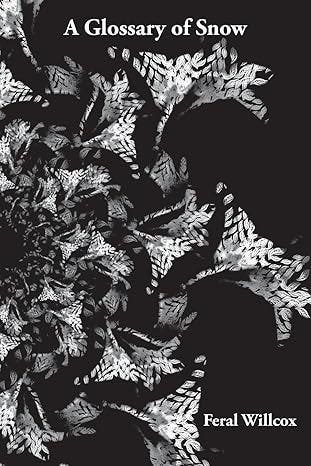
Next up, a book that allowed me to further indulge my re-reading habit: A Glossary of Snowby Feral Wilcox. The collection is a true glossary that defines emergent terms for the diversity of snow.
Feral and I have been friends for twenty years, and so I’ve had the pleasure of reading her imaginative yet sensual work in various incarnations. These poems are some of her most musical, making excellent use of all the sensory strategies she is intimate with as a poet, musician, and visual artist.
Even in the collection’s prose poems, the music is dense and fecund. From the first stanza of “Daughter of Pearl”
daughter of pearl a hard snow born from a harder snow, under the hard shell of a dull grey sky
In an era of hollow dolls lost in warspell, sororities of the pearled-up poor, glamour girls pushed from great depressions into chorus lines, high kicks and cattle calls of drunken flesh swirled in a syrupy cocktail of dresses, pleats and flounces, cleavages, pearlescent romances, crooning juniors of blue-blood seniors, shills of swindlers, big brass boards of hidden hitlers melting their hot silver spoons into shrapnel kisses milked from winter skies uddered with promises, falling, falling as tin cups filled with snow rattle off into the steaming rubble of true love, I’ll be waiting for you, dear, with home appliances and recipes, the basics of home-economics, the rich give a gift to the poor, another war.
Part indulgence, part politics, part fortune-telling, and all art, A Glossary of Snow is another queer book of the present moment.
Thanks for reading So many books, so little time! Subscribe for free to receive new posts and support my work.
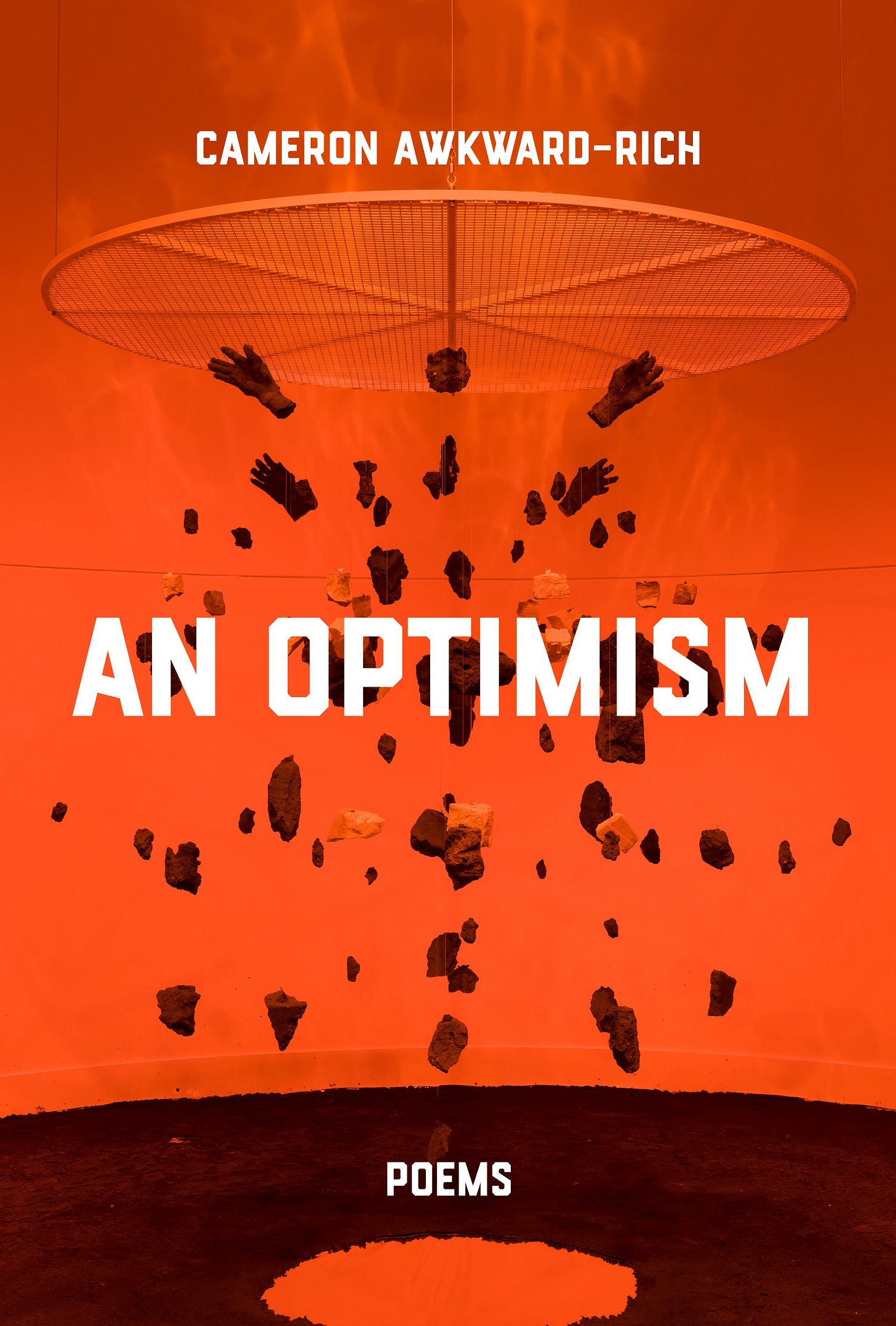
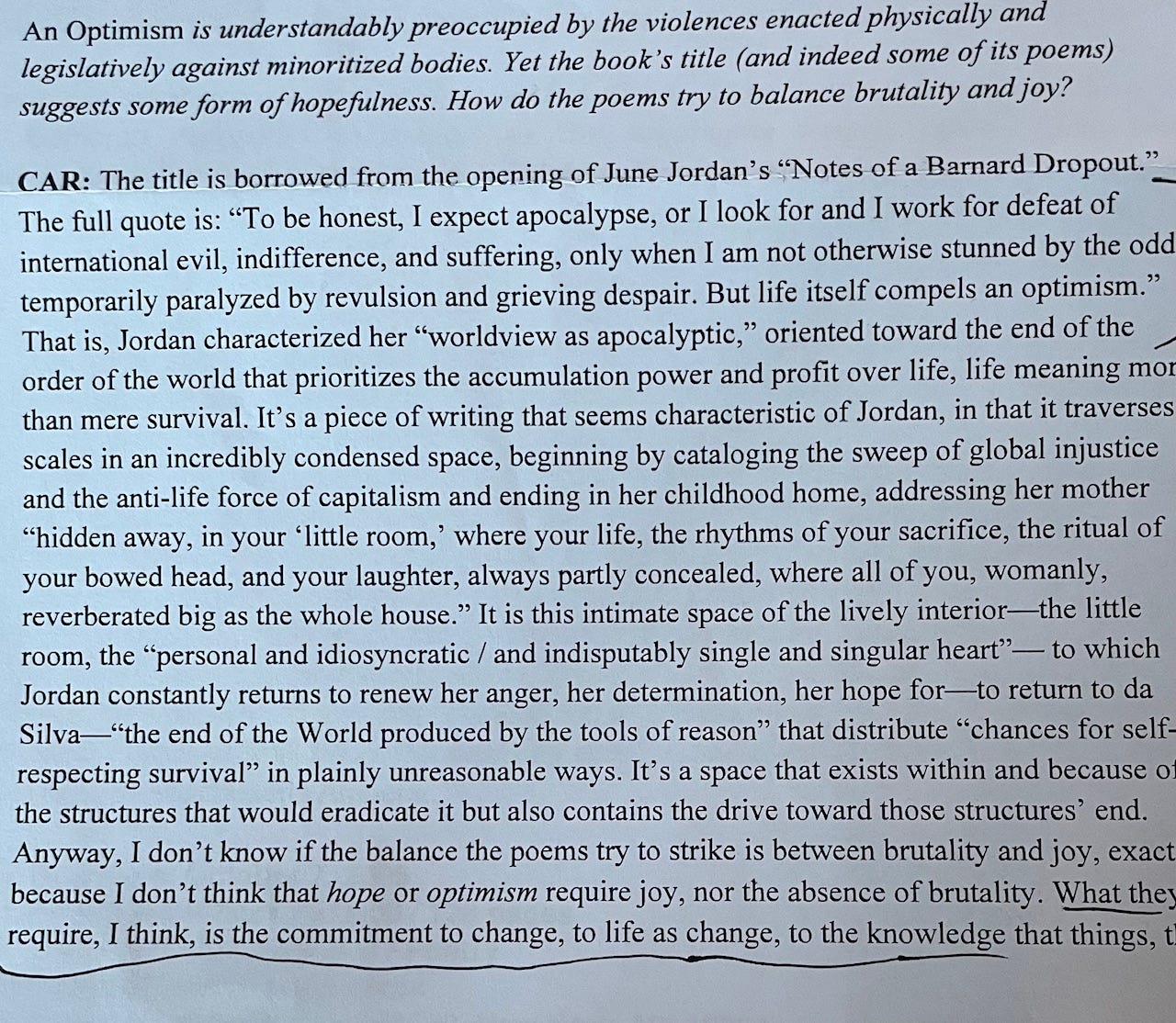
Cameron Awkward-Rich’s book, An Optimism, is thrillingly intellectual while being achingly emotional. Quite a feat. Big thanks to Gabriel Fried over at Persea Books for the ARC (Advance Reading Copy), which included a transcription of an interview with the poet. I read the interview first; in it, Awkward-Rich mines his experience teaching an undergrad class, “Poetry in/as Black Feminist Thought” along with his cultural criticism work for exemplars of his ideas. Here’s a screenshot from that fortunately long interview, where he explains the title of his book as borrowed from a line of June Jordan’s:
The poems enact the idea of cultural criticism, using disparate texts ranging, for example, from the work of Pauli Murray, to Neverland and Peter Pan, to the opening sentence of Charles Dickens’ A Tale of Two Cities as subjects. Often, there’s a young speaker who longs for mirroring: to see someone like himself.
One surprising-to-me trope is the character of Odo from Star Trek: Deep Space Nine, who is “trapped between forms.” In his natural state, he’s a gelatinous mass, but he is a shape-shifter who assumes the appearance of anyone and anything. Change is Odo’s baseline. Even I, a cis woman, can see parallels here to trans experiences in a transphobic world.
From one of several poems titled “It Was the Best of Times, It Was the Worst of Times”:
I didn’t know yet that it was possible, to be, like that, unmade
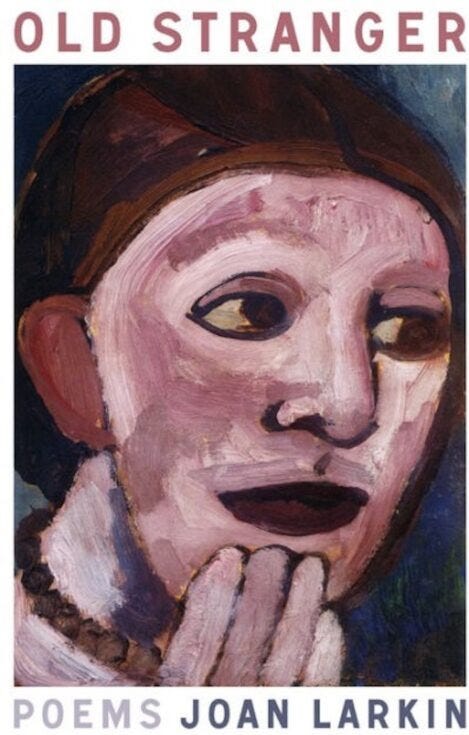
Does the the brevity of lyric poetry appeal to Millennial and Gen Z readers? The turns from narrative to lyric modes in Joan Larkin’s new poetry collection Old Stranger may be attractive to them then, but the poems will also resonate with readers who’ve attained longevity. An octogenarian, Larkin has been celebrated for blending lyric and narrative elements in her work and for nudging her poems toward resolution and epiphany. Her reliance on the lyric mode in Old Stranger intensifies as the collection progresses, while not entirely abandoning narrative. The superseding of narrative by lyric elements tends to form its own arc in a story about aging through perceptions of time and the past.
Larkin was born in Boston, a few months before the 1939 invasion of Poland that set off World War II. Eighteen years older than I, she is a writer I’ve respected as an elder who is always a generation ahead of me in experience, and in the wisdom that may come from it. I’ve followed her work for decades, beginning in the 1970’s at New Words Bookstore in Cambridge, Massachusetts, where I began seeking out queer and feminist literature as a teen. Now, almost 50 years later, Larkin’s poetry continues to create beauty and delight while offering wisdom as I enter my elderhood.
It’s uncommon for poets to have 50-year publishing careers, even now that life expectancy has grown over the past century. If a poet’s early work establishes their personal mythology, as Larkin’s did, what happens to that mythology over a lifetime? Does it grow stale, or get reassessed, or reinforced, or even abandoned? In Old Stranger, the subjects of Larkin’s foundational narratives – rape, abortion, miscarriage, coming out as lesbian, getting sober – are often reshaped through the lens of lyric, which emphasizes the distillation of seemingly truthful perceptions rather than the arc toward them. This turn to the lyric is a Swedish death cleaning of sorts that sweeps events to the side and prioritizes images of insight and emotional truth.
Of course, neither lyric nor narrative modes exist in separate bubbles. There’s a term in poetic discourse for combining them: the lyric-narrative poem. During the first months of an MFA program in the 1990’s, where I was struck by how much I did not know about poetry, “lyric-narrative poetry” especially confused me. Any initial recognition of ignorance may often play a part of the narrative arc of achieving wisdom, but I did not achieve any lasting wisdom on this point. Thirty years later, Old Stranger has revived my old confusion, especially in its poems treating narrative time as both rigid and flexible. Now, though, I can at least see the assumptions that stand in my way: that the lyric exists outside of time, but that narrative relies on time to be understood, and time relies on narrative to be parsed.
A disregard of narrative time first appears in the book’s fourth poem, “The Body Inside My Body,” where a second body, belonging to the speaker, asserts its power. This body wants “the breath it lost trying to escape / that afternoon in Hell’s Kitchen.” With short, declarative sentences establishing her authority, Larkin convinces me this alter-body can get that breath back. The poem offers hope to anyone with traumatic memories who, like the second body, “[h]as had it up to here with the scalding” and “wants the whole carcass unburied.” But the uncovering and implied dissection of the carcass of the past is just the beginning. The carcass’ obliteration is what this alter-body is after, as it wakes in a gothic setting that “any body wants,” where vultures “hiss in the low branches,” ready to do what vultures do. Who wouldn’t want painful events and their sequelae picked apart, swallowed, and annihilated by a vulture’s acid-bath gut?
First up, warm praise for a reading method new to me in 2024: slow reading.
Like the slow food movement, slow reading encourages the practice of attentiveness to the moment. I may have achieved dog-consciousness as a slow reader.
As a happy 2024 follower of the Footnotes and Tangents slow read of War and Peace, one chapter a day of this humane novel brought me all the pleasures of a well-plotted story, plus unexpected insights into human nature and history. The book has gobs of contemporary political and emotional relevance, and the international reading community’s commentary and extra info provided by leader Simon Haisell is a treat. For a busy person who wants to maintain a daily reading practice, consider a subscription to one of the many slow read offerings out there on the benevolent side of the internet. I wholly recommend Simon’s several 2025 offerings as he is well-informed about the books he chooses, he has an international following of readers who encourage friendly, diverse discussion of the books, and he is an excellent, reliable manager. I’m participating in the Wolf Hall Trilogy slow read this year.
Here’s some thoughts on the best books I read in the summer of 2024, and the kinds of readers who might appreciate those books.
The most unusual book of the summer for me was How Far the Light Reaches: A Life in Ten Sea Creaturesby queer science journalist Sabrina Imbler, who juxtaposes their own growing up story with the stories of unusual marine organisms. The result is a series of stunning extended metaphors that undulate between the wonders of underwater life and the wonders of human consciousness. An excellent selection for readers who enjoy nature writing, magical metaphors, and the macro-micro entanglement of the big world and the individual psyche.
Double trouble: I read one book — Find Me— by Floridian Laura van den Berg and immediately requested another — State of Paradise — from my library. Both are quirky stories with low-key incorporation of supranatural events. Both books have an original voice, an original premise, and a full-throttle plot, and are great choices for those who love Florida in all its other-worldly diversity.
I’d never heard the name “Miranda July” before picking up All Fours, so the book must have been endorsed by a credible-to-me person somewhere on the benevolent internet. The narrator is perimenopausal, which was its own special delight. The book probably struck me as particularly imaginative because I knew nothing about the author while reading it. The plot is compelling, and the sex scenes are detailed, diverse, and hot, hot, hot. Read this book if you love sex.
Liars by Sarah Manguso was recommended by Lyz Lenz in her crucial yet hilarious stack, Men Yell at Me.I know I stayed up past my bedtime reading Liars because it had a propulsive plot, but I can’t remember a fucking thing about it beyond that. Probably says more about me than about the book. A good choice for those interested in the state of American cis/het marriage and books meant to be read at an astonishing speed.
In her memoir Wishing for Snow, Minrose Gwin writes of growing up with and rediscovering her schizophrenic poet mother, Erin Taylor. Closely observed on internal and external levels, the book is strikingly honest, and it incorporates many of Erin Taylor’s poems. Gwin is new to me, and I’m planning to read more of her graceful work. Read this memoir for the beauty of its language and to know more about mother/daughter relationships, schizophrenia, and poetry.
Consent by Jill Ciment reviews and revises her first memoir, Half a Life. Why? Because the first one didn’t sufficiently interrogate her relationship with and marriage to artist Arnold Mesches. The couple met when Mesches was a 40-something married man with kids and Ciment was his 17-year old art student in a situation that would be described today as sketchy in terms of the power dynamics. Ciment is such an authorial powerhouse in both memoirs, though, that the question of consent is nuanced and perhaps unanswerable. A book for anyone who enjoys or needs the skill of accepting opposing versions of reality.
Jane Satterfield’s phenomenal poetry collection, The Badass Brontës, is a must read (IMHO) for all Brontëphiles. Satterfield writes of her own encounters with Brontë texts, as well as how she imagines interactions among and between sisters Charlotte, Emily, and Anne, both in the past and in a time-optional afterlife. The surprising rhythms of the poems demand attentiveness, like curveballs and reversals in any context do. Perfect for poetry lovers and anyone fascinated by the Brontës.
Jesmyn Ward’s most daring book so far, Let Us Descend, is a book that makes me wish for a long enough life to read everything she will write in the future. It’s daring in the steps it takes into the spirit world, in its visceral detail of the suffering of enslaved people, and in the cascades of inter-related images it uses like a net of jewels to gather the best parts of being human. I read it first in February of 2024 and again over the summer. Everyone should read this book for its power, beauty, and humanity, and, given our in our current world situation, for its combination of cleansing rage and miraculous compassion.
If you like to buck trends, consider reading a memoir, since the powers-that-be never tire of telling us that memoirs are hard to sell. This year, I interviewed two authors with memoirs that came out in 2024, and I recommend both.
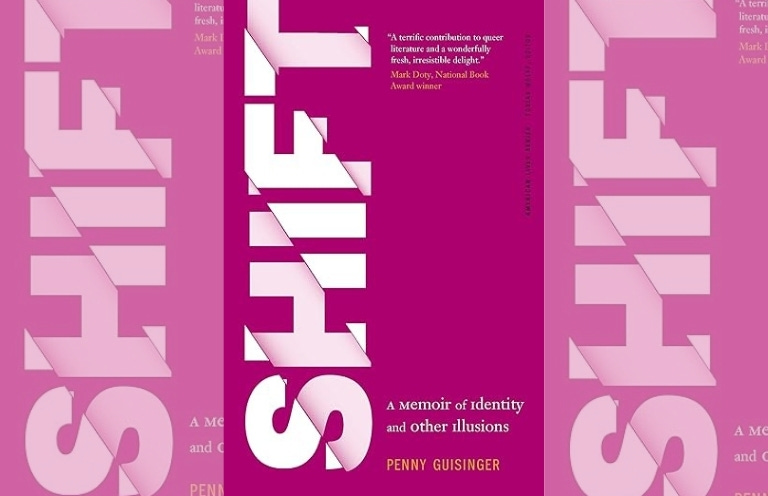
Penny Guisinger’s SHIFT: A Memoir of Identity and Other Illusions explores the power of change in the physical, emotional, and political shifts that occur within (and outside of) the memoir. Gusinger fell in love with a woman in her Downeast Maine community, ended her heterosexual marriage, and continued to parent her two children, who were quite young, and to work in a high stress job. The shifts required to make all this happen are set against the tumultuous context of Maine’s on-again-off-again Marriage Rights saga from 2011 — 2013. It’s also filled with that subtle Maine humor:
“I had a beer bottle wedged into a mesh cup holder hanging below the arm of my chair. I got right to work peeling the label from the exposed section of glass. I stayed on task throughout the conversation.”
Who hasn’t peeled a label off a sweating bottle during a hot, high stakes moment? This understated humor is one of the many elements in SHIFT that captured my heart. The book is also an intellectual treat, examining non-linear time in the context of personal and political “shifts,” including coming out as lesbian.
The book’s haunting relevance to the past decade’s Twilight Zone attacks on individual rights across the United States makes it a must read for understanding the current American political moment. Penny and her wife Kara lived through the approval and subsequent repeal of marriage rights on the state level in Maine. Their courage in managing their personal, family, and professional lives in the shadows cast by the bullshit repeal is just the sort of stubbornness so many of us need now.
SHIFT is a rare confluence of passion, humor, politics, and personal insight. Highly recommend. For more about the book, check out my interview with Penny in CRAFT.
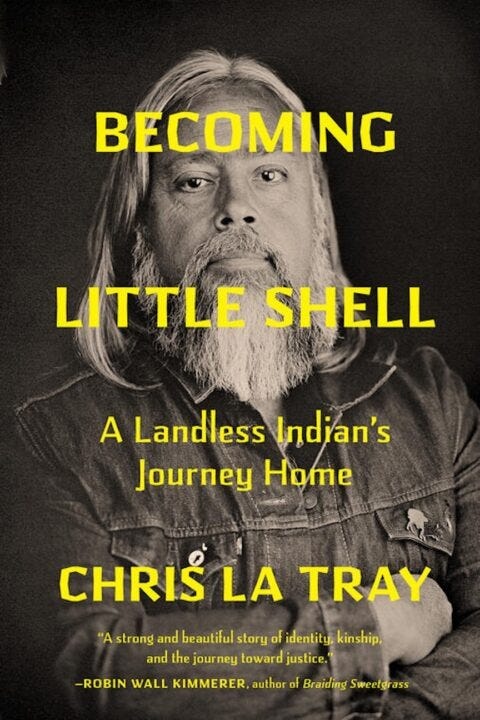
In Chris La Tray’s memoir Becoming Little Shell: A Landless Indian’s Journey Home, the recovery of the Chippewa identity his father hid happens as the Little Shell Tribe of Chippewa Indians endures the long process of achieving Federal restoration. The search for a hidden personal past is juxtaposed with political demands for restoration of a historical past. The memoir’s scale is vast, and readers will come away with insights into Chris’s struggles and the struggles of his tribe, and others, against the colonial violence and machinery of the United States. For more about this remarkable memoir, check out my essay/review for On the Seawall.
There’s much to learn from this book about the many paths resistance may take, about respect for others’ choices, and about the recursive nature of oppression. Plus, the book is a beautiful love poem (Chris is currently the Poet Laureate of Montana) to the High Plains region.
The world, and especially the U.S., needs more #adopteevoices.
The U.S. adoption industry operates now and historically as a money machine rife with corruption, misogyny, oppression, racism, and exploitation. All of these institutional characteristics work to silence adoptees. So when a book by an adoptee gets released, I celebrate!
Cover of Cleave
Cleave is a poetry collection of magnitude and fascination. I started reading it one evening after dinner and stayed up late with it, still reading. As one critic notes, “With breathtaking lyric beauty and formidable formal range, Nobile details the intimate effects of the international adoption industrial complex on children and parents caught up in a system’s unrelenting hunger. This is a book of remarkable compassion and real horror. Its stories will be news to many and all too familiar to others.”
I’m a domestic adoptee, and Tiana Nobile identifies as a Korean American adoptee, so there are important distinctions in our two experiences of adoption, but her stories are “all too familiar” to me.” Most, perhaps all, people who are adopted by strangers experience feelings of loss, alienation, of not fitting in.
Adoption doesn’t exist in a vacuum. The adoptee experience of loss and alienation can be exacerbated in transnational and transracial adoptions in a country like the U.S., where racism and anti-immigrant hate poison communities, families, and individuals. Tiana Nobile’s poems place a personal experience of adoption in that wider community and in a historical continuum. This is a critical book for critical times.
It’s also an aesthetically rich book, full of sensory delight in language and provocative use of many traditional elements of poetry like internal rhyme, organic form, alliteration, and startling imagery.
The poems in Cleave make expert use of a wide variety of intriguing formats. For example, in “Where Are You Really From?” Nobile employs a prose poem format that’s a list of place names in the U.S. that create a mystery narrative — one that illuminates the the empty past of people separated from family, culture, language, and history. A series of poems titled “Abstract” begin with white space, illustrating the absence of knowledge. The famous “monkey love” science experiments that separated newborn monkeys from their mothers is a recurring source of images.
Many of the poems mine science (or pseudo-science) for information on the mother-infant bond and details about fetal and infant development, a technique shared by the writer of the second book discussed here. Nobile’s poem, “Lost First Languages Leave Permanent Mark on The Brain, New Study Reveals,” uses this headline format to to introduce a meditation on what is lost:
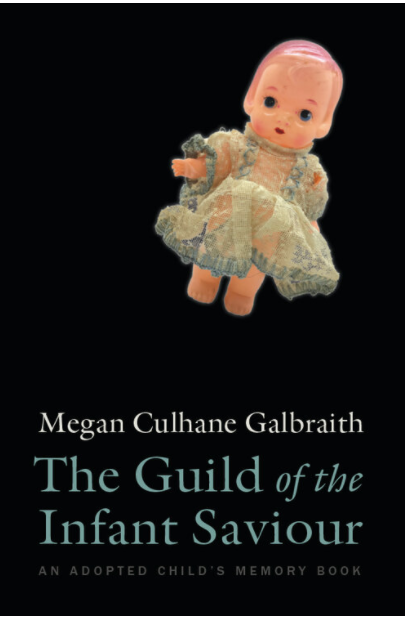
Megan Culhane Galbraith‘s genre-bending book, The Guild of the Infant Savior also kept me reading late into the night. I finished this 300 page collection of essays and visual art in two sittings. Galbraith’s artwork consists mainly of compositions of dollhouses and dolls from the 1960’s, the era in which she was born and then adopted. The visuals work in conversation with the text, but also with the history of women and motherhood.
The text often relies on poetic devices like juxtaposition and repetition to create meaning without overt explanation. But there are also plenty of insightful and direct observations about the adopted state, like these:
“As an adopted child, I’d felt like a thing to be played with instead of a person with her own identity.”
“Many pro-life groups use the term proadoption, but I am not their poster child.”
“I continually try on identities and feel like an actor in my own personal theater productions of The Good Child or Don’t Ever Leave Me Again or See, I Am Worthy of [insert here: Love, Kindness, Joy, Pleasure].”
Like Tiana Nobile, Galbraith explores historical and scientific beliefs about maternal separation. Her installations of period doll houses and dolls (photographed for inclusion in the book) re-create a “mothercraft” degree program at Cornell University in the 1960’s that used infants from orphanages as “practice babies” for students. Like the creators of the “monkey love” experiments, the architects of the Domecon program demonstrated a callous disregard for the emotional states of their subjects, in this case human babies who were put under the care of a rotating series of undergraduates. These babies were seen as in need of middle class remediation, and were later adopted anonymously. Galbraith herself was not a “Domecon baby,” but she spent her first five months in foster care wearing a mechanical brace to correct a medical condition before being adopted anonymously. The parallels are apparent.
The Guild of the Infant Savior publishes May 21, 2021. Pre-order the book here
Many thanks to the publisher, Mad Creek Books, for providing an advance review copy.
In my plantophile investigations, I became mildly obsessed with plants from the mint family. Most are what gardeners call “deer resistant,” meaning they don’t appeal to ravaging herds of deer who can mow down your garden in the blink of an eyeball. Doing research for the poem, I discovered that in botany, bisexual flowers are referred to as “perfect.” How nice!
The poem’s title is “The Mint Family,” but the editors chose another line as their graphic headline. Published December 28, 2020.
THE MINT FAMILY
Upright, with bisexual (or perfect) flowers, open
for business to bees. Aromatherapeutic against
memory’s dead hand. Other uses: teas, salads, salves
for stings. A shield for other greens against rapacious deer.
A shared geometry: stems near-perfect squares
in cross-section. Called Lamiaceae now, meaning deadnettle,
meaning not-a-nettle. Or possibly to nettle without sting,
like jolts of memory that don’t make one shrink.
Their long-dead name was Labiatae, as in labial.
Lipped, moist, impressionable. Easily stung,
yet they overrun gardens in bee balms, spearmints,
and sages. Re-member: no family’s perfect.
Some harp on the dead’s mistakes instead
of their memories, but The Mints come close
to perfect, modeling refreshment and courage,
their flowers unafraid of stings, open to all the bees.
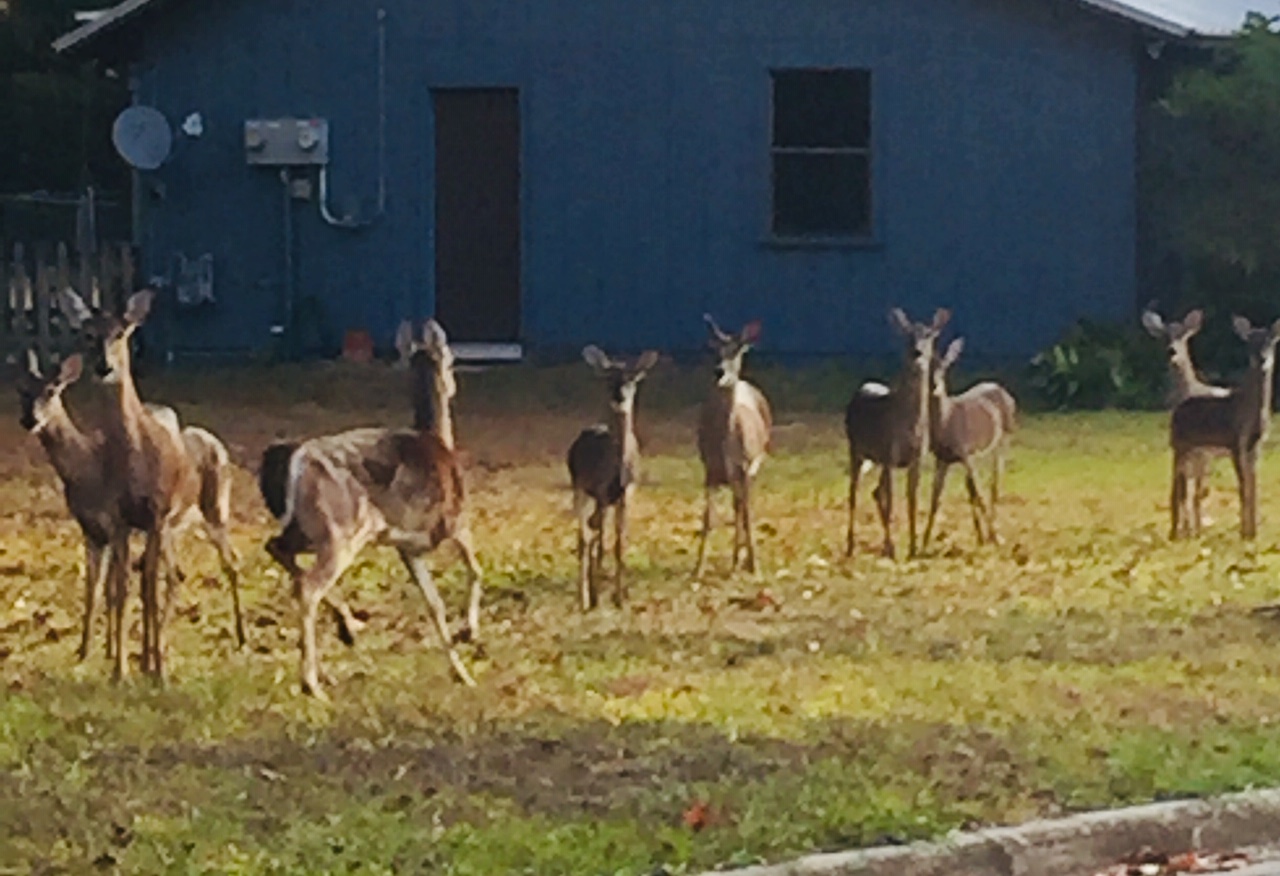
A herd of nine deer beside a house in my neighborhood
I start every day (after coffee) by walking my dogs in a woodsy park near my house. The park is wedged between two well-traveled roads, and the noise of traffic can overwhelm the quieter sounds of small birds. Still, it’s a refuge for wildlife in the area, and I often see deer on my walks.
A poet friend who was also a pig farmer used to call deer “rats with hooves.” He was at war with them over certain crops he grew to supplement the pig income.
Deer have acclimated quite well to living in proximity to humans, well enough to be deemed a nuisance or worse by farmers, gardeners, and motorists. And, the deer have acclimated well enough to see us humans as harmless, or even as food dispensers. A mistake on both sides of the relationship, in my view.
This poem, originally published in Sweet Lit, was prompted by one of my morning walks. Click the play icon for an audio version.
Ones & ZeROES
The doe’s belly ripples, then a placental hoof or knee pokes her skin from inside out. She watches me watch her,
browsing for a hand held out with treats, whatever’s tender or nearby. Re-programmed for curiosity toward humans,
she’s unremembered fear. A new machine can write a terabyte of data every day on five hundred trillion molecules
of DNA. That memory will last ten thousand years. Soon, the deer may see my dog, who never catches them,
as one more harmless thing. Is that the sort of bit she passes down to offspring? Her new fawn rests, wet and dazed, between
deep shade and sun. Such tender prey. Let the dogs run.
Cover of 2020 PASSAGER journal: “Meditation on Figs” by Hal Boyd. Image description: a cardinal surrounded by multi-colored leaves.
For the past 10+ years, I’ve sent work to Passager, a journal for art and writing by people over 50. They always have a beautiful cover!
I’m a slow writer. The poem I have in the current issue began as a response to the 2016 Pulse Nightclub murders in Florida. Then the summer rains began, and it seemed the storms would never end.
I submitted the poem at the beginning of 2020. Little did I know how Florida and her people would continue to suffer.








 Michele Sharpe