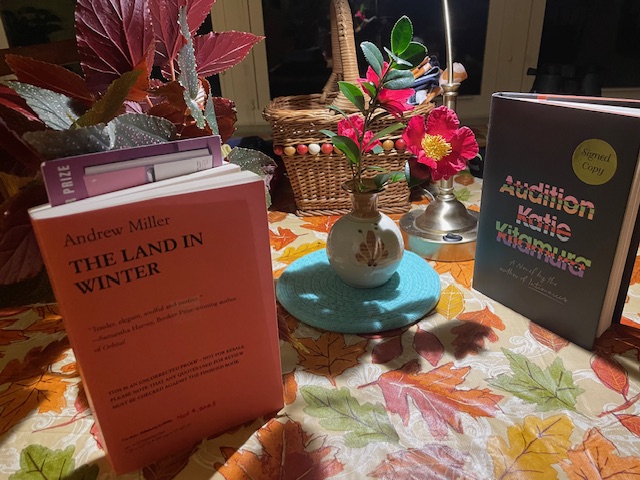
I’ve only read two titles on the Booker Prize short list, The Land in Winter by Andrew Miller and Audition by Katie Kitamura, so there’ no telling which book will win from my perspective. It’s the big night!
Audition was a First Editions Book Club pick at my local bookstore, The Lynx, a project spearheaded by writer Lauren Groff. The Lynx has been around now for a couple of years and its brick-and-mortar storefront and patio have added so much to cultural and social life in Gainesville, Florida. And, of course, Lauren and her team are fabulous curators, holding frequent book club meetings, author events, and writing classes.
Auditionis not “my sort of book” for a few reasons — it’s based in NYC, the setting for too many novels IMHO, the prose is crisp and unadorned, and its protagonist has respect for psychiatry. But it is “my sort of book” for other reasons — its protagonist is a woman and the whole second half of the book is a killer plot twist. The book is, for a dinosaur-brain like mine, experimental and a bit inaccessible, but it was still a compulsive read. Once I got to the second half, I couldn’t put it down. And, It has things to say about motherhood that seem unique in literature to me, except that I never read books about motherhood, so how would I know?
The Land in Wintercame to me via Autumn Toennis, a writer and an editor at Europa Editions who sent an ARC (advance review copy — because I write reviews, publishers often send ARCs to lucky me) with a note that said “Andrew doesn’t waste a sentence.” She’s right about that. Every sentence contributes to the plot, characterization, setting, or themes, but the prose is also elegant, even delicious. It’s a historical novel, set in England in the 1960’s during a brutal winter. As a Boomer, I resisted the idea that the 1960’s are so long ago they are historical. Reading it, though, was like diving into a not-too-cold pool. The opening propelled me underwater through the deep end and into a place of rest, where I could float on my back and look up at the clouds. It’s a novel reminiscent of Iris Murdoch’s finest work, where characters interact with each other on deep levels even when they are hiding truths from each other.
The Land in Winter is not “my sort of book” because it’s written by a man. Decades ago, I began avoiding contemporary fiction written by men because of my irritation at the inevitable misogyny. So many books, so little time, as you know. As a young reader I excused favorite 19th century writers like Tolstoy and Dostoevsky for their patriarchal alignments because they came from a different time. Kind of silly, right?
I recommend letting others choose your books sometimes. As it turned out, The Land in Winter is exactly my kind of book: that restrained, elegant British tone, that peculiar British humor, the stiff upper lip characters with tormented psyches, and a sense of land that is conscious of its own history.
So, which book won the 2025 Man Booker prize? Find out here.
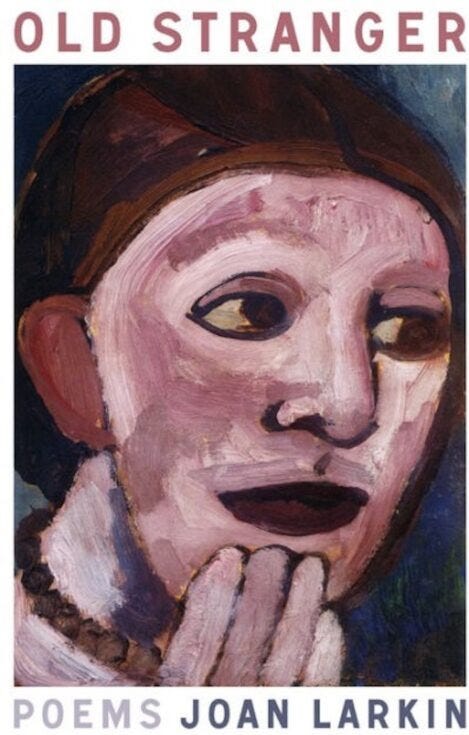
Does the the brevity of lyric poetry appeal to Millennial and Gen Z readers? The turns from narrative to lyric modes in Joan Larkin’s new poetry collection Old Stranger may be attractive to them then, but the poems will also resonate with readers who’ve attained longevity. An octogenarian, Larkin has been celebrated for blending lyric and narrative elements in her work and for nudging her poems toward resolution and epiphany. Her reliance on the lyric mode in Old Stranger intensifies as the collection progresses, while not entirely abandoning narrative. The superseding of narrative by lyric elements tends to form its own arc in a story about aging through perceptions of time and the past.
Larkin was born in Boston, a few months before the 1939 invasion of Poland that set off World War II. Eighteen years older than I, she is a writer I’ve respected as an elder who is always a generation ahead of me in experience, and in the wisdom that may come from it. I’ve followed her work for decades, beginning in the 1970’s at New Words Bookstore in Cambridge, Massachusetts, where I began seeking out queer and feminist literature as a teen. Now, almost 50 years later, Larkin’s poetry continues to create beauty and delight while offering wisdom as I enter my elderhood.
It’s uncommon for poets to have 50-year publishing careers, even now that life expectancy has grown over the past century. If a poet’s early work establishes their personal mythology, as Larkin’s did, what happens to that mythology over a lifetime? Does it grow stale, or get reassessed, or reinforced, or even abandoned? In Old Stranger, the subjects of Larkin’s foundational narratives – rape, abortion, miscarriage, coming out as lesbian, getting sober – are often reshaped through the lens of lyric, which emphasizes the distillation of seemingly truthful perceptions rather than the arc toward them. This turn to the lyric is a Swedish death cleaning of sorts that sweeps events to the side and prioritizes images of insight and emotional truth.
Of course, neither lyric nor narrative modes exist in separate bubbles. There’s a term in poetic discourse for combining them: the lyric-narrative poem. During the first months of an MFA program in the 1990’s, where I was struck by how much I did not know about poetry, “lyric-narrative poetry” especially confused me. Any initial recognition of ignorance may often play a part of the narrative arc of achieving wisdom, but I did not achieve any lasting wisdom on this point. Thirty years later, Old Stranger has revived my old confusion, especially in its poems treating narrative time as both rigid and flexible. Now, though, I can at least see the assumptions that stand in my way: that the lyric exists outside of time, but that narrative relies on time to be understood, and time relies on narrative to be parsed.
A disregard of narrative time first appears in the book’s fourth poem, “The Body Inside My Body,” where a second body, belonging to the speaker, asserts its power. This body wants “the breath it lost trying to escape / that afternoon in Hell’s Kitchen.” With short, declarative sentences establishing her authority, Larkin convinces me this alter-body can get that breath back. The poem offers hope to anyone with traumatic memories who, like the second body, “[h]as had it up to here with the scalding” and “wants the whole carcass unburied.” But the uncovering and implied dissection of the carcass of the past is just the beginning. The carcass’ obliteration is what this alter-body is after, as it wakes in a gothic setting that “any body wants,” where vultures “hiss in the low branches,” ready to do what vultures do. Who wouldn’t want painful events and their sequelae picked apart, swallowed, and annihilated by a vulture’s acid-bath gut?
Agnes, my current foster dog, with her copy of War and Peace.
2023 was the year of resuming my delight in Russian novels. Nearly fifty years of intermittent longing for a treasured copy of The Idiot by Fyodor Dostoevsky had passed; my first lover had torn and sliced the book into pieces and scattered it around my neighborhood. One day in 2023, I realized the same edition might be available through the internet. It was.
Inviting a powerful object into your life can open a door. Shortly after the replica of my long-lost book arrived, I received an assignment from Foreword Reviews to review the Russian novel A Volga Tale by Guzel Yakhina, and from there came the adventure of writing a longer, hybrid essay/review about A Volga Tale for On the Seawall. From there came learning of the Footnotes and Tangents community’s 2024 slow read of War and Peace, which I’m participating in now.
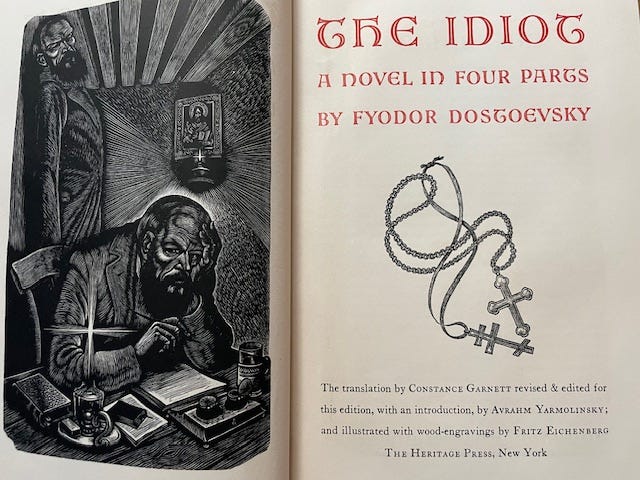
Aside from Nancy Drew mysteries and books about horses, there weren’t a lot of books in my childhood home, but a temporary subscription to a book club brought two new adult novels in. These were hardcovers that came in their own fabric-covered slipcases, which impressed me as classy. One was The Idiot, thick, heavy, and illustrated, a book that when open had a 14- by 10-inch footprint that could be draped across your lap like a small, sad dog. The Idiot’s illustrations, by Fritz Eichenberg, were wood cut prints, dark background and foreground with slashes and streaks of light outlining characters and their settings. The characters’ faces, for the most part, were contorted with emotion, like teenage life.
Title page of The Idiot with wood cut print of a struggling and divided Dostoevsky
I first read The Idiot several years before the destruction of my treasured copy. If you’re not familiar with the book, one way to summarize the novel is to say Dostoevsky wanted to write about a “wholly good man.” The novel’s good man, Prince Myshkin, is afflicted with a seizure disorder, not unlike Dostoevsky himself, who became epileptic as an adult.
This is a recurring trope — at least in certain stories — that moral perfection for men comes with injury to the body, or a physical difference from others. Think of the blinded, one-armed, and ethical-at-last Rochester at the end of Jane Eyre. Or, perhaps, Jaime Lannister from Game of Thrones, who loses his hand and briefly subscribes to a moral idea about community. Or Jesus.
When, in 2023, I opened the package with my new copy of The Idiot and slid the book from its classy slipcase, the slipcase came apart. The book itself was in better shape, and its heft brought back the sensation of being immersed in literature and the suffocating weight of a violent love affair. Being underwater feels powerful when I can swim, but frightening when I can’t swim away. But this is the story of reading, the one with a happy ending.
Nostalgia and excitement about something wholly new filled me in 2023 as I read A Volga Tale. The lush and rhythmic English translation by Polly Gannon reminded me of Constance Garnett’s translations of 19th century Russian fiction. Here were the sonic pleasures of subtle meter and rhyme, the roll of language as it meets with thought. Like Dostoevsky’s work, A Volga Tale employs magic realismand is concerned with “the relationship of the country and personality.”
The novel’s central character, Bach, is an ethnic German who lives on the Volga, a descendant of one of the many Germans encouraged to relocate to Russia by Catherine the Great. Bach is a village schoolteacher who loves languages but becomes speechless when he must face the Russian brutality that robs him of his wife and leaves him a daughter, Antje. With Antje, he conducts “a perpetual, gravely serious conversation in the language of breath and gesture and movement. Each of them was like an enormous ear, poised to listen and understand the other.”
Coming across familiar ideas brings the pleasure of recognition, and this can open my mind to new ideas, as if I’m also an enormous ear, poised to listen. What was new to me in Yakhina’s novel was her concern with “the issue of internal freedom and its ratio to the external freedom.” In Dostoevsky’s novels, freedom is sometimes granted through religious faith, but more often, it’s the characters’ own thoughts and actions that free them or shackle them, creating liberating epiphanies or inescapable prisons of remorse.
Yakhina’s outsider status as an ethnic Tatar woman in Russia may have contributed to her insights about the pressures of external freedom or lack thereof on a character’s internal freedom. In the early days of the Bolshevik Revolution depicted in A Volga Tale, the young people of Russia are swept up in a new life of communal effort for the communal good. Bach’s daughter Antje grows strong, happy, and free of gender constrictions with her comrades during that brief, pre-Stalin era.
The young women in The Idiot don’t experience such freedom; the main characters exist at opposite ends of literature’s traditional womanly spectrum: Aglaya Ivanovna, the virgin daughter of a general, and Nastassya Filipovna, an orphan, sold in some vague way to a wealthy man. By the time I read The Idiot, I’d already learned about the two ends of the womanly spectrum from Jane Eyre — the very good, innocent woman (Jane) at one end, and the very bad, experienced woman (Bertha) at the other end.
As is the habit of many readers, after the last page of A Volga Tale, I looked for more books by Guzel Yakhina and found her debut novel, Zuleikha, which is based on her family stories about life under Stalin and in the Siberian gulags. It is a spellbinding, cross-country epic, and because it won numerous literary awards around the world, I was able to get a copy from my local library. I’m hoping that Yakhina’s third book, a historical novel about the 1921 famine in Russia, will be translated into English soon.
In November of 2023, as if reading my mind (or my clicks, which are similar), Substack alerted me about a 2024 slow read of War and Peace. It had been decades since I read that book. Was it a coincidence that the used bookstore in my part of town had a paperback copy of War and Peace in the Constance Garnett translation, the translation I’d read in the 1970’s after The Idiot sent me in search of more Dostoevsky, which took me to the library and The Brothers Karamazov, The Possessed, Crime and Punishment, and later to War and Peace? Is it reckless of me, that with so many books and so little time, I turn to re-reading at least once a year?
Now it’s 2024, and I’m (re)reading a chapter a day of Tolstoy, thanks to an algorithm and to Simon Haisell and his Footnotes and Tangents group. Tolstoy’s words sound both familiar to my ear, and wholly new; I’d forgotten how funny he can be. This may be an even happier year than last year, when the used but new-to-me copy of The Idiot sat on my lap like a small, sad dog. Its pages felt soft, and miraculously whole.
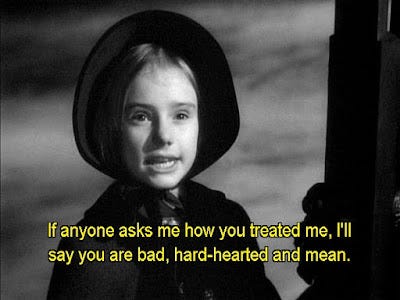
Still shot from 1943 film adaptation of Jane Eyre with text, “If anyone asks me how you treated me, I’ll say you are bad, hard-hearted and mean.”
Down some internet rabbit hole, I saw the title Praying with Jane Eyre: Reflections on Reading as a Sacred Practice. I will read almost anything about Jane Eyre, and when a quick browse revealed that Praying with Jane Eyre was written by Vanessa Zoltan, a Jewish atheist, I was relieved. Fundamentalist religion pasted on top of literature irritates me. On to my library’s database!
I first held Jane Eyre as a chronically ill child confined to bed, a girl who’d read every book in the house and whined for more. My adoptive mother drove to the local library. There, she asked for help from a miraculous but anonymous-to-me librarian who ended up having the most lasting and positive influence on my childhood.
[Please thank a librarian today, especially if you live in a state that’s under pressure from self-righteous book-banning organizations.]
Cover of Praying with Jane Eyre
Praying with Jane Eyre is a combination of memoir, sermon, and literary criticism. I couldn’t stop reading it, even though there’s a bit too much concrete spirituality for me in it, and I disagree with some of Zoltan’s opinions about the novel (the Reeds never deliberately tortured Jane? Please). Still, it’s Jane-adjacent, which I cannot resist, and Zoltan make many meaningful observations about Judaism, Atheism, the epigenetic impacts of the Holocaust (all four of her grandparents were Holocaust survivors), and the process of re-reading. Believing that re-reading can be a sacred act, she has this to say about faith and re-reading:
“what I came to mean by faith was that . . . the more time you spent with the text, the more gifts it would give you.” Even when “you realized it was racist and patriarchal in ways you hadn’t noticed when you were fifteen or twenty or twenty-five, you were still spending sacred time with the book.”
Honestly, I’m not clear on the idea of sacred time. Is it like when I take to the bed all day with a book? Is it like Mary Oliver paying close attention during her morning walks? Or is it about repetition? Or all of these?
Is sacred time forgiveness time? Is it a deliberate disregard for perfection? Most, maybe all, nineteenth century European literature is racist and patriarchal. Charlotte Brontë was not a feminist saint. But her most famous book is more than the sum of her writerly parts, maybe because she trusted in the magic of her unconscious. If she was stuck, as a writer, she asked her own dreams for help and illumination before falling asleep at night.
That’s the quality I most admired about Jane when first reading the book: she trusted her own mind, both the conscious and the unconscious parts. She was self-reliant.
Since childhood, I’ve re-read Jane Eyre yearly. There must have been skipped years, but since my obsession began at eight years old and I’m now sixty-six, I’ve probably read it fifty times. With each re-reading, the world of the novel is somehow made at once new and familiar.
How is it made new? Partly by what I notice. Children are the ultimate underdogs, and as a child, I noticed my own powerlessness as bitterly as Jane notices her powerlessness in the novel. As a teenager in a Karl Marx phase, I noticed the novel’s class struggles. In my early twenties, a second wave feminism phase, I noticed the caging of Bertha Mason.
Time can make a book new, too, if one’s well of compassion for others varies. Imagine my shock during my last re-reading when I felt compassion for the odious Mrs. Reed, that bad, hard-hearted, and mean substitute parent. Before that, even when my beloved Jane insisted on compassion for Mrs. Reed, I’d resisted. A year has passed, only a year, but I feel exponentially older and crabbier. I expect to have the pleasure of detesting Mrs. Reed again soon. It’s time.
In 2024, I’ll be joining a slow-read re-reading of War and Peace, a book I haven’t read for . . . let’s just say decades since I can’t recall exactly. Organized and hosted by Simon Haisell on Footnotes and Tangents, this will be my first experience of a slow-read and a communal internet read.
Maybe next summer I’ll host a slow read of Jane Eyre. Meanwhile I recommend the Rosenbach Museum’s free and streaming series “Sundays with Jane Eyre,” which covers satisfying chunks of the novel via discussions with Eyreheads from around the world.



 Michele Sharpe