Who Will Win the Booker Prize?

And why should I read outside of my comfort zone?
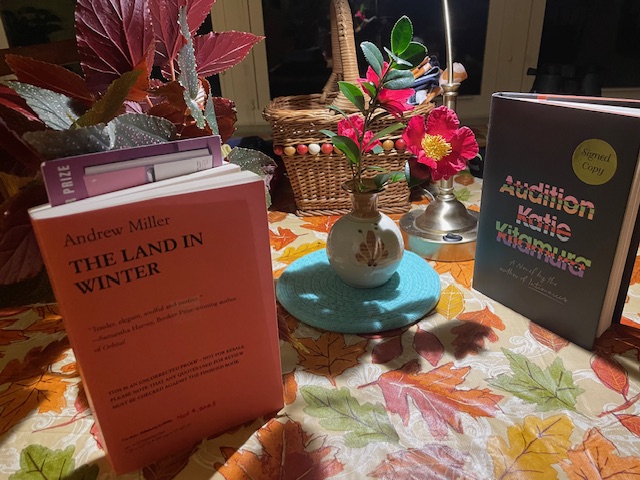
I’ve only read two titles on the Booker Prize short list, The Land in Winter by Andrew Miller and Audition by Katie Kitamura, so there’ no telling which book will win from my perspective. It’s the big night!

Audition was a First Editions Book Club pick at my local bookstore, The Lynx, a project spearheaded by writer Lauren Groff. The Lynx has been around now for a couple of years and its brick-and-mortar storefront and patio have added so much to cultural and social life in Gainesville, Florida. And, of course, Lauren and her team are fabulous curators, holding frequent book club meetings, author events, and writing classes.

Audition is not “my sort of book” for a few reasons — it’s based in NYC, the setting for too many novels IMHO, the prose is crisp and unadorned, and its protagonist has respect for psychiatry. But it is “my sort of book” for other reasons — its protagonist is a woman and the whole second half of the book is a killer plot twist. The book is, for a dinosaur-brain like mine, experimental and a bit inaccessible, but it was still a compulsive read. Once I got to the second half, I couldn’t put it down. And, It has things to say about motherhood that seem unique in literature to me, except that I never read books about motherhood, so how would I know?

The Land in Winter came to me via Autumn Toennis, a writer and an editor at Europa Editions who sent an ARC (advance review copy — because I write reviews, publishers often send ARCs to lucky me) with a note that said “Andrew doesn’t waste a sentence.” She’s right about that. Every sentence contributes to the plot, characterization, setting, or themes, but the prose is also elegant, even delicious. It’s a historical novel, set in England in the 1960’s during a brutal winter. As a Boomer, I resisted the idea that the 1960’s are so long ago they are historical. Reading it, though, was like diving into a not-too-cold pool. The opening propelled me underwater through the deep end and into a place of rest, where I could float on my back and look up at the clouds. It’s a novel reminiscent of Iris Murdoch’s finest work, where characters interact with each other on deep levels even when they are hiding truths from each other.

The Land in Winter is not “my sort of book” because it’s written by a man. Decades ago, I began avoiding contemporary fiction written by men because of my irritation at the inevitable misogyny. So many books, so little time, as you know. As a young reader I excused favorite 19th century writers like Tolstoy and Dostoevsky for their patriarchal alignments because they came from a different time. Kind of silly, right?

I recommend letting others choose your books sometimes. As it turned out, The Land in Winter is exactly my kind of book: that restrained, elegant British tone, that peculiar British humor, the stiff upper lip characters with tormented psyches, and a sense of land that is conscious of its own history.

So, which book won the 2025 Man Booker prize? Find out here.
Re-reading as Prayer

2. Jane Eyre

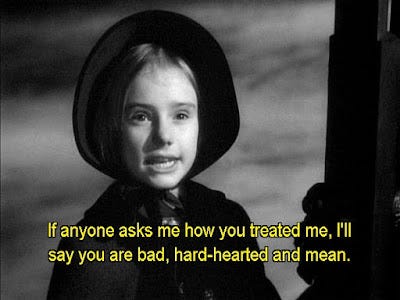
Still shot from 1943 film adaptation of Jane Eyre with text, “If anyone asks me how you treated me, I’ll say you are bad, hard-hearted and mean.”

Down some internet rabbit hole, I saw the title Praying with Jane Eyre: Reflections on Reading as a Sacred Practice. I will read almost anything about Jane Eyre, and when a quick browse revealed that Praying with Jane Eyre was written by Vanessa Zoltan, a Jewish atheist, I was relieved. Fundamentalist religion pasted on top of literature irritates me. On to my library’s database!

I first held Jane Eyre as a chronically ill child confined to bed, a girl who’d read every book in the house and whined for more. My adoptive mother drove to the local library. There, she asked for help from a miraculous but anonymous-to-me librarian who ended up having the most lasting and positive influence on my childhood.

[Please thank a librarian today, especially if you live in a state that’s under pressure from self-righteous book-banning organizations.]

Praying with Jane Eyre by Vanessa Zoltan
Cover of Praying with Jane Eyre

Praying with Jane Eyre is a combination of memoir, sermon, and literary criticism. I couldn’t stop reading it, even though there’s a bit too much concrete spirituality for me in it, and I disagree with some of Zoltan’s opinions about the novel (the Reeds never deliberately tortured Jane? Please). Still, it’s Jane-adjacent, which I cannot resist, and Zoltan make many meaningful observations about Judaism, Atheism, the epigenetic impacts of the Holocaust (all four of her grandparents were Holocaust survivors), and the process of re-reading. Believing that re-reading can be a sacred act, she has this to say about faith and re-reading:

“what I came to mean by faith was that . . . the more time you spent with the text, the more gifts it would give you.” Even when “you realized it was racist and patriarchal in ways you hadn’t noticed when you were fifteen or twenty or twenty-five, you were still spending sacred time with the book.”

Honestly, I’m not clear on the idea of sacred time. Is it like when I take to the bed all day with a book? Is it like Mary Oliver paying close attention during her morning walks? Or is it about repetition? Or all of these?

Is sacred time forgiveness time? Is it a deliberate disregard for perfection? Most, maybe all, nineteenth century European literature is racist and patriarchal. Charlotte Brontë was not a feminist saint. But her most famous book is more than the sum of her writerly parts, maybe because she trusted in the magic of her unconscious. If she was stuck, as a writer, she asked her own dreams for help and illumination before falling asleep at night.

That’s the quality I most admired about Jane when first reading the book: she trusted her own mind, both the conscious and the unconscious parts. She was self-reliant.

Since childhood, I’ve re-read Jane Eyre yearly. There must have been skipped years, but since my obsession began at eight years old and I’m now sixty-six, I’ve probably read it fifty times. With each re-reading, the world of the novel is somehow made at once new and familiar.

How is it made new? Partly by what I notice. Children are the ultimate underdogs, and as a child, I noticed my own powerlessness as bitterly as Jane notices her powerlessness in the novel. As a teenager in a Karl Marx phase, I noticed the novel’s class struggles. In my early twenties, a second wave feminism phase, I noticed the caging of Bertha Mason.

Time can make a book new, too, if one’s well of compassion for others varies. Imagine my shock during my last re-reading when I felt compassion for the odious Mrs. Reed, that bad, hard-hearted, and mean substitute parent. Before that, even when my beloved Jane insisted on compassion for Mrs. Reed, I’d resisted. A year has passed, only a year, but I feel exponentially older and crabbier. I expect to have the pleasure of detesting Mrs. Reed again soon. It’s time.

In 2024, I’ll be joining a slow-read re-reading of War and Peace, a book I haven’t read for . . . let’s just say decades since I can’t recall exactly. Organized and hosted by Simon Haisell on Footnotes and Tangents, this will be my first experience of a slow-read and a communal internet read.

Maybe next summer I’ll host a slow read of Jane Eyre. Meanwhile I recommend the Rosenbach Museum’s free and streaming series “Sundays with Jane Eyre,” which covers satisfying chunks of the novel via discussions with Eyreheads from around the world.

Re-reading for Brain Soothing

Fingersmith by Sara Waters

No photo description available.
Buttonbush in flower. Photo by Michele Sharpe

Repetition is soothing. Looking at an image with a fractal pattern like this photo of a buttonbush in flower is soothing for many people. Listening to music that repeats a rhythm or melody is soothing for many people.

You can also try re-reading a favorite book. Your brain recalls much of what will happen in the book, but not everything, so re-reading is a soothing blend of the familiar with sprinklings of new discoveries. Falling back into the world of a book you’ve already entered can be relaxing, and re-reading can also reveal how you’ve changed since last reading the book.

Here’s an example of that reveal function: I loved all of Jane Austen’s novels as a kid until I got to Emma. It was so horrible, I didn’t believe it was written by the same person. When I revisited it as an adult, I saw why: Emma’s character faults (bossy, know-it all, and yet unperceptive when it came to what was right in front of her) were too much like mine. Re-reading revealed that I’d grown up enough to recognize those character faults.

This week, I extended my re-reading to a new book: the twistily plotted Fingersmith by Sara Waters, which I first read in 2008 or 2009 while living in Idaho. Here’s the set up: An elaborate confidence game brings two young women from different class backgrounds together in 1800’s England, and they fall in love.

The novel’s period details are riveting enough to transport me out of my 21st century world, and on re-reading those details brought me fresh pleasure. Or horror, like this detail: for the convenience of their keepers, the hair of asylum inmates could be shaved off — or it could be braided and sewn to their heads with cotton thread.

This is literary fiction with a plot twist, and another twist, and another twist, with an immersion in England’s 19th century class obsessions and oppressions, and a consuming love story. What did the re-reading reveal to me? That 10+ years of writing prose has made me more attuned to technique than when I first read the book.

Shout out to The Handmaiden, the 2016 South Korean film adaptation of Fingersmith directed, co-written, and co-produced by Park Chan-Wook. It’s a sumptuous, erotic beauty of a film that replaces the book’s British class conflicts with the ethnic status conflicts between Korean and Japanese people in the 19th century.

Got any reading recommendations?

Check out my Substack, So many books, so little time, where this piece was originally published

Can Objects have feelings?

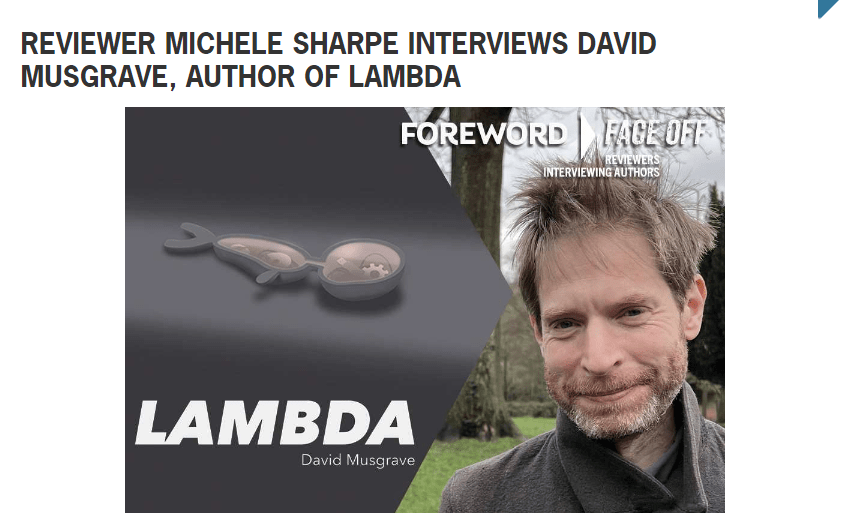
Here’s my interview of British author David Musgrave, whose science fiction novel, Lambda, took me out of this world!

The book is an on-the-edge-of-your-seat story where even your toothbrush collects data on you. It also considers important questions about the meaning of being human and whether a near-future (a/k/a “now”) surveillance state impacts that meaning. By bringing programming languages and natural languages together, the book adds a meta layer to the question of whether objects can have sentience.

Click here, too, for my review of Lambda.

A Perfect Pandemic Novel

The perfect pandemic novel is a short novel, since our attention spans may be diminished by panic, or loss, or involuntary isolation. It is a novel set in a predictable world unlike the one we now inhabit, in order to offer us temporary relief from the 2020 shitshow.

Piranesi, the title character, lives in a labyrinth that offers the peace of solitude among beauty, interrupted only by brief interactions with “the Other.” He sets himself tasks, some wholly pragmatic, and some philosophic. His ongoing task is to know his world. Our task, as readers, is to discover how he ended up there.

The novel we need now might be one with an innocent protagonist like Piranesi because we ourselves may have become jaded by daily reports of infections and deaths and the callous responses of our government. We may need a likeable protagonist, too, because isolation may have made us unlikeable. Or perhaps the people we live with have become unlikeable, or even intolerable.

A perfect novel for this dark winter has a strange plot, original enough to be compelling, with just enough touchstones to invite us to try making sense of it. And because it is a novel, in the end we find a way through the strange yet familiar labyrinth. We reach a resolution. Sort of.

This is the book that kept me awake in the good way of reading because I believed whole-heartedly in a world, as opposed to the bad way of doomscrolling for jolts of “I cannot believe this bullshit.”

Piranesi, it turns out, is a man who can change his opinions when the facts demand it – a good lesson for us all in challenging times.

Famous Adopted People — the book!

39010828. sy475
Cover of the novel FAMOUS ADOPTED PEOPLE by Alice Stephens

FAMOUS ADOPTED PEOPLE by Alice Stephens (@AliceKSStephens) kept my attention riveted from start to finish, like a roller coaster ride through a kaleidoscope. It’s a book that switches gears a lot, and the author manages the transitions very well, partly because the novel is told through the perspective of a single protagonist who has a distinct voice. Lisa, a multiracial international adoptee from Korea who grew up with white adoptive parents in America, is a hard-drinking, work-shirking young woman whose close friendship with Mindy, another international adoptee, blows up when the two young women are traveling in Asia. What starts out as a story about friendship and identity becomes a crime mystery/political thriller/cultural criticism story with a little magic realism and a good bit of humor thrown in.

This was a very satisfying read for me. It kept me up at night and it kept me thinking. The whiplash ways of this novel seemed to me to be a meta-metaphor for the situation of transracial and international adoptees whose lives, like all adoptees’ lives, begin with the emotional whiplash of family separation and are further complicated by the cultural whiplash of being raised by a family that is obviously not their family of origin.

I love reading stories about adoption — fiction or nonfiction — because I was separated from my family by adoption as an infant, and I need stories that represent my experience. As a domestic adoptee, there are significant differences between my experiences and those of Lisa, the novel’s main character, but I still identified strongly with her questions about her own identity and her sense of alienation.

If you’re looking for a riveting read to take your mind off of COVID-19, I highly recommend this novel. And if you’re looking for insight on the adoptee experience, I highly recommend it for that reason, too. More great reads by adoptees or recommended by adoptees can be found at Karen Pickell’s wonderful Adoptee Reading website.