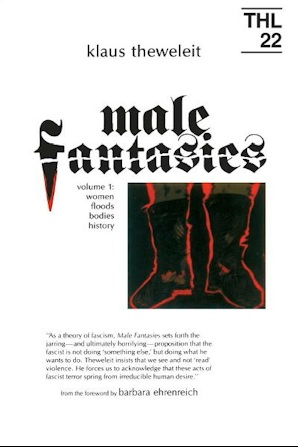
About 40 years ago, a friend gave me Klaus Theweleit’s book Male Fantasies, the first in his series about the fascist imagination, specifically how it was expressed in letters and journals of the post-WW I Friekorpsmen, who were the forerunners of the Nazi SS. It was a seminal (pun intended) book for my evolving political thinking.
Like many people, I’m aghast at our American government’s violence and endorsement of violence, and its elevation of lies over truth. Lyz Lenz’s current post in response to the murder of Renee Good covers all these shameful bases. Here’s just one paragraph:
We are trapped inside a fascist imagination. And we didn't get here by accident. We got here through a series of compromises, of well actuallys, of maybe they should have been nicer, kinder, more compliant; maybe they should smiled more, worn a better outfit. But there is no version of America where it won't be your fault when you are shot. There is no life you can live that is pure enough, good enough, that when the state kills you, it won't call you the victim.
Luckily, I’m not in the habit of watching television news or listening to the radio. It’s overwhelming, at least for me, just to read the news and newsletters like Lyz’s, without engaging any of my other senses. Reading provides me with more control over what I consume than video or audio or even static images. Again, at least for me this is true.
But, I’ll keep reading about our American fascist moment and keep hoping it’s truly a moment, and not a death sentence for freedom, tolerance, education, and democracy.
Agnes, my current foster dog, with her copy of War and Peace.
2023 was the year of resuming my delight in Russian novels. Nearly fifty years of intermittent longing for a treasured copy of The Idiot by Fyodor Dostoevsky had passed; my first lover had torn and sliced the book into pieces and scattered it around my neighborhood. One day in 2023, I realized the same edition might be available through the internet. It was.
Inviting a powerful object into your life can open a door. Shortly after the replica of my long-lost book arrived, I received an assignment from Foreword Reviews to review the Russian novel A Volga Tale by Guzel Yakhina, and from there came the adventure of writing a longer, hybrid essay/review about A Volga Tale for On the Seawall. From there came learning of the Footnotes and Tangents community’s 2024 slow read of War and Peace, which I’m participating in now.
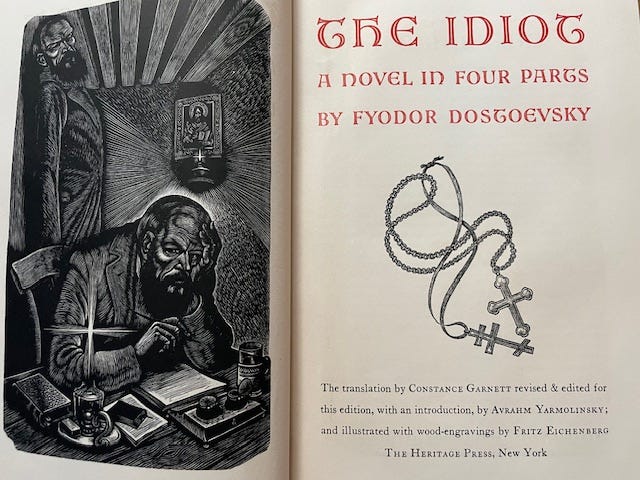
Aside from Nancy Drew mysteries and books about horses, there weren’t a lot of books in my childhood home, but a temporary subscription to a book club brought two new adult novels in. These were hardcovers that came in their own fabric-covered slipcases, which impressed me as classy. One was The Idiot, thick, heavy, and illustrated, a book that when open had a 14- by 10-inch footprint that could be draped across your lap like a small, sad dog. The Idiot’s illustrations, by Fritz Eichenberg, were wood cut prints, dark background and foreground with slashes and streaks of light outlining characters and their settings. The characters’ faces, for the most part, were contorted with emotion, like teenage life.
Title page of The Idiot with wood cut print of a struggling and divided Dostoevsky
I first read The Idiot several years before the destruction of my treasured copy. If you’re not familiar with the book, one way to summarize the novel is to say Dostoevsky wanted to write about a “wholly good man.” The novel’s good man, Prince Myshkin, is afflicted with a seizure disorder, not unlike Dostoevsky himself, who became epileptic as an adult.
This is a recurring trope — at least in certain stories — that moral perfection for men comes with injury to the body, or a physical difference from others. Think of the blinded, one-armed, and ethical-at-last Rochester at the end of Jane Eyre. Or, perhaps, Jaime Lannister from Game of Thrones, who loses his hand and briefly subscribes to a moral idea about community. Or Jesus.
When, in 2023, I opened the package with my new copy of The Idiot and slid the book from its classy slipcase, the slipcase came apart. The book itself was in better shape, and its heft brought back the sensation of being immersed in literature and the suffocating weight of a violent love affair. Being underwater feels powerful when I can swim, but frightening when I can’t swim away. But this is the story of reading, the one with a happy ending.
Nostalgia and excitement about something wholly new filled me in 2023 as I read A Volga Tale. The lush and rhythmic English translation by Polly Gannon reminded me of Constance Garnett’s translations of 19th century Russian fiction. Here were the sonic pleasures of subtle meter and rhyme, the roll of language as it meets with thought. Like Dostoevsky’s work, A Volga Tale employs magic realismand is concerned with “the relationship of the country and personality.”
The novel’s central character, Bach, is an ethnic German who lives on the Volga, a descendant of one of the many Germans encouraged to relocate to Russia by Catherine the Great. Bach is a village schoolteacher who loves languages but becomes speechless when he must face the Russian brutality that robs him of his wife and leaves him a daughter, Antje. With Antje, he conducts “a perpetual, gravely serious conversation in the language of breath and gesture and movement. Each of them was like an enormous ear, poised to listen and understand the other.”
Coming across familiar ideas brings the pleasure of recognition, and this can open my mind to new ideas, as if I’m also an enormous ear, poised to listen. What was new to me in Yakhina’s novel was her concern with “the issue of internal freedom and its ratio to the external freedom.” In Dostoevsky’s novels, freedom is sometimes granted through religious faith, but more often, it’s the characters’ own thoughts and actions that free them or shackle them, creating liberating epiphanies or inescapable prisons of remorse.
Yakhina’s outsider status as an ethnic Tatar woman in Russia may have contributed to her insights about the pressures of external freedom or lack thereof on a character’s internal freedom. In the early days of the Bolshevik Revolution depicted in A Volga Tale, the young people of Russia are swept up in a new life of communal effort for the communal good. Bach’s daughter Antje grows strong, happy, and free of gender constrictions with her comrades during that brief, pre-Stalin era.
The young women in The Idiot don’t experience such freedom; the main characters exist at opposite ends of literature’s traditional womanly spectrum: Aglaya Ivanovna, the virgin daughter of a general, and Nastassya Filipovna, an orphan, sold in some vague way to a wealthy man. By the time I read The Idiot, I’d already learned about the two ends of the womanly spectrum from Jane Eyre — the very good, innocent woman (Jane) at one end, and the very bad, experienced woman (Bertha) at the other end.
As is the habit of many readers, after the last page of A Volga Tale, I looked for more books by Guzel Yakhina and found her debut novel, Zuleikha, which is based on her family stories about life under Stalin and in the Siberian gulags. It is a spellbinding, cross-country epic, and because it won numerous literary awards around the world, I was able to get a copy from my local library. I’m hoping that Yakhina’s third book, a historical novel about the 1921 famine in Russia, will be translated into English soon.
In November of 2023, as if reading my mind (or my clicks, which are similar), Substack alerted me about a 2024 slow read of War and Peace. It had been decades since I read that book. Was it a coincidence that the used bookstore in my part of town had a paperback copy of War and Peace in the Constance Garnett translation, the translation I’d read in the 1970’s after The Idiot sent me in search of more Dostoevsky, which took me to the library and The Brothers Karamazov, The Possessed, Crime and Punishment, and later to War and Peace? Is it reckless of me, that with so many books and so little time, I turn to re-reading at least once a year?
Now it’s 2024, and I’m (re)reading a chapter a day of Tolstoy, thanks to an algorithm and to Simon Haisell and his Footnotes and Tangents group. Tolstoy’s words sound both familiar to my ear, and wholly new; I’d forgotten how funny he can be. This may be an even happier year than last year, when the used but new-to-me copy of The Idiot sat on my lap like a small, sad dog. Its pages felt soft, and miraculously whole.
It is a truth universally acknowledged that all happy families are alike; each family formed by adoption is unhappy in its own way.” [Apologies to Jane Austen and Leo Tolstoy for the mashup of opening lines from Pride & Prejudice and Anna Karenina.]
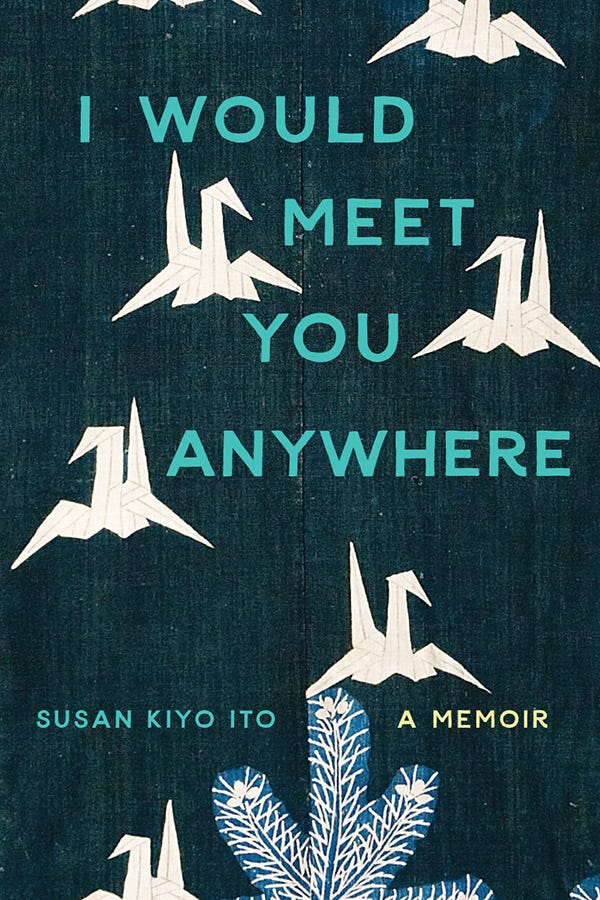
Susan Kiyo Ito’s memoir of her on-again, off-again relationship with her blood mother is a marvel of pacing. Scenes crucial to the narrative are slowed down to the moment-by-moment level of specific gestures, dialogue, interior thoughts, and exterior observations. This strategy allows readers to fully inhabit Susan’s real-time experiences of searching, finding, and accommodating Yumi, the woman who gave birth to her.
Susan’s adoptive parents supported her search for and subsequent relationship with Yumi, and tried to bring everyone in the adoption triad together. What was intended as loving and supportive ironically intensifies questions of family loyalty. During early meetings with Yumi, when Susan is in thrall to the very idea of being near to her own flesh blood, it’s as if she wants their relationship to be private. In aching, honest prose, she describes the awkwardness of feeling pulled toward Yumi and toward her adoptive parents when the four of them meet.
This early, innocent awkwardness is short-lived; it quickly turns into anger, anxiety, and pressure, for Susan’s existence is Yumi’s secret shame. Yumi is married and has two other children who know nothing of Susan. Yumi is anxious to keep the truth from them and everyone in her circle who knows her as a successful wife, mother, and businesswoman. A fragile, intermittent, under-the-radar relationship between Susan and Yumi results from this pressure. Even though Yumi cuts Susan off again and again, Susan keeps welcoming her back when Yumi turns up after years of estrangement as if everything is okay.
Maybe Susan keeps welcoming Yumi back because severing ties is too painful for a woman who who was separated from her mother as an infant. And maybe Yumi cuts Susan off and keeps coming back because it’s too painful for her, too. A survivor of the World War II Japanese internment camps, Yumi was also a survivor of misogynist American culture that shamed unmarried women who became pregnant, and then coerced them into giving up their babies to a predatory adoption industry. Maybe the blood ties between mother and child are so strong they cannot be permanently destroyed, so strong that they can overcome the pressures of culture.
I wouldn’t know. My own mother, fourteen when she became pregnant with me, died one year before my adoption search was successful. I’m childless, too, so the whole mother/child thing is mysterious to me, something I can only learn about from other people’s stories. Susan Kiyo Ito’s memoir I Would Meet You Anywhere is one of those stories: it brims with the contemporary details that translate another’s experiences and embraces the distance needed to interpret those experiences and give them meaning.
Tolstoy knew that on the surface at least, a happy family is one that conforms with societal values, like the Ozzie and Harriet family of the 20th century, and the Instagrammable family of the 21st century. A family that’s cobbled together by another family’s loss and grief — what’s usually the second best choice of adoption — is by definition unconforming and “unhappy in its own ways.” Reading about and listening to the experiences of adopted people, told in their own voices, is the only way to understand those unique experiences. And every one of our stories will be different.
Last week, the Minnesota Supreme Court overturned a man’s rape conviction because the victim, a woman, was voluntarily intoxicated. Minnesota laws (and the laws of 39 other states) do not include voluntary intoxication as a circumstance that can make consent impossible.
Yeah, that pissed me off.
Modern American laws against rape can trace their origins 2,000 years ago to the Romans. The laws were enacted to protect men’s property interests in their chaste wives and daughters, and it’s been a shitshow ever since. Even with the positive changes to sexual assault laws (thank you, feminism!), in Minnesota and 39 other states, rapists can declare open season on people who choose to get drunk
Here’s a friend link to get you past the Medium paywall if you’d like to read on.
Image description: Book cover featuring photo of Laura Hershey, a white woman with O2 line and wheelchair, at her desk.
The publication of a new book by an author you love is a wonderful thing, perhaps especially when that author is no longer in this world Last month, a posthumous collection of Laura Hershey’s poetry and prose was published by The Unsung Masters Series, a project of Pleiades Press, Gulf Coast Journal, and Copper Nickel Journal.
Hershey passed away after a sudden illness in November of 2010; this came as a shock to her many friends and followers, including me. I’d met Laura when she organized a WOM-PO event at the 2010 AWP conference in Denver. About 30 women attended the lunch, exchanging news about recent books and publications.
I’d become familiar with Laura’s work through the WOM-PO listserv, and deeply admired her incisive intellect and her writing on personal and political facets of living as a disabled woman, and I was anxious to speak with her about her work. At the time, I was working on a chapbook of poems about my experience with hepatitis C and stigma. After some conversation, we embarked on an exchange of poems via email for mutual feedback.
Laura and her long-time partner Robin Stephens had recently adopted a teenage girl, and many of her poems in our brief exchange centered on her new daughter. As an adoptee raised in a fucked-up home, I had a bad taste in my mouth about adoption in general. Laura’s poems were a palate cleanser for me. I had no idea that an adoptive parent could focus, as she and Robin did, on learning all they could about who their daughter was, understanding her daughter as an individual, and acting for the benefit of their child.
The Unsung Masters Series project is an important one, but Laura Hershey was hardly unsung in the many communities she touched with her poetry, prose, and activism. For a sampling of her international influence, check out her website, which continues to live on after her death.
She put her considerable energies to work for both the theory and practice of LGBTQ and disability rights. In addition to her prolific writing, she worked with ADAPT, Not Dead Yet, and other disability rights activist groups. Among other issues, she advocated for universal design — a world that is ready-made for all of us — because, as she asked, “what could be more universal than having a body?”
One of Laura’s poems, “You Get Proud by Practicing,” was set to music and also became a rallying cry for many people with disabilities. It’s included in this important book. Here’s an excerpt:
You Get Proud by Practicing by Laura Hershey
If you are not proud
For who you are, for what you say, for how you look;
If every time you stop
To think of yourself, you do not see yourself glowing
With golden light; do not, therefore, give up on yourself.
You can get proud.
You do not need
A better body, a purer spirit, or a Ph.D.
To be proud.
You do not need
A lot of money, a handsome boyfriend, or a nice car.
You do not need
To be able to walk, or see, or hear,
Or use big, complicated words,
Or do any of those things that you just can’t do
To be proud. A caseworker
Cannot make you proud,
Or a doctor.
You only need more practice.
You get proud by practicing.
I don’t know who my father was — and maybe that’s why I got so riled up about a recent news story about “fertility doctors” scamming their patients who were trying to get pregnant by substituting their own sperm for donor sperm.
Try this timed writing exercise: First, make a list of the insults used only against women. Then, make a list of the insults used only against men. Compare your lists.
You’ll see that most derogatory terms for women have to do with promiscuity and most derogatory terms for men have to do with homosexuality.
I used this excercise back in the twentieth century when teaching college writing to women in a re-entry program. The point of the exercise was to demonstrate how language both creates and reflects cultural values. It’s very easy [surprise!] to come up with a long list of insults that get slung against women, but not so easy to write a list of insults slung only against men, especially if you don’t use slurs against specifically gay men. . . .
I dreamed of being serene, no longer subject to fits of anger and outrage.
I longed for the wisdom of age that would stop me from making the same stupid mistakes, over and over again.
Only the first wish came true.
Anger, agitation, and outrage fuel my political writing. I tone the rage down so it’s safe for public consumption, instead of being a chaotic string of expletives and, more importantly, I back up my rants with research and facts.
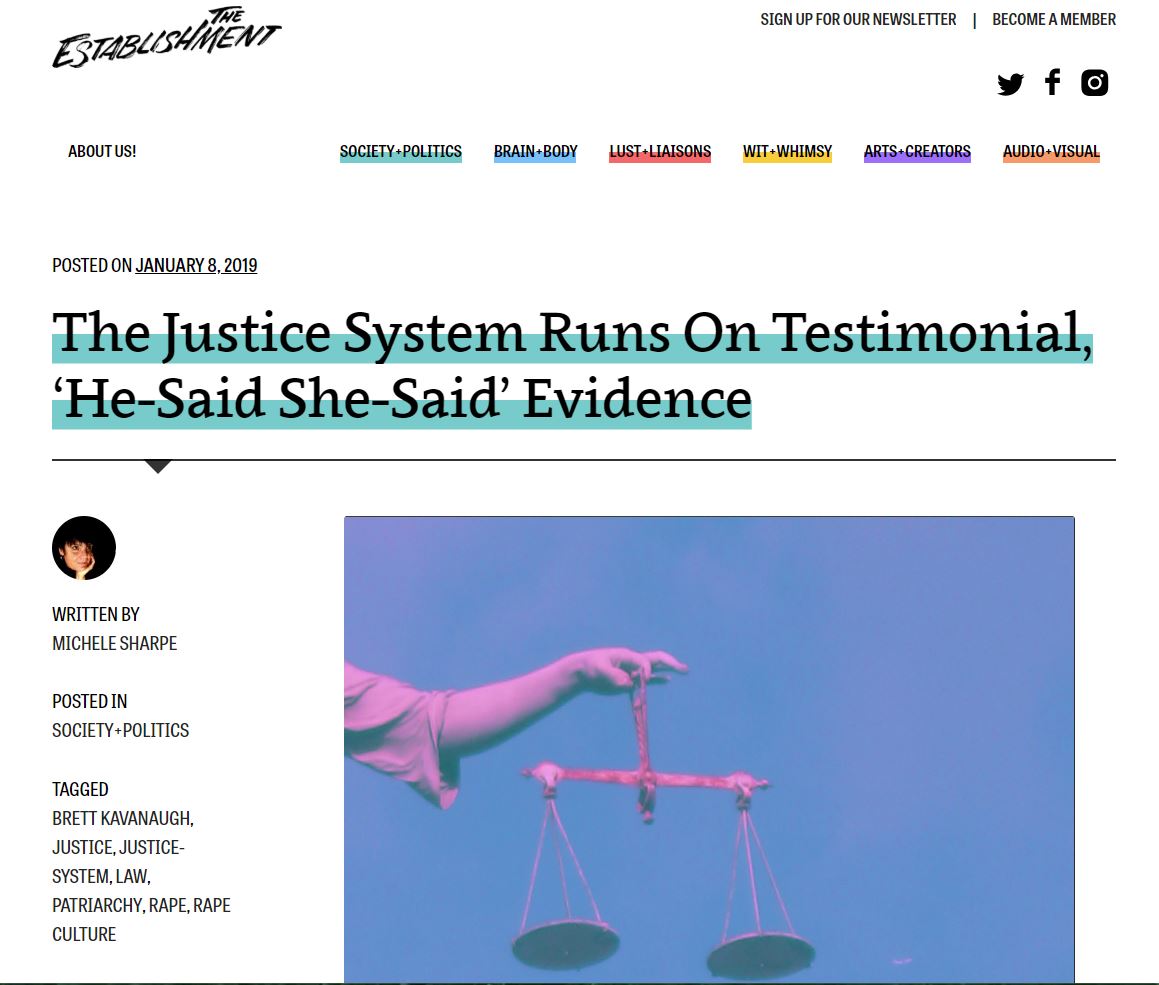
One of the many things that has pissed me off is how pundits and others minimize or dismiss allegations of sexual assault with “We can’t know the truth because it’s a he said/she said situation.”
Like many people in America, I’ve been following the Kavanaugh confirmation hearings. We all bring our experience to the table when analyzing the news, and I’ve been looking at the issues raised by these hearings as both a feminist and a former trial attorney.
Sometimes, anger motivates me to write. I want to figure out why I’m angry, what I can do about it, and whether my anger is valid. I mean “valid” in the logical sense.
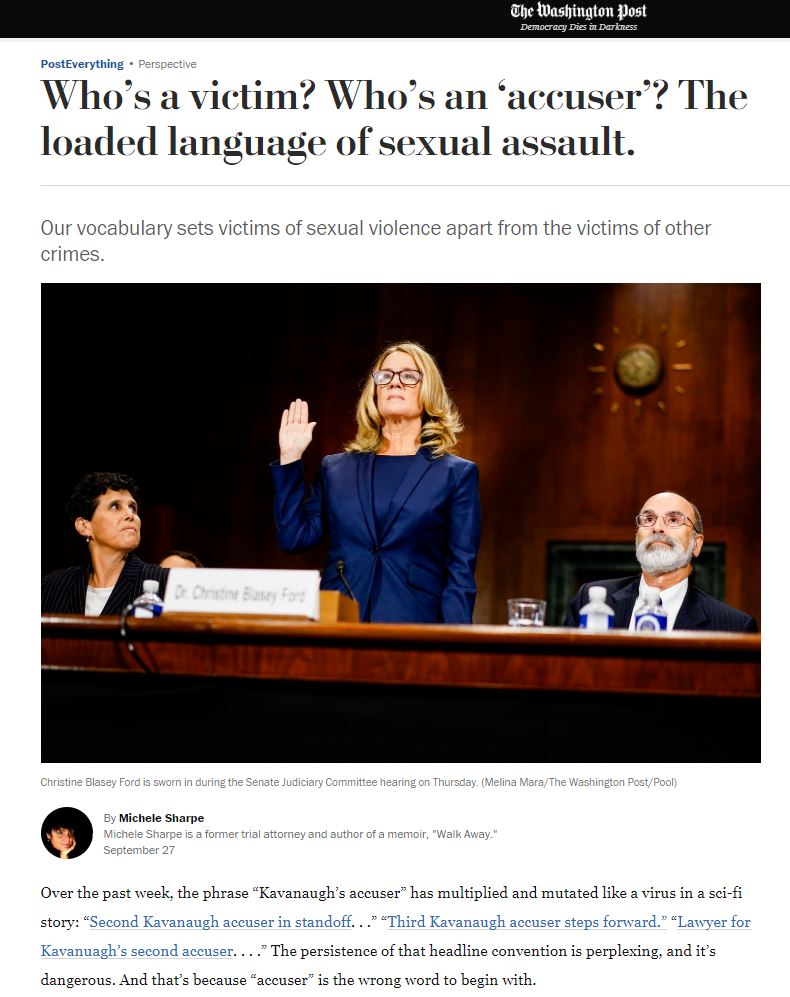
This article, published last week by the Washington Post, concerns something I’ve been angry about since I was in law school: special terminology that sets alleged sexual assault victims apart from alleged victims of other crimes. As I note in the article, you never hear alleged robbery victims referred to as “the accuser,” and yet, this is the norm for the media in cases of sexual assault.
Many people begin writing poetry during adolescence, a turbulent time of life when we’re wrestling with identity, independence, and desire. That’s a full plate for sure, and no wonder so many young people turn to poetry to try to sort out their feelings and make sense of their place in the world.
As an aside, if you are a young poet (either in age or in your writing career), I have a piece of advice: Keep everything you write. Don’t delete or discard anything. Some of it will probably embarrass you if you look back on it from a more mature perspective, but everything you write is potentially valuable. And, your prior work is also a potential goldmine for later writing projects.
Like many angsty teens, when I started writing, it was to understand my mixed-up thoughts about identity, independence, and desire. What’s interesting to me now, though, as an older person, is the different ways we look back at adolescence.
Some poets, like Claude McKay, have looked back on adolescence as a time of innocence. For Rita Dove, in “Adolescence II,” it seems like a time of magical but frightening transformation. For Adrienne Su, adolescence takes on a broader meaning.
For the following poem on adolescence, originally published in my collection Back East, I considered a memory of one pure afternoon.
Quarry
That volcanic August, the asphalt steamed
behind their older cousin’s El Camino,
a car so hot no one questioned why
it sported a pick-up bed, or why it took
them to skinny-dip at the long- abandoned quarry.
On the path through the woods, they foraged for sex without
knowing it, plucking shapely fungi
and curling moss. They came to the water before
it was too late. Years before one lost
an arm to the road and another lost his life
to it, the boys jumped feet first from the cliff, cupping hands in prayer around their genitalia.
The flower-power girls dove in before
rapes, abortions, cancers, free-fall naked without a single consequence, their hands
the points of spades cleaving the mirror.
Treading water, they traded stories of boys
who’d broken their necks and girls who’d disappeared. The well of rainfall, fluent in the tongue
of silk, praised their barest skin and cooled them.






 Michele Sharpe