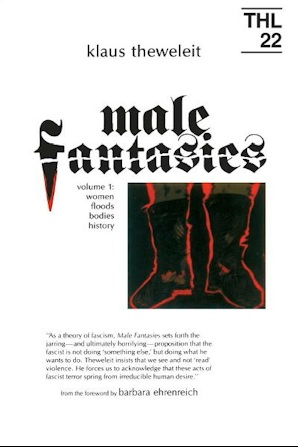
About 40 years ago, a friend gave me Klaus Theweleit’s book Male Fantasies, the first in his series about the fascist imagination, specifically how it was expressed in letters and journals of the post-WW I Friekorpsmen, who were the forerunners of the Nazi SS. It was a seminal (pun intended) book for my evolving political thinking.
Like many people, I’m aghast at our American government’s violence and endorsement of violence, and its elevation of lies over truth. Lyz Lenz’s current post in response to the murder of Renee Good covers all these shameful bases. Here’s just one paragraph:
We are trapped inside a fascist imagination. And we didn't get here by accident. We got here through a series of compromises, of well actuallys, of maybe they should have been nicer, kinder, more compliant; maybe they should smiled more, worn a better outfit. But there is no version of America where it won't be your fault when you are shot. There is no life you can live that is pure enough, good enough, that when the state kills you, it won't call you the victim.
Luckily, I’m not in the habit of watching television news or listening to the radio. It’s overwhelming, at least for me, just to read the news and newsletters like Lyz’s, without engaging any of my other senses. Reading provides me with more control over what I consume than video or audio or even static images. Again, at least for me this is true.
But, I’ll keep reading about our American fascist moment and keep hoping it’s truly a moment, and not a death sentence for freedom, tolerance, education, and democracy.
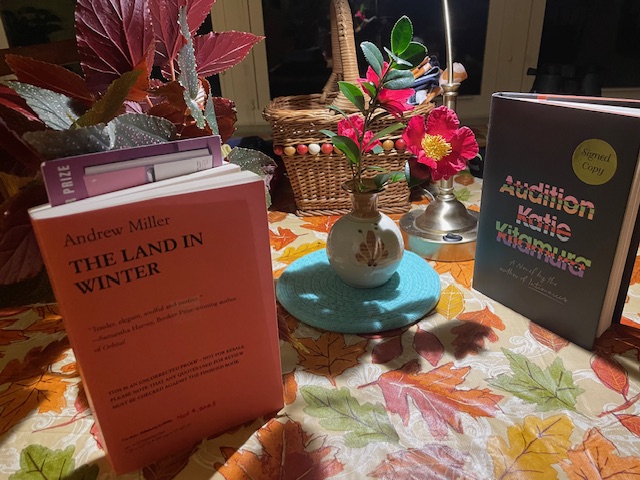
I’ve only read two titles on the Booker Prize short list, The Land in Winter by Andrew Miller and Audition by Katie Kitamura, so there’ no telling which book will win from my perspective. It’s the big night!
Audition was a First Editions Book Club pick at my local bookstore, The Lynx, a project spearheaded by writer Lauren Groff. The Lynx has been around now for a couple of years and its brick-and-mortar storefront and patio have added so much to cultural and social life in Gainesville, Florida. And, of course, Lauren and her team are fabulous curators, holding frequent book club meetings, author events, and writing classes.
Auditionis not “my sort of book” for a few reasons — it’s based in NYC, the setting for too many novels IMHO, the prose is crisp and unadorned, and its protagonist has respect for psychiatry. But it is “my sort of book” for other reasons — its protagonist is a woman and the whole second half of the book is a killer plot twist. The book is, for a dinosaur-brain like mine, experimental and a bit inaccessible, but it was still a compulsive read. Once I got to the second half, I couldn’t put it down. And, It has things to say about motherhood that seem unique in literature to me, except that I never read books about motherhood, so how would I know?
The Land in Wintercame to me via Autumn Toennis, a writer and an editor at Europa Editions who sent an ARC (advance review copy — because I write reviews, publishers often send ARCs to lucky me) with a note that said “Andrew doesn’t waste a sentence.” She’s right about that. Every sentence contributes to the plot, characterization, setting, or themes, but the prose is also elegant, even delicious. It’s a historical novel, set in England in the 1960’s during a brutal winter. As a Boomer, I resisted the idea that the 1960’s are so long ago they are historical. Reading it, though, was like diving into a not-too-cold pool. The opening propelled me underwater through the deep end and into a place of rest, where I could float on my back and look up at the clouds. It’s a novel reminiscent of Iris Murdoch’s finest work, where characters interact with each other on deep levels even when they are hiding truths from each other.
The Land in Winter is not “my sort of book” because it’s written by a man. Decades ago, I began avoiding contemporary fiction written by men because of my irritation at the inevitable misogyny. So many books, so little time, as you know. As a young reader I excused favorite 19th century writers like Tolstoy and Dostoevsky for their patriarchal alignments because they came from a different time. Kind of silly, right?
I recommend letting others choose your books sometimes. As it turned out, The Land in Winter is exactly my kind of book: that restrained, elegant British tone, that peculiar British humor, the stiff upper lip characters with tormented psyches, and a sense of land that is conscious of its own history.
So, which book won the 2025 Man Booker prize? Find out here.
My dear friend Sandra Lambert planned a birthday party for her wife, Pam, and the date arrived shortly after the 2025 Lammy Awards were announced. At the party, I was still thrilling from the news that Sandra’s essay collection WON A FUCKING LAMMY. The party felt like an episode of the Twilight Zone because no one was talking about her big win. Early on, when only a few guests had arrived, my self-control evaporated and I jumped up and down, yelling SANDRA WON A FUCKING LAMMY!
During the rest of my time at the party, I talked about what other people were talking about: the lack of rain, camping, Lucy, the cute middle-aged chihuahua that Sandra and Pam were fostering-to-adopt, and Andrew Fabian, Pomeranian, who is in this photo and is my current super-senior foster dog. He’s also called “Benzo” for his calming effect on humans. He nicely snuggled on my lap part of the time.
Chronic illness and advancing introversion makes parties uncomfortable for me. By the time celebrations were in full swing, it was time for home, sweet home.
But still, no one was talking about Sandra’s Lammy Award. I opened the door to leave quietly, but then shouted “Let me say one thing before I leave: SANDRA WON A FUCKING LAMMY!” Shutting the door, I saw glasses raised and heard universal cheers for Sandra. Finally. Sheesh.
One description that’s been applied to me all my life, in theory as a compliment, is “You’re so laid back.” It’s never set that well with me. Laid back in the grave? Laid back like a pillow princess? Maybe chronic illness has made me appear flat. Inside, I’m a roiling stew of eccentric thoughts, bizarre ideas, and chunks of beloved books.
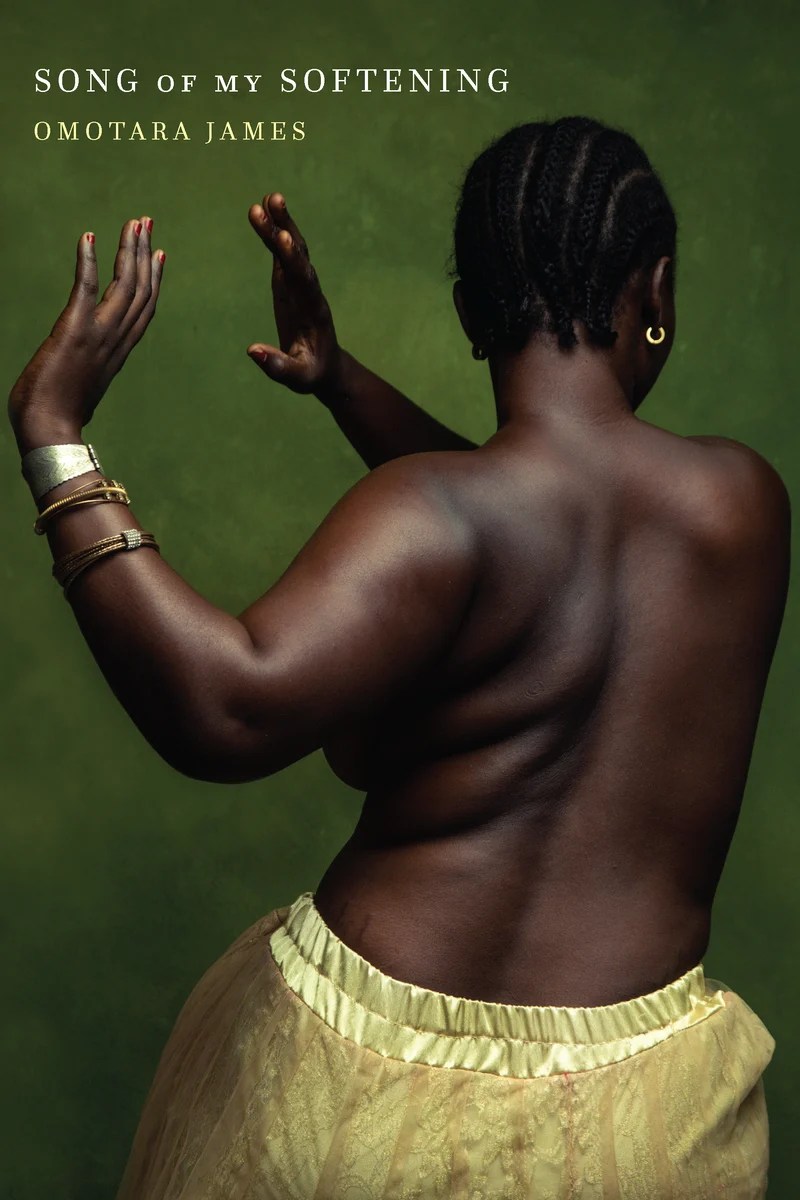
Please celebrate with me! Sandra’s book, My Withered Legs and Other Essayswon first place in lesbian memoir/biography, and Omotara James’ poetry collection, Song of My Softening, won first place in lesbian poetry. I know Omotara from social media and have followed her work for a few years. If I’d been at her wife’s birthday party and no one was talking about her Lammy, I’d have been the same mouthy bitch.
I began this year’s Sealy Challenge inspired by poet friend Linda Cue who engages with the challenge every year. Although reading a whole book of poetry in a day is clearly too much for me, the challenge has made me read more poetry than I usually do, and that’s to the good for my mind and heart.
Re-reading is my preference when it comes to poetry.
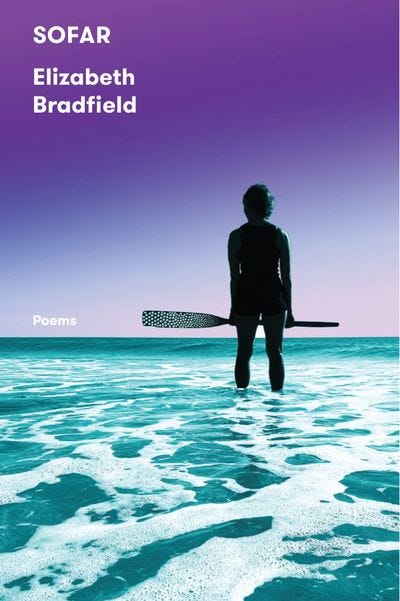
One book that I read and re-read in August is the newly released collection SOFAR by Elizabeth Bradfield. This expansive collection teems with the panoply of life on Earth, spreading the news that attentiveness to the “more than human” world offers relief from bland fascist notions of uniformity and extraction.
Moments of intense joy come from such attentiveness. But moments of stunning grief come from attentiveness as well, and in some poems, attentiveness brings both joy and grief. “Dispatch from this Summer,” with its hermit crab form is one of these. The crab makes a house for its soft body in a discarded shell; in the form, one narrative holds the other, but the form is not a comparison giving one story ascendancy.
The “house” narrative concerns the invasive gypsy moths’ decimations of trees by “unrelenting mastication” that results in a rain of “a constant heavy frass.” Still, the forest holds beauty
. . . If you can stand to walk a narrow path through the leafless forest, you can arrive at a circle of water that will allow your body to be beautifully held, whoever you are. It’s true, you’ll have to return
by the same path . . .
The body held in this poem’s house is a host of vulnerable bodies, the “Florida dancers,” who were killed in the 2016 mass murder at Orlando’s Pulse nightclub, the dozens more who were injured, and the community who witnessed. The naturalist notes that taking the journey to be “beautifully held” means traveling back through the “apocalyptic trees.” In other words, through a shit storm.
“Dispatch from this Summer,” and this book, and Bradfield’s work as a queer poet and naturalist, all have an urgent significance to me. We live in dangerous times, where gross homophobia is pushing its way onto national, state, and local levels, even into my beloved Florida’s liberal enclaves, like Orlando, where a rainbow crosswalk adjacent to the Pulse Memorial was erased overnight. In Gainesville, my home town, city councilors voted unanimously to obey the state’s order to erase our rainbow crosswalks. Fuck that noise.
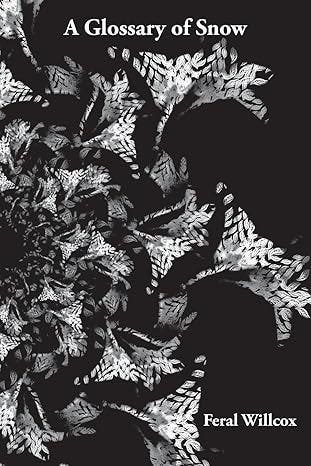
Next up, a book that allowed me to further indulge my re-reading habit: A Glossary of Snowby Feral Wilcox. The collection is a true glossary that defines emergent terms for the diversity of snow.
Feral and I have been friends for twenty years, and so I’ve had the pleasure of reading her imaginative yet sensual work in various incarnations. These poems are some of her most musical, making excellent use of all the sensory strategies she is intimate with as a poet, musician, and visual artist.
Even in the collection’s prose poems, the music is dense and fecund. From the first stanza of “Daughter of Pearl”
daughter of pearl a hard snow born from a harder snow, under the hard shell of a dull grey sky
In an era of hollow dolls lost in warspell, sororities of the pearled-up poor, glamour girls pushed from great depressions into chorus lines, high kicks and cattle calls of drunken flesh swirled in a syrupy cocktail of dresses, pleats and flounces, cleavages, pearlescent romances, crooning juniors of blue-blood seniors, shills of swindlers, big brass boards of hidden hitlers melting their hot silver spoons into shrapnel kisses milked from winter skies uddered with promises, falling, falling as tin cups filled with snow rattle off into the steaming rubble of true love, I’ll be waiting for you, dear, with home appliances and recipes, the basics of home-economics, the rich give a gift to the poor, another war.
Part indulgence, part politics, part fortune-telling, and all art, A Glossary of Snow is another queer book of the present moment.
Thanks for reading So many books, so little time! Subscribe for free to receive new posts and support my work.
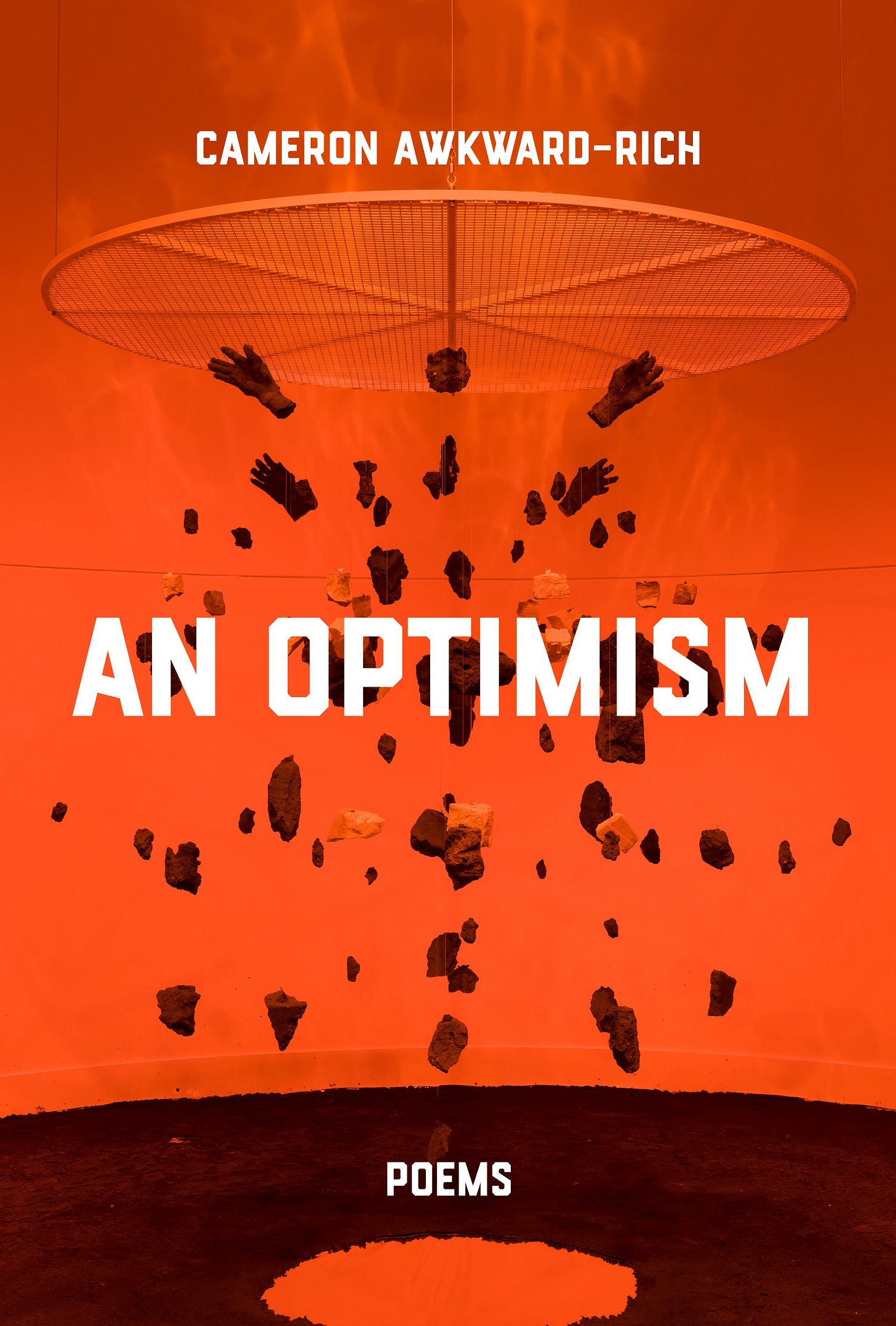
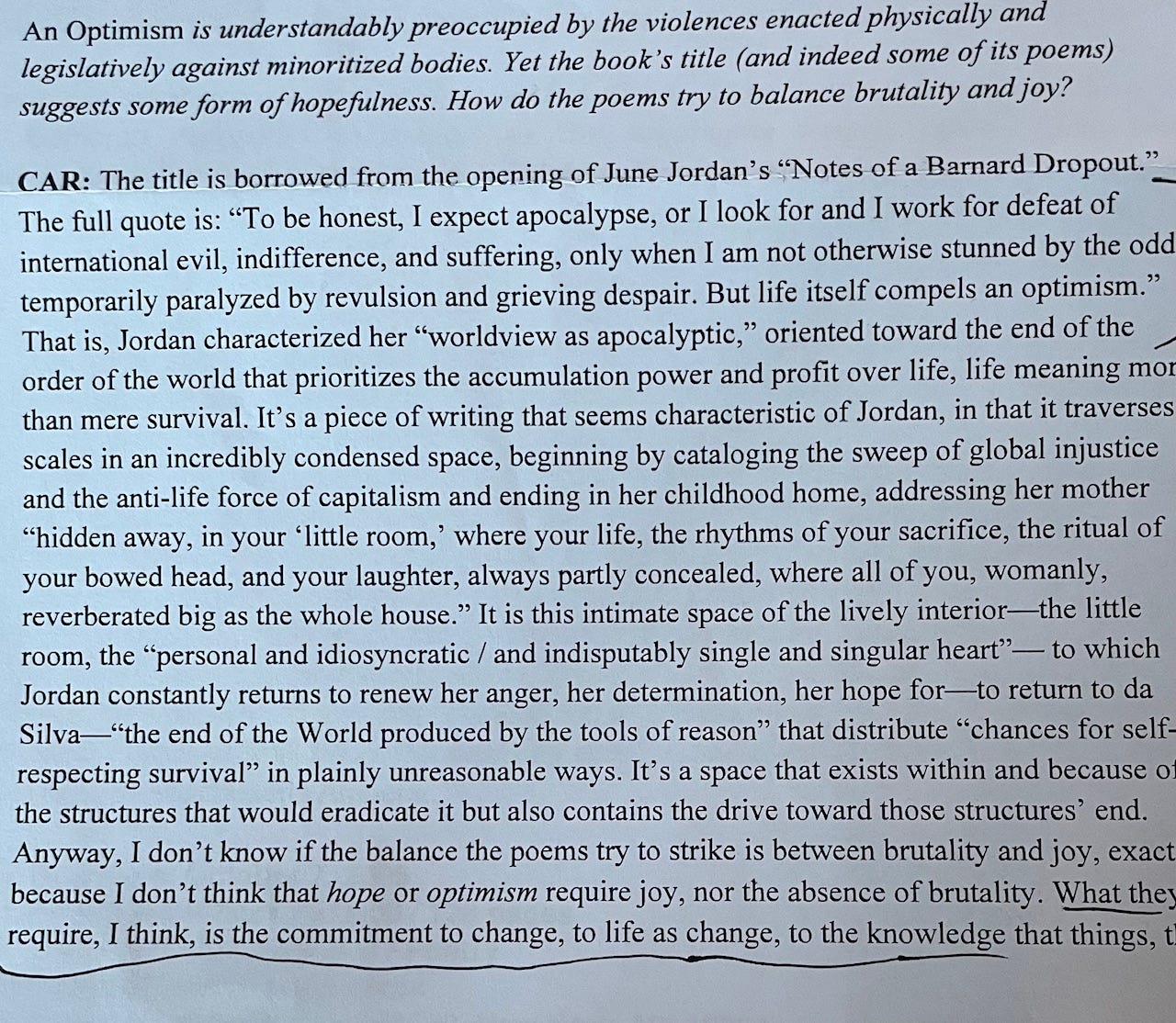
Cameron Awkward-Rich’s book, An Optimism, is thrillingly intellectual while being achingly emotional. Quite a feat. Big thanks to Gabriel Fried over at Persea Books for the ARC (Advance Reading Copy), which included a transcription of an interview with the poet. I read the interview first; in it, Awkward-Rich mines his experience teaching an undergrad class, “Poetry in/as Black Feminist Thought” along with his cultural criticism work for exemplars of his ideas. Here’s a screenshot from that fortunately long interview, where he explains the title of his book as borrowed from a line of June Jordan’s:
The poems enact the idea of cultural criticism, using disparate texts ranging, for example, from the work of Pauli Murray, to Neverland and Peter Pan, to the opening sentence of Charles Dickens’ A Tale of Two Cities as subjects. Often, there’s a young speaker who longs for mirroring: to see someone like himself.
One surprising-to-me trope is the character of Odo from Star Trek: Deep Space Nine, who is “trapped between forms.” In his natural state, he’s a gelatinous mass, but he is a shape-shifter who assumes the appearance of anyone and anything. Change is Odo’s baseline. Even I, a cis woman, can see parallels here to trans experiences in a transphobic world.
From one of several poems titled “It Was the Best of Times, It Was the Worst of Times”:
I didn’t know yet that it was possible, to be, like that, unmade
Agnes, my current foster dog, with her copy of War and Peace.
2023 was the year of resuming my delight in Russian novels. Nearly fifty years of intermittent longing for a treasured copy of The Idiot by Fyodor Dostoevsky had passed; my first lover had torn and sliced the book into pieces and scattered it around my neighborhood. One day in 2023, I realized the same edition might be available through the internet. It was.
Inviting a powerful object into your life can open a door. Shortly after the replica of my long-lost book arrived, I received an assignment from Foreword Reviews to review the Russian novel A Volga Tale by Guzel Yakhina, and from there came the adventure of writing a longer, hybrid essay/review about A Volga Tale for On the Seawall. From there came learning of the Footnotes and Tangents community’s 2024 slow read of War and Peace, which I’m participating in now.
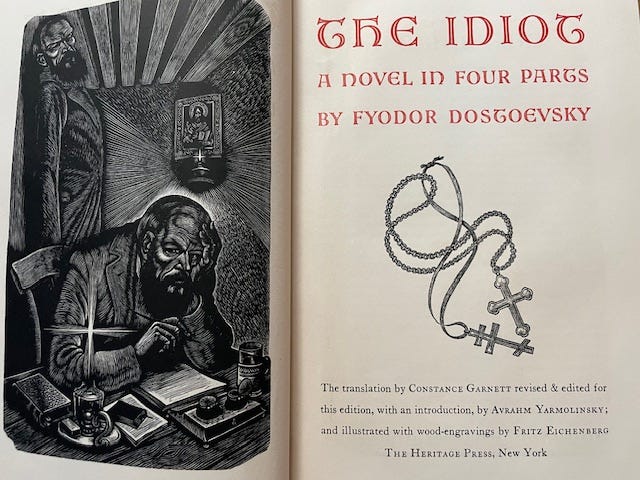
Aside from Nancy Drew mysteries and books about horses, there weren’t a lot of books in my childhood home, but a temporary subscription to a book club brought two new adult novels in. These were hardcovers that came in their own fabric-covered slipcases, which impressed me as classy. One was The Idiot, thick, heavy, and illustrated, a book that when open had a 14- by 10-inch footprint that could be draped across your lap like a small, sad dog. The Idiot’s illustrations, by Fritz Eichenberg, were wood cut prints, dark background and foreground with slashes and streaks of light outlining characters and their settings. The characters’ faces, for the most part, were contorted with emotion, like teenage life.
Title page of The Idiot with wood cut print of a struggling and divided Dostoevsky
I first read The Idiot several years before the destruction of my treasured copy. If you’re not familiar with the book, one way to summarize the novel is to say Dostoevsky wanted to write about a “wholly good man.” The novel’s good man, Prince Myshkin, is afflicted with a seizure disorder, not unlike Dostoevsky himself, who became epileptic as an adult.
This is a recurring trope — at least in certain stories — that moral perfection for men comes with injury to the body, or a physical difference from others. Think of the blinded, one-armed, and ethical-at-last Rochester at the end of Jane Eyre. Or, perhaps, Jaime Lannister from Game of Thrones, who loses his hand and briefly subscribes to a moral idea about community. Or Jesus.
When, in 2023, I opened the package with my new copy of The Idiot and slid the book from its classy slipcase, the slipcase came apart. The book itself was in better shape, and its heft brought back the sensation of being immersed in literature and the suffocating weight of a violent love affair. Being underwater feels powerful when I can swim, but frightening when I can’t swim away. But this is the story of reading, the one with a happy ending.
Nostalgia and excitement about something wholly new filled me in 2023 as I read A Volga Tale. The lush and rhythmic English translation by Polly Gannon reminded me of Constance Garnett’s translations of 19th century Russian fiction. Here were the sonic pleasures of subtle meter and rhyme, the roll of language as it meets with thought. Like Dostoevsky’s work, A Volga Tale employs magic realismand is concerned with “the relationship of the country and personality.”
The novel’s central character, Bach, is an ethnic German who lives on the Volga, a descendant of one of the many Germans encouraged to relocate to Russia by Catherine the Great. Bach is a village schoolteacher who loves languages but becomes speechless when he must face the Russian brutality that robs him of his wife and leaves him a daughter, Antje. With Antje, he conducts “a perpetual, gravely serious conversation in the language of breath and gesture and movement. Each of them was like an enormous ear, poised to listen and understand the other.”
Coming across familiar ideas brings the pleasure of recognition, and this can open my mind to new ideas, as if I’m also an enormous ear, poised to listen. What was new to me in Yakhina’s novel was her concern with “the issue of internal freedom and its ratio to the external freedom.” In Dostoevsky’s novels, freedom is sometimes granted through religious faith, but more often, it’s the characters’ own thoughts and actions that free them or shackle them, creating liberating epiphanies or inescapable prisons of remorse.
Yakhina’s outsider status as an ethnic Tatar woman in Russia may have contributed to her insights about the pressures of external freedom or lack thereof on a character’s internal freedom. In the early days of the Bolshevik Revolution depicted in A Volga Tale, the young people of Russia are swept up in a new life of communal effort for the communal good. Bach’s daughter Antje grows strong, happy, and free of gender constrictions with her comrades during that brief, pre-Stalin era.
The young women in The Idiot don’t experience such freedom; the main characters exist at opposite ends of literature’s traditional womanly spectrum: Aglaya Ivanovna, the virgin daughter of a general, and Nastassya Filipovna, an orphan, sold in some vague way to a wealthy man. By the time I read The Idiot, I’d already learned about the two ends of the womanly spectrum from Jane Eyre — the very good, innocent woman (Jane) at one end, and the very bad, experienced woman (Bertha) at the other end.
As is the habit of many readers, after the last page of A Volga Tale, I looked for more books by Guzel Yakhina and found her debut novel, Zuleikha, which is based on her family stories about life under Stalin and in the Siberian gulags. It is a spellbinding, cross-country epic, and because it won numerous literary awards around the world, I was able to get a copy from my local library. I’m hoping that Yakhina’s third book, a historical novel about the 1921 famine in Russia, will be translated into English soon.
In November of 2023, as if reading my mind (or my clicks, which are similar), Substack alerted me about a 2024 slow read of War and Peace. It had been decades since I read that book. Was it a coincidence that the used bookstore in my part of town had a paperback copy of War and Peace in the Constance Garnett translation, the translation I’d read in the 1970’s after The Idiot sent me in search of more Dostoevsky, which took me to the library and The Brothers Karamazov, The Possessed, Crime and Punishment, and later to War and Peace? Is it reckless of me, that with so many books and so little time, I turn to re-reading at least once a year?
Now it’s 2024, and I’m (re)reading a chapter a day of Tolstoy, thanks to an algorithm and to Simon Haisell and his Footnotes and Tangents group. Tolstoy’s words sound both familiar to my ear, and wholly new; I’d forgotten how funny he can be. This may be an even happier year than last year, when the used but new-to-me copy of The Idiot sat on my lap like a small, sad dog. Its pages felt soft, and miraculously whole.
It is a truth universally acknowledged that all happy families are alike; each family formed by adoption is unhappy in its own way.” [Apologies to Jane Austen and Leo Tolstoy for the mashup of opening lines from Pride & Prejudice and Anna Karenina.]
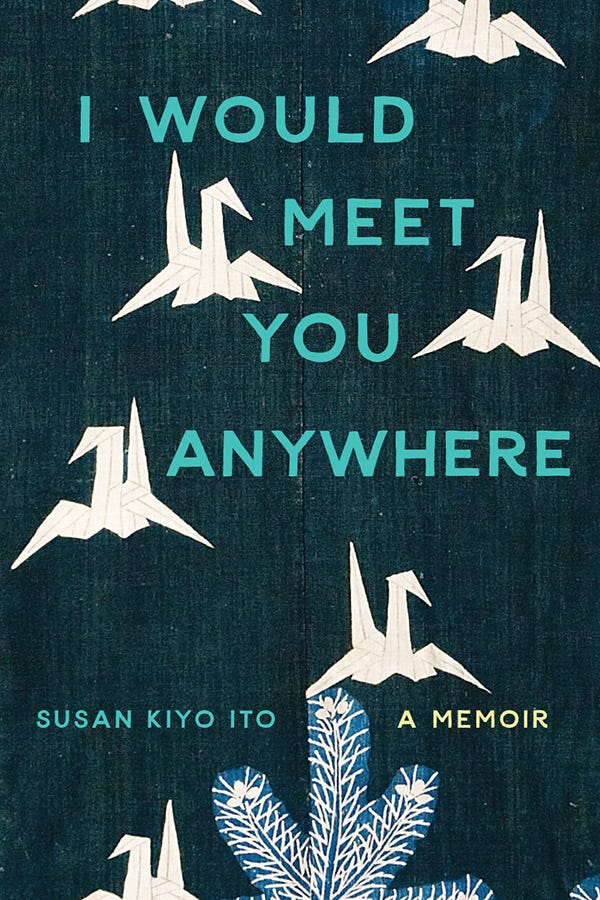
Susan Kiyo Ito’s memoir of her on-again, off-again relationship with her blood mother is a marvel of pacing. Scenes crucial to the narrative are slowed down to the moment-by-moment level of specific gestures, dialogue, interior thoughts, and exterior observations. This strategy allows readers to fully inhabit Susan’s real-time experiences of searching, finding, and accommodating Yumi, the woman who gave birth to her.
Susan’s adoptive parents supported her search for and subsequent relationship with Yumi, and tried to bring everyone in the adoption triad together. What was intended as loving and supportive ironically intensifies questions of family loyalty. During early meetings with Yumi, when Susan is in thrall to the very idea of being near to her own flesh blood, it’s as if she wants their relationship to be private. In aching, honest prose, she describes the awkwardness of feeling pulled toward Yumi and toward her adoptive parents when the four of them meet.
This early, innocent awkwardness is short-lived; it quickly turns into anger, anxiety, and pressure, for Susan’s existence is Yumi’s secret shame. Yumi is married and has two other children who know nothing of Susan. Yumi is anxious to keep the truth from them and everyone in her circle who knows her as a successful wife, mother, and businesswoman. A fragile, intermittent, under-the-radar relationship between Susan and Yumi results from this pressure. Even though Yumi cuts Susan off again and again, Susan keeps welcoming her back when Yumi turns up after years of estrangement as if everything is okay.
Maybe Susan keeps welcoming Yumi back because severing ties is too painful for a woman who who was separated from her mother as an infant. And maybe Yumi cuts Susan off and keeps coming back because it’s too painful for her, too. A survivor of the World War II Japanese internment camps, Yumi was also a survivor of misogynist American culture that shamed unmarried women who became pregnant, and then coerced them into giving up their babies to a predatory adoption industry. Maybe the blood ties between mother and child are so strong they cannot be permanently destroyed, so strong that they can overcome the pressures of culture.
I wouldn’t know. My own mother, fourteen when she became pregnant with me, died one year before my adoption search was successful. I’m childless, too, so the whole mother/child thing is mysterious to me, something I can only learn about from other people’s stories. Susan Kiyo Ito’s memoir I Would Meet You Anywhere is one of those stories: it brims with the contemporary details that translate another’s experiences and embraces the distance needed to interpret those experiences and give them meaning.
Tolstoy knew that on the surface at least, a happy family is one that conforms with societal values, like the Ozzie and Harriet family of the 20th century, and the Instagrammable family of the 21st century. A family that’s cobbled together by another family’s loss and grief — what’s usually the second best choice of adoption — is by definition unconforming and “unhappy in its own ways.” Reading about and listening to the experiences of adopted people, told in their own voices, is the only way to understand those unique experiences. And every one of our stories will be different.
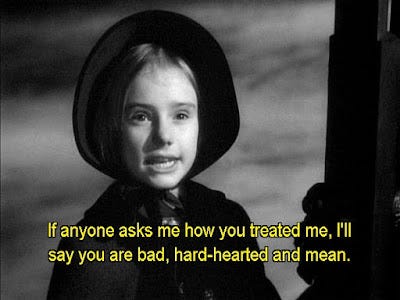
Still shot from 1943 film adaptation of Jane Eyre with text, “If anyone asks me how you treated me, I’ll say you are bad, hard-hearted and mean.”
Down some internet rabbit hole, I saw the title Praying with Jane Eyre: Reflections on Reading as a Sacred Practice. I will read almost anything about Jane Eyre, and when a quick browse revealed that Praying with Jane Eyre was written by Vanessa Zoltan, a Jewish atheist, I was relieved. Fundamentalist religion pasted on top of literature irritates me. On to my library’s database!
I first held Jane Eyre as a chronically ill child confined to bed, a girl who’d read every book in the house and whined for more. My adoptive mother drove to the local library. There, she asked for help from a miraculous but anonymous-to-me librarian who ended up having the most lasting and positive influence on my childhood.
[Please thank a librarian today, especially if you live in a state that’s under pressure from self-righteous book-banning organizations.]
Cover of Praying with Jane Eyre
Praying with Jane Eyre is a combination of memoir, sermon, and literary criticism. I couldn’t stop reading it, even though there’s a bit too much concrete spirituality for me in it, and I disagree with some of Zoltan’s opinions about the novel (the Reeds never deliberately tortured Jane? Please). Still, it’s Jane-adjacent, which I cannot resist, and Zoltan make many meaningful observations about Judaism, Atheism, the epigenetic impacts of the Holocaust (all four of her grandparents were Holocaust survivors), and the process of re-reading. Believing that re-reading can be a sacred act, she has this to say about faith and re-reading:
“what I came to mean by faith was that . . . the more time you spent with the text, the more gifts it would give you.” Even when “you realized it was racist and patriarchal in ways you hadn’t noticed when you were fifteen or twenty or twenty-five, you were still spending sacred time with the book.”
Honestly, I’m not clear on the idea of sacred time. Is it like when I take to the bed all day with a book? Is it like Mary Oliver paying close attention during her morning walks? Or is it about repetition? Or all of these?
Is sacred time forgiveness time? Is it a deliberate disregard for perfection? Most, maybe all, nineteenth century European literature is racist and patriarchal. Charlotte Brontë was not a feminist saint. But her most famous book is more than the sum of her writerly parts, maybe because she trusted in the magic of her unconscious. If she was stuck, as a writer, she asked her own dreams for help and illumination before falling asleep at night.
That’s the quality I most admired about Jane when first reading the book: she trusted her own mind, both the conscious and the unconscious parts. She was self-reliant.
Since childhood, I’ve re-read Jane Eyre yearly. There must have been skipped years, but since my obsession began at eight years old and I’m now sixty-six, I’ve probably read it fifty times. With each re-reading, the world of the novel is somehow made at once new and familiar.
How is it made new? Partly by what I notice. Children are the ultimate underdogs, and as a child, I noticed my own powerlessness as bitterly as Jane notices her powerlessness in the novel. As a teenager in a Karl Marx phase, I noticed the novel’s class struggles. In my early twenties, a second wave feminism phase, I noticed the caging of Bertha Mason.
Time can make a book new, too, if one’s well of compassion for others varies. Imagine my shock during my last re-reading when I felt compassion for the odious Mrs. Reed, that bad, hard-hearted, and mean substitute parent. Before that, even when my beloved Jane insisted on compassion for Mrs. Reed, I’d resisted. A year has passed, only a year, but I feel exponentially older and crabbier. I expect to have the pleasure of detesting Mrs. Reed again soon. It’s time.
In 2024, I’ll be joining a slow-read re-reading of War and Peace, a book I haven’t read for . . . let’s just say decades since I can’t recall exactly. Organized and hosted by Simon Haisell on Footnotes and Tangents, this will be my first experience of a slow-read and a communal internet read.
Maybe next summer I’ll host a slow read of Jane Eyre. Meanwhile I recommend the Rosenbach Museum’s free and streaming series “Sundays with Jane Eyre,” which covers satisfying chunks of the novel via discussions with Eyreheads from around the world.





 Michele Sharpe