July, the month when the Americans with Disabilities Act, or ADA, was passed, is Disability Pride Month. Today, it’s not July, but every month is an opportunity to honor the history, achievements, experiences, and struggles of the disability community. Things many of us expect (sort of) now, like accessible public buildings and public transportation, only came about thanks to the tenacious activism of people with disabilities and their allies.
Sandra’s memoir, A Certain Loneliness, published by University of Nebraska, is a classic text about growing up disabled. As an “old polio,” a person who contracted polio during the mid-twentieth century epidemic, growing into her adult identity as a disabled lesbian, she learns how disability can become more complex as we age. With the focus on the body personal and the body politic you might anticipate in a book from Sandra if you’ve read any of her fine essays, this memoir resonates with joy, even as it sometimes burrows into pain and frustration with forces that work against community. It contains some of the most eloquent, visceral descriptions of chronic pain I’ve ever read. Having access to her rendering of her arm and shoulder pain (think of hauling yourself around on crutches for decades) and the deadening fatigue of continuing to work as a book seller through that pain was analgesic for me when I struggled with chronic pain while working a desk job.
But wait, there’s more! Sandra recently published an environmental thriller on her Substack and as an ebook. The Sacrifice Zoneis a wholly original page-turner that’s kept me up past my bedtime. Set in Georgia and Florida, the main character, Vicky Jean to her family and Vic to others, is a journalist who comes from a family attached to their coastal Florida environment in deep and sometimes disturbing ways. When a nuclear plant near her family home explodes, releasing a deadly toxin, Vic is in Washington DC in her first media job out of college. Told that her whole family has been wiped off the map, she doubles down on investigating the explosion, the toxin, and the chaos that follows. Something isn’t right, and it never was.
And still more! In March, 2024, University of Georgia will publish Sandra’s essay collection, My Withered Legs. The title, in case you’re wondering, is both ironic and sarcastic; it was a phrase tossed at Sandra by a long ago editor who thought she needed to describe how her legs look. The editor didn’t know what Sandra’s legs looked like, but still felt free to offer the phrase “withered legs,” a description the editor imagined on their own. Well, some people think they know what it’s like to be other people without even asking.
Thank the stars for reading, which does allow us to experience at least a smidgen of another person’s life if we can forego varnishing it with our own expectations. My Withered Legs is now available for pre-order from the University of Georgia press, and online outlets including Barnes & Noble and Amazon.
Have there always been mean girls, or was that an invention of the 1990’s? Based on my reading habits, I’d say the mean girls have been with us for centuries, from Becky Sharp (no relation!) to the Heathers in Daniel Waters’ film of the same name to Regina George in Tina Fey’s film, Mean Girls.
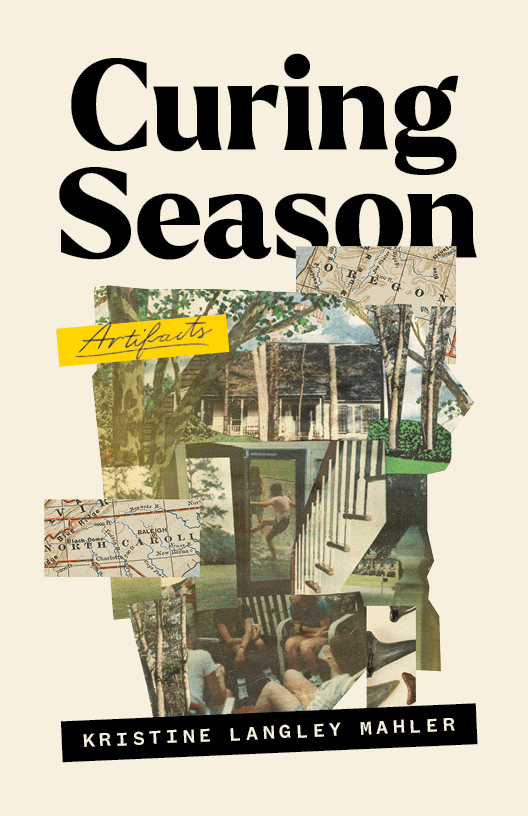
Kristine Langley Mahler’s essay collection, Curing Season: Artifacts offers an exhumation, an exorcism, and a bit of anodyne in response to questions of whether people can recover from toxic, obsessive friendships, and whether those of us who’ve felt out of place can find ourselves at home.
Forced to move with her parents from an idealized Oregon to the foreign country of the Deep South, Kristine’s journey through adolescence is complicated by the difficulty of breaking into an established brood of upper middle class, middle school girls. Worse, on visits back to Oregon, her old friends have changed. Some people don’t remember her, but she remembers her life, past and present, in shining and precise detail.
This skill (or inborn talent) ends up giving her the tools she needs to write these essays: a deep understanding of how details fit together to form meaning, of how artifacts reinforce memory and reality, of how relationships, and the stories we tell ourselves about them, both leave marks.
Praised for its masterful inventions in essay form, Curing Season is often as intriguing in its formatting as it is in its narrative. It’s written in such a diversity of forms, the figuring out of each essay’s pattern is as pleasurable as solving a puzzle. The essay “Creepsake” employs my favorite form of the collection: making up a word, and then writing narrative definitions of the word. So cool and inventive! Here’s an excerpt:
Creepsake
a memento growing along a wall, like a vine
I left things behind, fetishes tied around the fences I wanted to infiltrate. I pushed my copy of The Baby-Sitters Club Super Special #1 under the dust ruffle of Heather’s bed after a sleepover . . . I thought my “misplaced” belongings would be magnets, inexorably pulling relationships back to me . . .
Available from the publisher, WVU Press and the usual suspects.
Foreword’s image for this interview, a mash-up of the book’s cover, the author’s photo, and a glimpse of New Orleans
If you love New Orleans or want to visit there, check out C.W. Cannon’s I Want Magic for an insider’s take on what makes the city tick.
As a young woman who grew up under New England’s puritan Blue Laws, I found New Orleans’ legal public drinking exotic. I dreamed of partying there. By the time I had the freedom and money to attend Mardi Gras, though, it had lost its appeal for me, probably because I’d spent too many years bartending by then. For servers, holidays like New Year’s Eve can mean great tips, but they’re also amateur nights, where inexperienced drinkers overdo it and either act the donkey or puke or both.
A place where sensuality is celebrated year-round has a great appeal for me, though. As a mad hedonist who drenches food in butter or sugar or both, who chooses the 90-minute massage over the one-hour version whenever possible, I loved the lust for life (thank you, Iggy Pop) and nonjudgmental vibes New Orleans exuded once I finally visited the city in my fifties. I was delighted to review I Want Magic for Foreword, and to interview the author, C.W. Cannon.
My first interview question was about that lust for life:
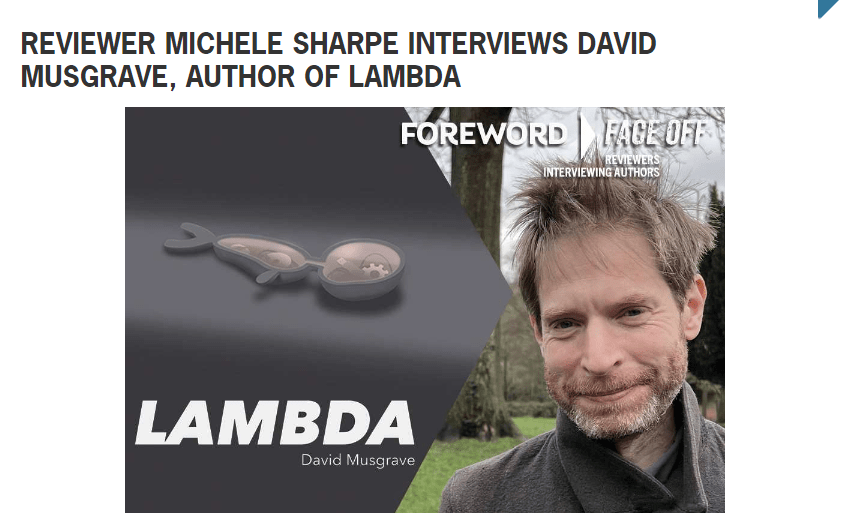
Here’s my interview of British author David Musgrave, whose science fiction novel, Lambda, took me out of this world!
The book is an on-the-edge-of-your-seat story where even your toothbrush collects data on you. It also considers important questions about the meaning of being human and whether a near-future (a/k/a “now”) surveillance state impacts that meaning. By bringing programming languages and natural languages together, the book adds a meta layer to the question of whether objects can have sentience.
Danielle Geller shares her efforts to reclaim her mother in a quiet, yet powerful voice that’s substantially free of retrospective editorializing. For readers who want to learn a life lesson along with the memoirist, this absence of “and now I know” observations may disappoint. For me, it was refreshing to read a memoir that kept that sort of clutter out of a story. Geller’s mother leaves her home on the Navajo reservation at nineteen, marries Geller’s father, and has three daughters. Alcohol takes over her life and she’s unable to care for her children; Geller grows up with one sister and their paternal grandmother. She has little contact with her mother and none with her mother’s family, and when her mother dies, Geller gradually takes steps to understand her mother, her mother’s family, and her mother’s culture. Her search for a true image of her mother has universal elements beyond the personal details of her story. Adoptees, foster care survivors, and others separated from their mothers as children will recognize the complexities of a child’s feelings toward an absent mother, how one carries those feelings into adulthood, the drive to connect with blood relatives, and how family separation creates generational loss. As an adoptee in reunion with my maternal family, Geller’s words rang true. As a writer and reader, I was swept up in the story, the structure, the imagery, and the wisdom. Looking forward to Danielle Geller’s next book.
One of Medium’s best ideas in 2021 has been starting the #StopAsianHate blog. I’m looking forward to reading and learning more about what life is like for people who identify as Asian in the present day and in the past. Reading has been an important way for me to educate myself about racism and anti-racism.
I’m especially hoping that Medium will include voices of transracial and transnational adoptees who identify as Asian, like J.S. Lee who writes about the trauma of transnational adoption for Yes! magazine
As a domestic adoptee, I feel a sense of solidarity with all adoptees. We all bring an outsider’s perspective with us to some extent, but people adopted from other countries and into families of other races often have an especially keen perspective on American culture. In any conversation about #StopAsianHate, the words of transracial and transnational Asian adoptees make a critical contribution, as so many have been “reckoning with racial identity and systems that tolerate and encourage racism” all of their lives.
As part of the announcement about the new blog, Medium sent an email asking folks to participate with some #StopAsianHate writing prompts, including “What does it mean to be co-laborers to advance racial justice? What does allyship look like to you?”
So what does allyship with Asian-Americans look like for me, a little old 97% white lady?
First, I’ll out myself as a disabled person: traveling and showing up at demonstrations are both difficult for me. I spend most of my time at home, but I am an avid reader and writer. My allyship takes the form of promoting Asian American literature by writing and publishing reviews of new books. Books from independent presses are usually the ones that get my attention. I publish the reviews on my blog, Amazon, and Goodreads, and sometimes the reviews are published online by literary magazines.
If you’re looking to read work by Asian American writers, I’ve included links to several of my favorite authors’ webpages at the end of this article. Meanwhile, here’s reviews of two recent books by Asian American adoptees that I enjoyed:
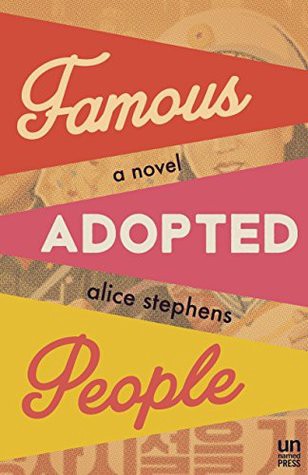
Famous Adopted Peopleby Alice Stephens (@AliceKSStephens) kept my attention riveted from start to finish, like a roller coaster ride through a kaleidoscope. It’s a book that switches gears a lot, and the author manages the transitions very well, partly because the novel is told through the perspective of a single protagonist who has a distinct voice. Lisa, a multiracial international adoptee from Korea who grew up with white adoptive parents in America, is a hard-drinking, work-shirking young woman whose close friendship with Mindy, another international adoptee, blows up when the two young women are traveling in Asia. What starts out as a story about friendship and identity becomes a crime mystery/political thriller/cultural criticism story with a little magic realism and a good bit of humor thrown in.
This was a very satisfying read for me. It kept me up at night and it kept me thinking. The whiplash ways of this novel seemed to me to be a meta-metaphor for the situation of transracial and international adoptees whose lives, like all adoptees’ lives, begin with the emotional whiplash of family separation and are further complicated by the cultural whiplash of being raised by a family that is obviously not their family of origin.
I love reading stories about adoption — fiction or nonfiction — because I was separated from my family by adoption as an infant, and I need stories that represent my experience. As a domestic adoptee, there are significant differences between my experiences and those of Lisa, the novel’s main character, but I still identified strongly with her questions about her own identity and her sense of alienation.
If you’re looking for a classic page-turner, I highly recommend this novel. And if you’re looking for insight on the adoptee experience, I highly recommend it for that reason, too. [originally published on my blog]
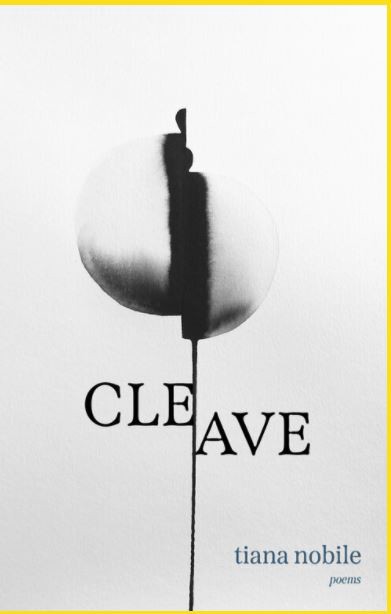
Cover of Tiana Nobile’s poetry collection CLEAVE
Cleaveby Tiana Nobile is a poetry collection of magnitude and fascination, spanning continents, history, and personal obsessions. I started reading it one evening after dinner and stayed up late with it, still reading. As poet Gabrielle Calvocoressi notes on the publisher’s page, “With breathtaking lyric beauty and formidable formal range, Nobile details the intimate effects of the international adoption industrial complex on children and parents caught up in a system’s unrelenting hunger. This is a book of remarkable compassion and real horror. Its stories will be news to many and all too familiar to others.”
Most, perhaps all, people who are adopted by strangers have experienced feelings of loss and alienation and an absence of knowledge about their origins. I’m a domestic adoptee, and Tiana Nobile identifies as a Korean American adoptee, so there are important distinctions in our two experiences of adoption, but her stories are still “all too familiar” to me. In a series of poems titled “Abstract” that are spaced out in the collection Nobile works with the abstraction that looms in absence. All these poems begin with wide, white space, visually illustrating the blank page that many of us face.
Mother without a face looks in the mirror. I wonder what creases we share. I wonder how long her hair is. I wonder if she chews on the inside of her mouth until the skin is chafed pulp . . . (10)
Adoption is often portrayed as a private family matter, but it’s a cultural practice, and it doesn’t exist in a vacuum. The adoptee experience of loss and alienation can be exacerbated in transnational and transracial adoptions in a country like the U.S., where racism and anti-immigrant hate poison communities, families, and individuals. Tiana Nobile’s poems place her personal experience of adoption in that wider community and in a historical continuum of American imperialism in Asian countries, making this a critical book for our critical times.
It’s also an aesthetically rich book, full of sensory delight in language and provocative use of many traditional elements of poetry like internal rhyme, organic form, alliteration, and startling imagery, much of which is taken from the “monkey love” science experiments of the 1960’s that separated newborn monkeys from their mothers in a study of maternal deprivation. From “Mother of Wire” (43)
Call me Rhesus Young and Moonless monkey without a cloth to dust her bones
A variety of intriguing formats in addition to the “Abstract” poems are included in the collection. For example, in “Where Are You Really From?” Nobile employs a justified prose poem format. A list of place names in the U.S. create a mystery narrative — one that illuminates the empty past of people separated from mother, family, culture, language, and history
Intercourse, Pennsylvania. Fertile, Iowa. Uncertain, Texas. Hazard, Nebraska. Accident, Maryland. Why, Arizona. Hell, Michigan. Disappointment, Kentucky. Embarrass, Minnesota. Truth or Consequences, New Mexico. Nameless, Tennessee. No Name, Colorado. Nada, Texas. Nothing, Arizona. (9)
Many of the poems mine science (or pseudo-science) for information on the mother-infant bond and details about fetal and infant Nobile’s poem, “Lost First Languages Leave Permanent Mark on The Brain, New Study Reveals,” uses this headline format to introduce a final meditation on what is lost
How do I translate the sound of my mother’s moaning? It’s a soft wail I hang on the wall of my windpipe (44)
A few more brilliant Asian American writers with recent brilliant books are graphic memoirist Mira Jacob (I wanted to give her Good Talk to everyone I know!), novelist Matthew Salesses (existentialism updated for a quirky 21st century), and Steph Cha (literary fiction meets crime drama meets recent history).
Writing even a very short review on Goodreads or Amazon for a book you enjoyed can have a significant impact on sales. It’s an effective way to support Asian writers doing the important work of bringing their stories into the light.
Read everything from Michele Sharpe — and more.
Upgrade to Medium membership to directly support independent writers and get unlimited access to everything on Medium.Become a member
Words in NYT, WaPo, Oprah Mag, Poets&Writers, et als. Adoptee/high school dropout/hep C survivor/former trial attorney. @MicheleJSharpe & MicheleSharpe.com
Everything you’ve heard is true: Gale Massey’s characters are filled with desires, ambitions, misgivings, and the whole range of human emotions. They are people whose fates you need to know.
Massey’s figurative language is often stunning and powerful, contributing to each story’s plot, characterization, and emotional tone. The opening of “Racine,” for example, describes the inevitability of the story’s conflict and its stoic emotional tone with “The minutes gather at her feet, pooling there like water seeping through a crack below a door.”
This collection illuminates many of the dark corners of what it means to be a woman in a time and place where women are [still] at the mercy of woman-hating policies, whether those are governmental, individual, or family policies.
In artistic terms and in terms of human relevance, Massey’s stories deliver. The short form gives her characters and themes the right amount of space to entice and then surprise. Most of all, these intense short stories succeed as literary page-turners readers will find irresistible.
Thanks to NetGalley for an advance review copy of this short story collection.
The perfect pandemic novel is a short novel, since our attention spans may be diminished by panic, or loss, or involuntary isolation. It is a novel set in a predictable world unlike the one we now inhabit, in order to offer us temporary relief from the 2020 shitshow.
Piranesi, the title character, lives in a labyrinth that offers the peace of solitude among beauty, interrupted only by brief interactions with “the Other.” He sets himself tasks, some wholly pragmatic, and some philosophic. His ongoing task is to know his world. Our task, as readers, is to discover how he ended up there.
The novel we need now might be one with an innocent protagonist like Piranesi because we ourselves may have become jaded by daily reports of infections and deaths and the callous responses of our government. We may need a likeable protagonist, too, because isolation may have made us unlikeable. Or perhaps the people we live with have become unlikeable, or even intolerable.
A perfect novel for this dark winter has a strange plot, original enough to be compelling, with just enough touchstones to invite us to try making sense of it. And because it is a novel, in the end we find a way through the strange yet familiar labyrinth. We reach a resolution. Sort of.
This is the book that kept me awake in the good way of reading because I believed whole-heartedly in a world, as opposed to the bad way of doomscrolling for jolts of “I cannot believe this bullshit.”
Piranesi, it turns out, is a man who can change his opinions when the facts demand it – a good lesson for us all in challenging times.
Right in time for #NAAM2019, my review of memoirs by adoptees Nicole Chung, Karen Pickell, and Lori Jakiela appear in the current issue of Hippocampus Magazine. Each memoir is lyrical and insightful, and each presents a distinct experience of being adopted.
Hippocampus Magazine, by the way, publishes terrific nonfiction stories. If you are a writer of nonfiction looking to publish a piece, check them out!
From the review:
“With its built-in interrogation of what it means to belong to a family, adoption offers a rich context for memoir. Quests to locate mysterious origins provide deeply archetypal narrative arcs for adoption stories, too, and the specialized dialect of adoption invites stories that consider the impact of language on life.”
Click here for the full review — and check out these excellent memoirs!






 Michele Sharpe