Right in time for #NAAM2019, my review of memoirs by adoptees Nicole Chung, Karen Pickell, and Lori Jakiela appear in the current issue of Hippocampus Magazine. Each memoir is lyrical and insightful, and each presents a distinct experience of being adopted.
Hippocampus Magazine, by the way, publishes terrific nonfiction stories. If you are a writer of nonfiction looking to publish a piece, check them out!
From the review:
“With its built-in interrogation of what it means to belong to a family, adoption offers a rich context for memoir. Quests to locate mysterious origins provide deeply archetypal narrative arcs for adoption stories, too, and the specialized dialect of adoption invites stories that consider the impact of language on life.”
Click here for the full review — and check out these excellent memoirs!
I don’t know who my father was — and maybe that’s why I got so riled up about a recent news story about “fertility doctors” scamming their patients who were trying to get pregnant by substituting their own sperm for donor sperm.
Try this timed writing exercise: First, make a list of the insults used only against women. Then, make a list of the insults used only against men. Compare your lists.
You’ll see that most derogatory terms for women have to do with promiscuity and most derogatory terms for men have to do with homosexuality.
I used this excercise back in the twentieth century when teaching college writing to women in a re-entry program. The point of the exercise was to demonstrate how language both creates and reflects cultural values. It’s very easy [surprise!] to come up with a long list of insults that get slung against women, but not so easy to write a list of insults slung only against men, especially if you don’t use slurs against specifically gay men. . . .
This memoir excerpt about discovering I was adopted was coincidentally published during November, which is National Adoption Awareness Month. The piece is also about the “secret mission” my adoptive father went on when I was ten years old.
If you’re reading this as an adult, you may already guess that the secret mission was not the heroic event I believed in as a child, but a story fabricated by adults to cover up a shame. Much as some adoptive parents (ncluding my own) kept adoptions secret to cover their shame at infertility or some other perceived inadequacy, the secret mission was a way of explaining a long absence. Hint: it invovled the FBI.
If you’re a writer who aims to be published, take heart from the publication of this essay. It was rejected at least 40 times before finally finding a home at Signal Mountain Review. From the time I first drafted it out in 2010 to this month’s publication, it went through many, many revisions. To some extent, getting published is about being tenacious and walking the fine line between believing in your own work and being willing to consider criticism.
November is National Adoption Awareness Month, which began in 1976 in Massachusetts to promote awareness of the need for adoptive families for children in foster care. While the “celebration” has continued to promote adoption from foster care, it’s also been co-opted by the for-profit adoption industry.
Every adoption begins with the breakdown of a family, and for this reason, a national celebration of adoption can bring up feelings of loss and alienation for adoptees and first parents. Adoption is complicated, and its effects are lifelong for everyone involved.
In my family, there’s a rich history of mothers giving up their children — most often to other family members, though. “Maternity Cave” is a story about how that history, and the tragedy of family breakdown, has played out for me and for one of my nieces.
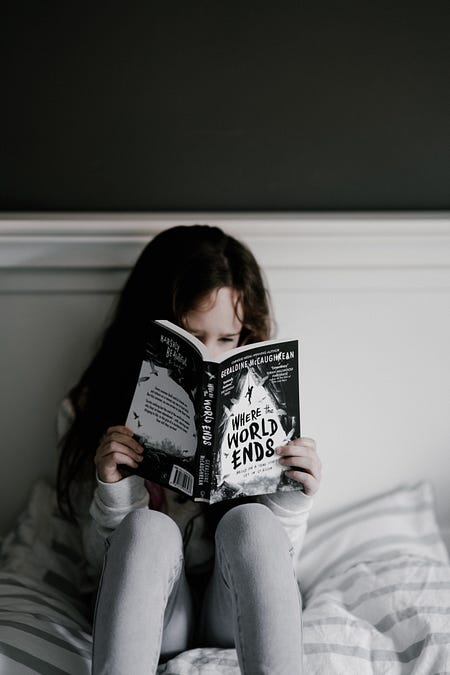
A girl reading a book with the title “Where the World Ends.” Photo by Annie Spratton Unsplash
Where do I end the world of my memoir? The ending keeps getting further away from me.
Some well-worn advice is to end on an image, or an action, or with dialogue, or (very carefully) with a reflection.
I’ll stay away from the reflection possibility because of my bad habit of wrapping up any story or poem with a cutesy little bow.
One of the best essays I’ve read so far about ending a memoir is Leigh Stein’s HOW TO END A MEMOIR WITHOUT
GETTING MARRIED. It appeals to me because Leigh shows herself struggling against the neatly tied up ending.
I love it when a book’s conflicts and themes get resolved. But not too resolved.
Do readers earn the right to a snug, reassuring wrap up to a memoir? Must the narrative of a segment of a life (which is what a memoir is) unfailingly end neatly? And even if it seems to, neither we, nor the narrator, can know for example, if the recovering addict falls off the wagon the very day we sigh with satisfaction over the end of an addiction memoir.
I have to choose an endpoint, and maybe I should choose based on the memorableness of the end-point. So here goes with examples of how I might use image, action, and dialogue to conclude my memoir draft. Coming up with these examples may prove helpful, but right now they are just making me more indecisive.
My first instinct is to end on an image. In one scene from the middle of my current draft, I’m on the Tybee Island beach at night and the ocean has turned phosphorescent. My aunt starts telling the little kids that it’s magic fairies in the water, but my uncle starts explaining bioluminescence to them. When his wife objects, he says “They make their own damn light. Isn’t that magic enough?” I’d love to return to that image.
Writers are such vultures, by the way. Another reason I can’t decide is that events keep happening that make me think “This would be a great ending to my memoir!”
I have a very big family, and someone is always saying or doing something that relates to my themes of finding identity and figuring out what makes a family stick together.
Maybe dialogue would work. Like when I was with my nephew and two of my nieces just before Christmas. They had a playful argument about “whose story was best,” of the ones I’d written about each of them: Alan Michael, Theresa, and BeeBee.
The joking conversation they had touched me deeply. I’m very lucky that my family supports my writing unconditionally, even when they know I’m in vulture mode, thinking about how I can use something they’re saying or doing in a poem or essay. I could end the memoir with their dialogue about their stories!
Or maybe an action is how the memoir should end. I recently published a short piece with Shondaland about searching for an Elvis tapestry that belonged to the mother I never met. If I use that action — the searching — I might be able to slap that already-written-essay onto the end of of the 80,000+ words I’ve written so far. So tempting!
What are your thoughts — are stories best when all their loose ends are tied up? Or do you like some ambiguity at the end? What are some of the best endings you’ve read or written?
In writing memoir, one of the critical challenges is deciding what to leave out. I’ll use my current memoir project as an example. It’s about reuniting with my birth family, and how building relationships with them, especially my nieces, changed my identity.
A subplot of the identity theme is the question of who my father is. In trying to find that out, my half-sister, my aunt and I all spat in our own little tubes for a DNA test. A surprise result of that test was that my sister and I both had some African-American heritage.
If I stray from the paternity issue and include that information about race in the memoir, that opens up a whole new set of issues. My mother’s dark skin, her racism, her husband’s membership in the Ku Klux Klan, the true identity of her father, my siblings’ participation in forced integration in the South in the 1970’s, the diverse attitudes about race among my siblings, and on and on and on.
Oy. Every time I’m sure it’s best to leave the race issue out, I think of a reason why I should include it. If I don’t disclose it, I’m suppressing the truth that many American white people have African ancestors. If I don’t disclose it, I’m white-washing myself, “passing” as white as one or more of my ancestors must have done. If I don’t disclose it, I’m cheating the reader of another dimension of the story.
Opening a box often means opening another box.
Oy, oy, oy. I turned to Auntie Google for advice on what to leave in and what to leave out. Most of what I found was some variation on “leave out anything that doesn’t further your theme.”
Oy, oy, oy, oy, oy. Now I have to figure out what my memoir’s theme is.
Many memoirs have more than one theme, but if so, they are usually connected in some way. The main theme of my project is “Blood will out”: meeting my family in my thirties opened up greater understanding of my own identity. It also taught me a lot about family identity and family connections.
[Side note: themes are often clichés. That’s not a bad thing. A cliché gets to be cliché by being repeated — because it has some universal truth to it.]
If the memoir’s theme is about identity, then it seems I should cover all aspects of the DNA test, maybe even the Facebook chat I had today with one of my nieces about how her parents disapprove of her Honduran boyfriend, or her just-barely-teenage son’s African-American girlfriend.
And that’s another problem — figuring out where to end. Because we’re a colorful bunch, my identity and my family’s identity keeps changing. But that seems like a topic for another blog post. Heaven help me.
“A little figure toy sitting in front of a window on a rainy day in Indonesia” by Rhendi Rukmana on Unsplash
In fresh grief, writing can bring a sense of calm, and order, and even, for a time, a sense of closure. It can help us navigate different stages of grief: denial, anger, bargaining, depression and acceptance.
In the midst of fresh grief, or in the memory of grief, writing can be a way to move inward, and it can also be a way to come up for air.
Grief informs many memoirs, whether the writer is grieving the loss of a loved one, or the loss of health, or a lost innocence or a lost opportunity. In my current memoir project, the central grief is the loss of my mother, or, more accurately, the loss of the opportunity to meet my mother. We were separated by adoption when I was an infant, and she passed away just a year before I was able to find my family.
This past spring, the goal I set for myself was to finish a first-but-coherent draft of my memoir of reuniting with my birth family. It took an extra month for me to finish that draft, and the rest of the summer to revise it. It’s a bit over 80,000 words, most of which has been published as stand-alone essays.
My biggest challenge in combining these essays has been to locate the narrative arcs between the conflicts and the resolutions. Today, while working on revisions, I began to see the arc of my grief for my mother, which first cut into me when I learned I was adopted, and has never really ended.
Grief has an arc, but like most complex emotions, it often has more than one arc, and sometimes, one arc repeats in a story, over and over again. In writing about my family and how I fit with them, I learned that as each of my five brothers passed away, I relived all the regrets I had about not searching for my mother before she died. Those regrets, which began with my inaction or procrastination, sometimes resolved when I took a positive action. Sometimes they resolved in acceptance. And sometimes, a regret stuck, and didn’t resolve. These are all possible arcs.
But the main arc of my grief is my search for a ghost-woman who held me as a secret and who died young. I’ve found bits of her in the gestures and expressions I share with my siblings, in my own laughter, which they say mirrors hers, in the physical characteristics I see repeated in her grandchildren, and in our family’s legacy of addiction.
Will I ever find enough pieces of her to feel my search is complete? Probably not. I think this searching arc will keep repeating. Whenever I feel that I’ve found her, she slips away. Whenever I accept that we’ll never meet, I find myself denying that I ever missed her.
Maybe grief is an emotion that resists a narrative arc with a beginning, a middle, and an end.
Person standing still in front of a mural of a sneaker while cars zoom past. Photo by Ashim D’Silva on Unsplash
Real life happens chronologically, but memoirs and personal essays don’t have to. In fact, sometimes they shouldn’t if there’s some suspense or wisdom to be gained by juxtaposing events from various points in the past.
This technique is sometimes called using flashbacks. A more complex form of juxtaposing multiple times and threads is often called braiding.
Writers use several methods to alert readers to time changes in stories. The first involves simple signalling in phrases like “But ten years ago, I thought differently,” or “Two years before this event.”
A second method is to switch settings once you’ve already established a primary setting. An example might be found in a memoir about serving in the military in Vietnam. Whenever the writer flashes back to high school in America, we the readers will know that time has shifted too and that the high school is not in Vietnam.
Strong images or memorable characters associated with particular time periods can also serve as signals to the reader. A memoir that covers two marriages is one type of story that can use this technique, toggling back and forth between the two spouses or between two strong images like a granite fireplace in one marriage and a concrete swimming pool in another.
I’ve written a number of braided essays, and ironically that has made it difficult to compile them in my current memoir project, which is chronological. Maybe I should re-think that. But currently what I’m doing is chopping those essays up into their discrete times and threads in order to weave them back together in a chronological timeline.
One example of a braided essay that I’m currently chopping up is “Maternity Cave,” included in the March 2017 issue of Hippocampus. Like most of my publications, I worked on writing this piece for several years, and worked for even more years trying to figure out what the events in the story meant.
I don’t usually intend to braid different time periods, but it happens a lot. Every so often, a phrase or an image or a small event in daily life captures my attention as being connected to a phrase or image or event from the past. Those little a-ha moments are often the beginnings of my stories.
The maternity cave story begins in 2006 on a visit to a bat cave in Central Florida with my teenage niece Candi, where we saw thousands of little brown bats swirling up into the dusk, then it wiggles around in the 1990’s between my first marriage, my experience of infertility, and finding my birth family, and then it shoots ahead to a family picnic in 2016, when Candi is a grown woman with two children of her own. There was a moment at that picnic that lit up the past for me.
The story doesn’t follow linear time, and I’ve been thinking lately that’s one of the benefits of being a reader of personal essays: we get to experience hard-earned wisdom in a way that isn’t tied to chronology. We get to look back, be in the present, and jump ahead to the future in less time than it takes to bake a cake. There’s no undo or do-over button because truth doesn’t change, but at least we get to see truth’s trail.
Memoirs and personal essays are time capsules, freezing us in a series of moments. But they can be time machines, too, taking us forward and backward, allowing us to grab on to the hindsight and foresight in someone else’s experiences, even when that sort of wisdom escapes us in our own lives.
Why shouldn’t we include photographs in memoirs? The only reason I can think of is that some (maybe many) publishers don’t want the hassle. Publishing images is more complex, more expensive than publishing text only. Unless, of course, you’re publishing on the internet.
That damn internet. It’s changing everything.
Some publishers are welcoming work that combines text and image. Some can be found in this list of cross-genre publishers curated by New Pages.
Here’s my attempt at a cross-genre piece combining photographs I took of trees with text about family trees.
Twisted branches, Unity, Maine
Maybe it was me who doctored this photograph, trying to give it an heirloom appearance.
I see a “B” in this tree. Or maybe a “D,” or a sideways “A.”
Or a man, hanging face down with his arms extended, reaching for something on the ground.
Or a lizard with its tail curled up behind it. Or the predictable snake.
Or a tree, twisted by snow and ice, and the deaths of other trees, and by forces I cannot imagine, putting forth the predictable new growth in spring.
Unknown dead tree, North Central Florida
I leaned against trees, wrapped my arms around trees, swung from trees and hid in trees, and walked on limbs as if they were tightropes. I prayed to trees, I raged at trees. Far away, the half-brothers I now know cut trees down for very little pay.
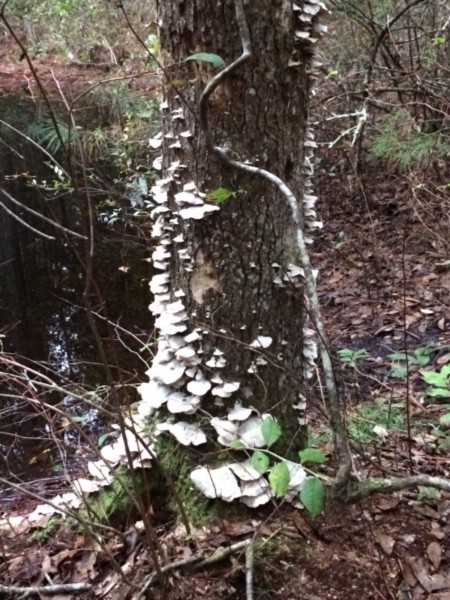
In my private forest, which isn’t mine, but belongs to the town, I watch this tree, and the spiral of fungi around its trunk that curves around in question marks and other symbols. It might be my family tree: no hierarchy, no single ancestor, and certainly no single pattern.
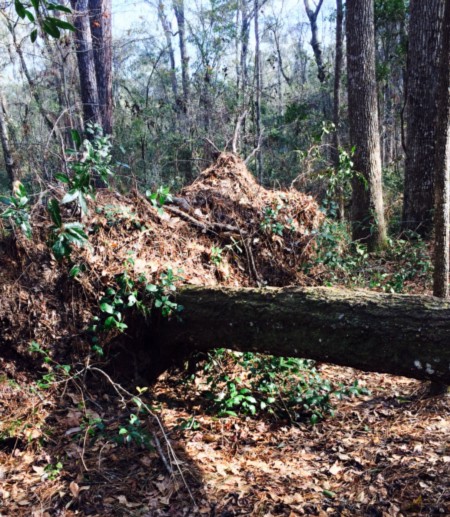
Living Turkey Oak, fallen, North Central Florida.
This tree took the earth with it when it tipped over in a windthrow. It is the only tree in this quadrant that fell. Maybe another trauma, like heart rot fungus, affected its anchorage and prepared it to let go.The letting go starts a new creation story: a hole opens in the canopy, and sunlight pours down on the forest floor. Saplings stuck in the pole stage may wake up and start to grow gain.
New stories mean new names. The earth ripped up with the tree is now called a tip-up mound.
Dead Cypress, North Central Florida.
This tree has been dead for so long, you can see right through it in spots. How did that happen? I imagine the branches fell first, then the crown, and then the bark sloughed off like the skin of a snake, and then the core collapsed on itself. What’s left is a suggestion of the strong column it once was, a gesture toward how the column once spun upward in helix fashion.
What’s left of the tree has the pocked and scored look of the karst limestone under the ground around these parts. Maybe the tree has taken on some characteristics of the stone.
Even long dead, and even taking on other characteristics, the tree is still a tree.









 Michele Sharpe