Books and Swedish Death Cleaning

I’m not much of a collector, but for the past twenty years or so I’ve been collecting chronic illnesses on my way to the big dirt nap. As a lifelong asthmatic who spent way too much of the first thirty years of my life hospitalized, I had experience with illness. But then in my forties came hepatitis C, arthritis, kidney disease, and fibromyalgia. So when I had pneumonia twice this winter — it began with a minor cold — I started thinking about how much stuff I wanted to leave behind.

The answer is “Not much.”

Moving from one state to another to another and back has helped keep my stuff quotient low, at least for a middle-class American woman. Now, at 66 years old, I hope to never move again. To make it easier for those who survive me, I need to ditch stuff they wouldn’t want. That’s the point of Swedish Death Cleaning: making things easy for those who survive you.

First, I looked at clothes I was saving for I don’t know what sort of occasion. Weddings and funerals, I guess. One wedding outfit and one funeral outfit seems sufficient, don’t you think? I don’t expect to be attending any big events unless they are outdoors, and who gets dressed up outdoors? And shoes! If I hadn’t worn them recently, I realized, that must be because they hurt my feet. Out with them! Off went a couple of bags of shoes and clothes to the Humane Society thrift store. Soon I’ll turn my fiery gaze to sweaters. I’m still culling.

But what about the greenery? I do collect plants, of both the indoor and outdoor variety, and propagating them is fun. I give many away each year. When Stephen and I were packing up to leave Idaho in 2011, I held a potted plant giveaway. Neighbors and friends snatched them up. Here in Florida, plants thrive, and thrive, and thrive. I think my nieces, friends, and neighbors would like to have the plants. Plus, plants aren’t “stuff,” right? They’re alive.

Okay, I can keep the plants.

My biggest, heaviest collection has been books. Once electronic readers became available, I thought my book collecting habits would dissipate, and they have, a little. I still buy poetry books because Kindle hasn’t figured out how to keep the line and stanza breaks of a poem intact in an electronic format. So that’s acceptable. Then I found myself buying the same hardcover version of The Idiot I read as a teenager, the one with the engravings. It’s dusty and heavy, and unfortunately the book’s sleeve (or is case the right term?) disintegrated in my hands the day it arrived. The book itself is in pretty good shape. I love to look at it and be reminded of how my [fucked-up] teenage brain worked. So I’m keeping it.

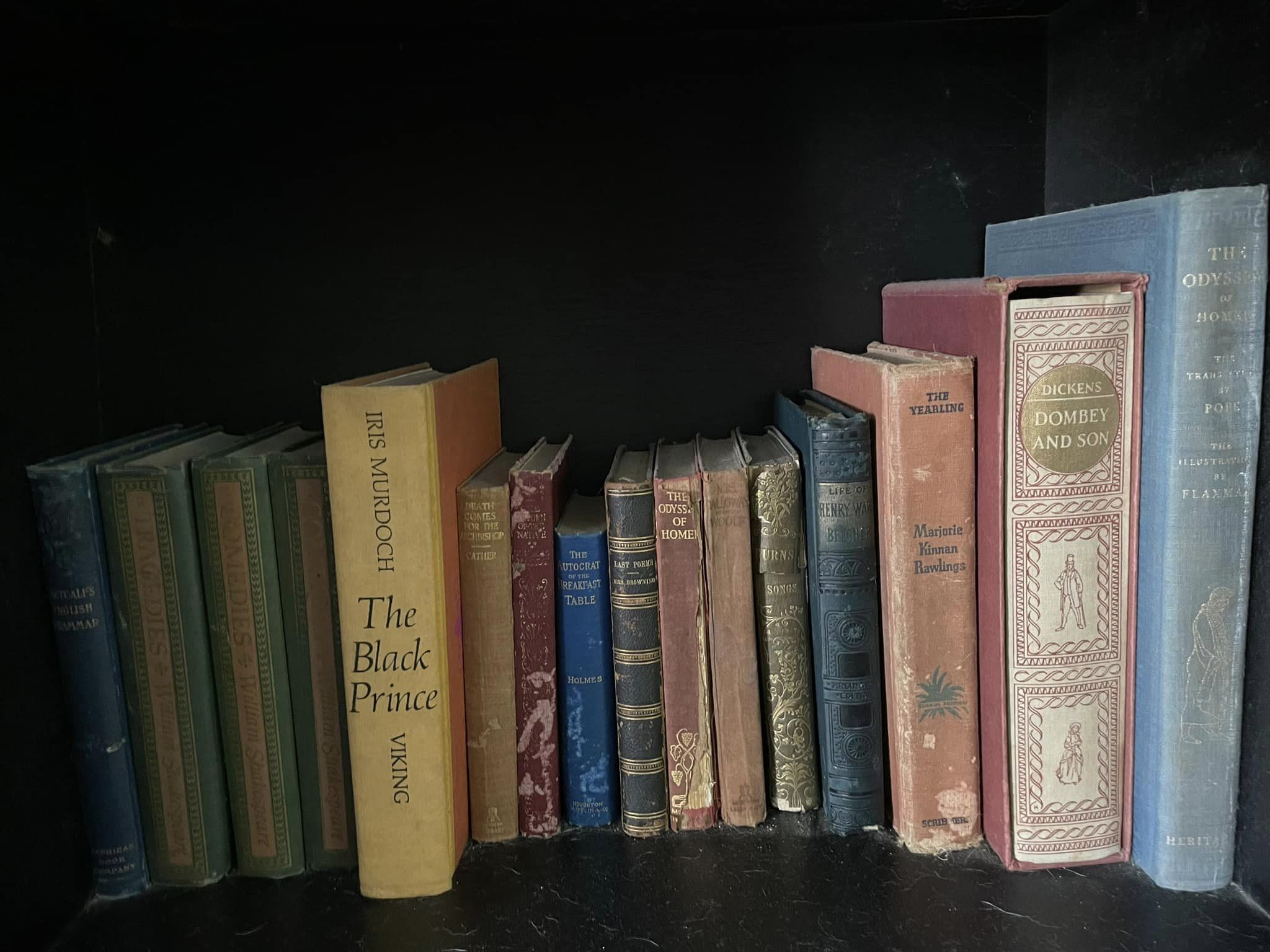
But I also had shelves of old hard cover books, some of them small enough for a small lady’s hand. Small books were fashionable in the 19th and early 20th century. Victorian stuff has always delighted me or annoyed me. I love entering past ways of thinking, and reading these old books gave me that.

But they had to go. I’m in a gifting network, and had a vague memory of someone collecting old books, so I posted a couple of shelves worth of these leather-bound classics. Someone scooped them up that very day.

What made the cut? That hardcover copy of The Idiot, of course, and a few other books that have become artifacts for me, representing a particular time and place. I also kept a couple of shelves of feminist essays, history, and theory, mostly from the 1970’s and 1980’s, plus the collected works of James Baldwin, some Winona Duke, and Ibram Kendi. We say “the internet is forever,” usually in response to a social or sexual gaffe, but anyone who’s studied history knows that nothing is forever. Rebels and their work can get suppressed and disappeared. I felt a moral obligation to keep the sorts of books that are being banned right now in Florida and elsewhere.

What’s next? It should be my poetry shelves that get the Swedish Death Cleaning Treatment. But poetry books are so small! And I keep buying them.

What do you give away? What do you hang on to, for dear life?

New-ish books to celebrate pride month

Every day is a good day to celebrate and envision equality for all, like my little dog Pilot here. In 2023, our Pride celebrations and activism have urgent significance, so this week I’ve chosen three books that celebrate queer survival and joy.

Didn’t Nobody Give a Shit about Carlotta by James Hannaham is set in and out of an upstate prison and Brooklyn in the 1980’s. The book opens as Carlotta, a trans woman, is about to go for a parole hearing after serving most of a 25-year sentence in a men’s prison. Parole is granted and she heads home on a bus. Arriving at the house where she grew up, she walks into an exuberant party with all the food, music, drinks, and dancing anyone could want. But the party isn’t for her homecoming — it’s for a dead man. Carlotta dismisses this mistake, at least on the surface, just as she dismisses any mention of her dead name as she grabs all the life she can on her first day out.

In a brilliant move, Hannaham ditches conventional punctuation and dialogue tags and blends first person and third person narration, allowing Carlotta’s thoughts and perspective to mesh with the voice of a cagey omniscient narrator.

The story and setting brought me back to my time as a public defender who was so often astonished by my clients’ reckless enthusiasm for life, even when life had shat upon them relentlessly. Carlotta is unforgettable.

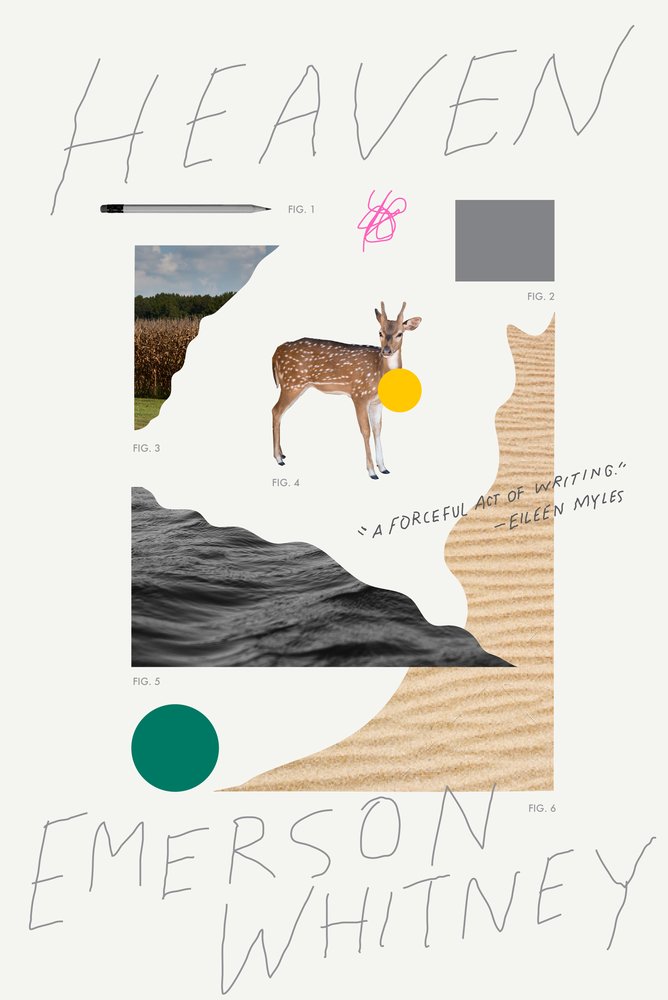
Heaven by Emerson Whitney

I came to this book because I needed more of Emerson Whitney’s writing after reading an advance review copy of their soon-to-be-published memoir, Daddy Boy, which becomes available June 27, 2023. Both books are from the McSweeney’s imprint, and both are literary excursions that draw on queer theory, art theory, and personal experience.

Heaven diagrams Whitney’s complex relationships with their family’s women. The book opens with Whitney re-remembering a story she’d been told about one of their mother’s near-death experiences of getting sober. The two, mother and child, are estranged, but Whitney isn’t here to judge. On the contrary: “Everything I fear in her lives hot inside of me.” Just look at how “hot,” one little word in a little sentence, opens up meaning. This is a short book, but one where you’ll probably highlight or copy down a zillion phrases or sentences. The writing is that good.

When the beloved grandmother asks “do you think you’re like this because your mother loved your brothers more?” Whitney notes that “No one asks about the root causes of heterosexuality or cisgenderism.” This questioning of underlying assumptions is the sort of thing I live for, along with relentless logic. The book is rich in both.

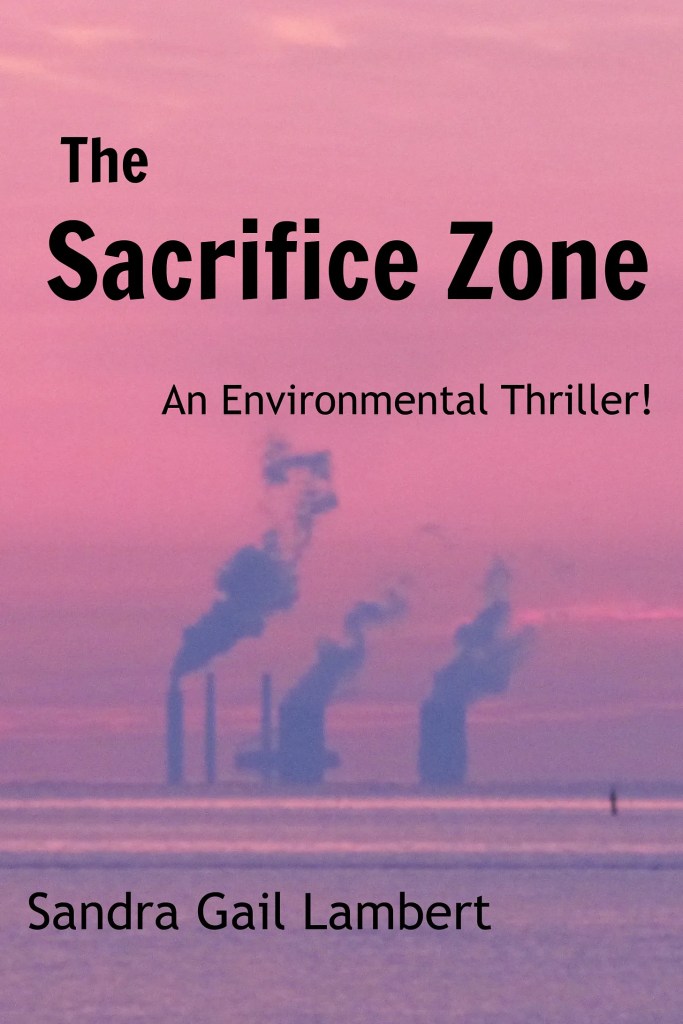
The Sacrifice Zone by Sandra Gail Lambert

Saving the best for last — and fessing up, up front, that author Sandra Lambert is my friend — is The Sacrifice Zone, a cli-fi, sci-fi environmental thriller with wholly unique elements, like one family’s sticky bond with the land they live on between the Gulf of Mexico and a nuclear power plant. Some think it’s a jealous, malevolent bond, one that makes it impossible for the family to leave.

A worldwide environmental disaster unfolds as Vic, the main character, is interning at a newsroom. She’s one of the few members of her family who can tolerate being away from home for long, and she’s different from them in other ways, too. A polio survivor, she uses braces and crutches to propel her through the world, and she’s a visibly butch lesbian.

At her newsroom, she hears and feels a siren going off hundreds of miles away. There’s been an explosion at the nuclear plant near her home, where a new device, “World’s Ease,” was being tested. This new technology, touted as civilization’s great energy solution, turns out to be a weapon. Vic leans into the horror that will change her family, her homeland, and the world, as she and her cameraman inch closer and closer to the truth.

Avalailable as an e-book, or the serialized version on Substack. Oh, and I have three FREE (no credit card required) one-month subscriptions to Lambert’s Substack to give out, which means you can read AND listen to The Sacrifice Zone in addition to her other witty and insightful essays about writing, queerness, disability, publishing, and aging. Send me an email if you want one of those free subscriptions: michelejsharpe (at) gmail

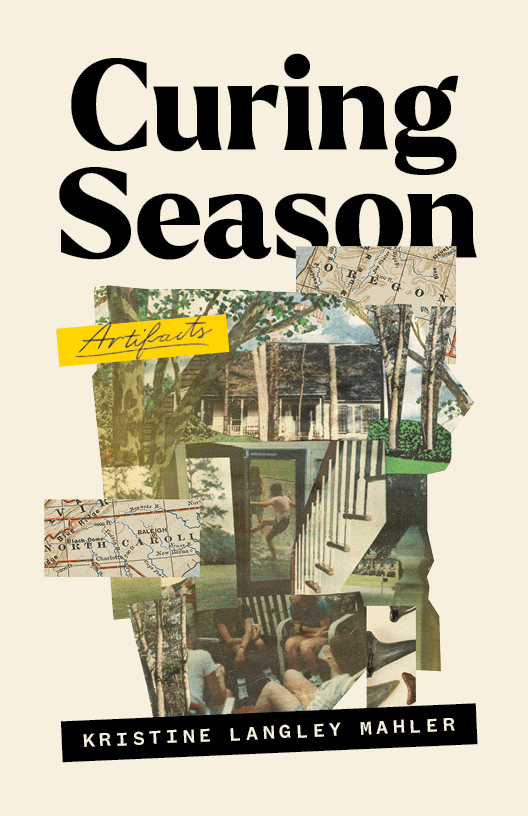
Curing the Mean Girls: A Review of Curing Season

Have there always been mean girls, or was that an invention of the 1990’s? Based on my reading habits, I’d say the mean girls have been with us for centuries, from Becky Sharp (no relation!) to the Heathers in Daniel Waters’ film of the same name to Regina George in Tina Fey’s film, Mean Girls.

Kristine Langley Mahler’s essay collection, Curing Season: Artifacts offers an exhumation, an exorcism, and a bit of anodyne in response to questions of whether people can recover from toxic, obsessive friendships, and whether those of us who’ve felt out of place can find ourselves at home.

Forced to move with her parents from an idealized Oregon to the foreign country of the Deep South, Kristine’s journey through adolescence is complicated by the difficulty of breaking into an established brood of upper middle class, middle school girls. Worse, on visits back to Oregon, her old friends have changed. Some people don’t remember her, but she remembers her life, past and present, in shining and precise detail.

This skill (or inborn talent) ends up giving her the tools she needs to write these essays: a deep understanding of how details fit together to form meaning, of how artifacts reinforce memory and reality, of how relationships, and the stories we tell ourselves about them, both leave marks.

Praised for its masterful inventions in essay form, Curing Season is often as intriguing in its formatting as it is in its narrative. It’s written in such a diversity of forms, the figuring out of each essay’s pattern is as pleasurable as solving a puzzle. The essay “Creepsake” employs my favorite form of the collection: making up a word, and then writing narrative definitions of the word. So cool and inventive! Here’s an excerpt:

Creepsake

  1. a memento growing along a wall, like a vine

I left things behind, fetishes tied around the fences I wanted to infiltrate. I pushed my copy of The Baby-Sitters Club Super Special #1 under the dust ruffle of Heather’s bed after a sleepover . . . I thought my “misplaced” belongings would be magnets, inexorably pulling relationships back to me . . .

Available from the publisher, WVU Press and the usual suspects.

Interviewing C.W. Cannon about I WANT MAGIC

Foreword’s image for this interview, a mash-up of the book’s cover, the author’s photo, and a glimpse of New Orleans

If you love New Orleans or want to visit there, check out C.W. Cannon’s I Want Magic for an insider’s take on what makes the city tick.

As a young woman who grew up under New England’s puritan Blue Laws, I found New Orleans’ legal public drinking exotic. I dreamed of partying there. By the time I had the freedom and money to attend Mardi Gras, though, it had lost its appeal for me, probably because I’d spent too many years bartending by then. For servers, holidays like New Year’s Eve can mean great tips, but they’re also amateur nights, where inexperienced drinkers overdo it and either act the donkey or puke or both.

A place where sensuality is celebrated year-round has a great appeal for me, though. As a mad hedonist who drenches food in butter or sugar or both, who chooses the 90-minute massage over the one-hour version whenever possible, I loved the lust for life (thank you, Iggy Pop) and nonjudgmental vibes New Orleans exuded once I finally visited the city in my fifties. I was delighted to review I Want Magic for Foreword, and to interview the author, C.W. Cannon.

My first interview question was about that lust for life:

Several essays in your book showcase New Orleans’ unapologetic sensuality. What sort of wisdom can the city offer to those who want to reclaim their exuberance after living through the COVID-19 pandemic?

Click here for the complete review

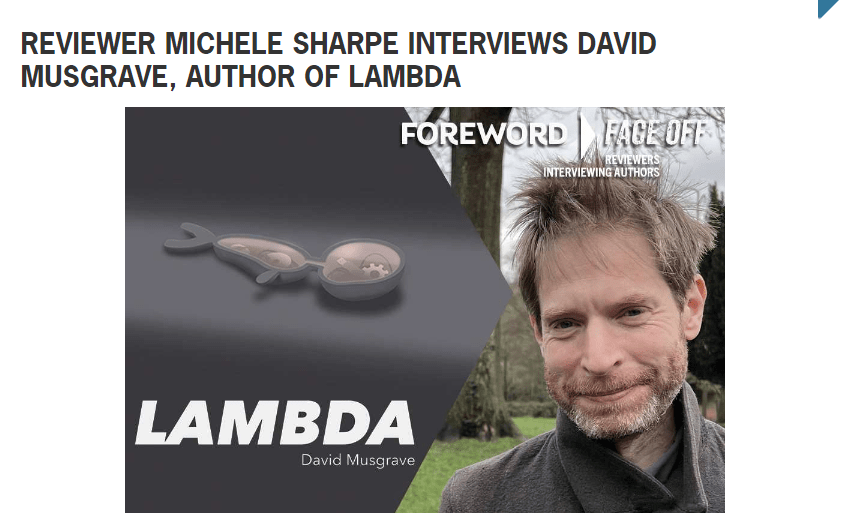
Can Objects have feelings?

Here’s my interview of British author David Musgrave, whose science fiction novel, Lambda, took me out of this world!

The book is an on-the-edge-of-your-seat story where even your toothbrush collects data on you. It also considers important questions about the meaning of being human and whether a near-future (a/k/a “now”) surveillance state impacts that meaning. By bringing programming languages and natural languages together, the book adds a meta layer to the question of whether objects can have sentience.

Click here, too, for my review of Lambda.

A womanist Take on the “Selfish Artist”

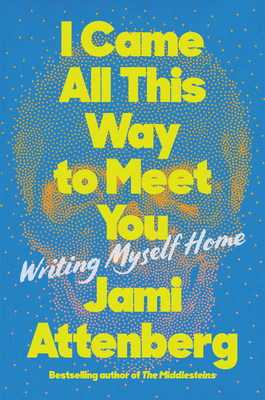
Reading Jami Attenberg’s memoir, I Came All This Way to Meet You, I kept thinking it was unlike any memoir I’d ever read. Above all, it’s a story of increasing dedication to the art of fiction, to an identity as a writer. Everything else is subordinate to her work, and everything else except family and friendships is transitory, even the idea of home.

Many male artists have told a story like this, but Attenberg brings a womanist take to the “selfish artist” trope without relying on some cathartic event to create her identity. Instead, she writes about the logistics of making time and space for her work, of dedication to selling her work, of understanding how she works.

The book hops around in time, but I found this pleasing along with the reflective bits toward the end where Attenberg tries to understand some of her less-than-happy behaviors.
Many thanks to NetGalley for an advance review copy. (less)

Sandra Gail Lambert

Jessica’s clone comes calling in this fast-paced story of nature, nurture, and survival.

Keily Blair's avatarSignal Mountain Review - Volume V, Issue I

Split Thread

White, neon light splatters over the windshield of the spacecraft. Although Jessica knows it can’t be called a windshield. There is no wind in space. Maybe there is. Earthbound, previously earthbound, Jessica is uncertain. Gayle43 reaches over and yanks on her harness until Jessica snaps tight against what should have been the co-pilot’s seat. But he is knocked out and stacked in a utility closet, along with the pilot, at the spaceport just outside Titusville which is forty miles down the Florida coast from Jessica’s home, which she will never be able to return to.

“Don’t touch anything.”

Gayle43 goes back to staring at the control panel in front of them. Lights blink, an alarm sounds, and Gayle43 punches buttons too fast for Jessica to follow. But not superpower fast. Does her clone have superpowers? The little craft twists sideways in quick loops. Streams of light crisscross in…

View original post 2,977 more words