A new poem in the fabulous (literally) journal, Rogue Agent
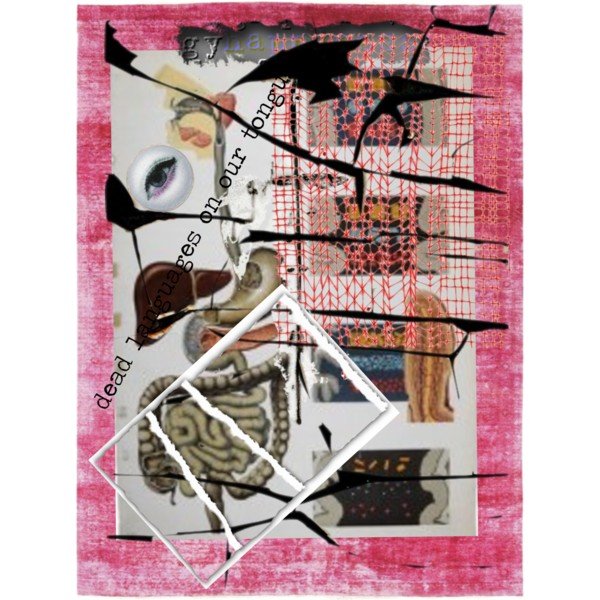
Jill Khoury’s cover art for Issue 107 of Rogue Agent: a square surrounded by a pink border and splashed with streaks of black or brown paint. At the top, the word “gyna-“ disappears under a piece of loosely-woven peach-colored fabric that covers the upper right part of the image. The words “dead languages on our tongues” appear diagonally across its left side. The rest of the image is made up of several pictures including an eye, a digestive tract, lungs, a liver, and bursts of colored pills.
Isn’t this cover image fabulous? As in like a fable, a fairy tale, a story. Collage art always captures my attention because of the work it does in juxtaposing images so that viewers can assemble a story to go with it.
Winter can be a difficult time for me and my old bones. My poem, “Aging in Place,” which appears in this current issue of Rogue Agent, reflects some of that difficulty.
Do you ever want to give up on healing? Why or why not?
My future snaps like a rusted latch and hasp. I live happily severed after. . . .
Agnes, my current foster dog, with her copy of War and Peace.
2023 was the year of resuming my delight in Russian novels. Nearly fifty years of intermittent longing for a treasured copy of The Idiot by Fyodor Dostoevsky had passed; my first lover had torn and sliced the book into pieces and scattered it around my neighborhood. One day in 2023, I realized the same edition might be available through the internet. It was.
Inviting a powerful object into your life can open a door. Shortly after the replica of my long-lost book arrived, I received an assignment from Foreword Reviews to review the Russian novel A Volga Tale by Guzel Yakhina, and from there came the adventure of writing a longer, hybrid essay/review about A Volga Tale for On the Seawall. From there came learning of the Footnotes and Tangents community’s 2024 slow read of War and Peace, which I’m participating in now.
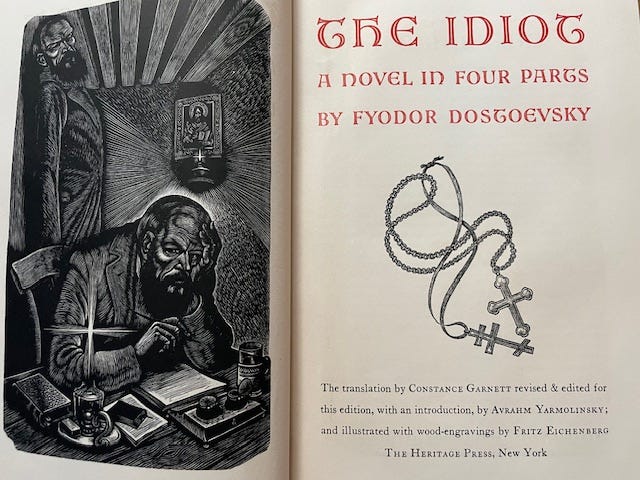
Aside from Nancy Drew mysteries and books about horses, there weren’t a lot of books in my childhood home, but a temporary subscription to a book club brought two new adult novels in. These were hardcovers that came in their own fabric-covered slipcases, which impressed me as classy. One was The Idiot, thick, heavy, and illustrated, a book that when open had a 14- by 10-inch footprint that could be draped across your lap like a small, sad dog. The Idiot’s illustrations, by Fritz Eichenberg, were wood cut prints, dark background and foreground with slashes and streaks of light outlining characters and their settings. The characters’ faces, for the most part, were contorted with emotion, like teenage life.
Title page of The Idiot with wood cut print of a struggling and divided Dostoevsky
I first read The Idiot several years before the destruction of my treasured copy. If you’re not familiar with the book, one way to summarize the novel is to say Dostoevsky wanted to write about a “wholly good man.” The novel’s good man, Prince Myshkin, is afflicted with a seizure disorder, not unlike Dostoevsky himself, who became epileptic as an adult.
This is a recurring trope — at least in certain stories — that moral perfection for men comes with injury to the body, or a physical difference from others. Think of the blinded, one-armed, and ethical-at-last Rochester at the end of Jane Eyre. Or, perhaps, Jaime Lannister from Game of Thrones, who loses his hand and briefly subscribes to a moral idea about community. Or Jesus.
When, in 2023, I opened the package with my new copy of The Idiot and slid the book from its classy slipcase, the slipcase came apart. The book itself was in better shape, and its heft brought back the sensation of being immersed in literature and the suffocating weight of a violent love affair. Being underwater feels powerful when I can swim, but frightening when I can’t swim away. But this is the story of reading, the one with a happy ending.
Nostalgia and excitement about something wholly new filled me in 2023 as I read A Volga Tale. The lush and rhythmic English translation by Polly Gannon reminded me of Constance Garnett’s translations of 19th century Russian fiction. Here were the sonic pleasures of subtle meter and rhyme, the roll of language as it meets with thought. Like Dostoevsky’s work, A Volga Tale employs magic realismand is concerned with “the relationship of the country and personality.”
The novel’s central character, Bach, is an ethnic German who lives on the Volga, a descendant of one of the many Germans encouraged to relocate to Russia by Catherine the Great. Bach is a village schoolteacher who loves languages but becomes speechless when he must face the Russian brutality that robs him of his wife and leaves him a daughter, Antje. With Antje, he conducts “a perpetual, gravely serious conversation in the language of breath and gesture and movement. Each of them was like an enormous ear, poised to listen and understand the other.”
Coming across familiar ideas brings the pleasure of recognition, and this can open my mind to new ideas, as if I’m also an enormous ear, poised to listen. What was new to me in Yakhina’s novel was her concern with “the issue of internal freedom and its ratio to the external freedom.” In Dostoevsky’s novels, freedom is sometimes granted through religious faith, but more often, it’s the characters’ own thoughts and actions that free them or shackle them, creating liberating epiphanies or inescapable prisons of remorse.
Yakhina’s outsider status as an ethnic Tatar woman in Russia may have contributed to her insights about the pressures of external freedom or lack thereof on a character’s internal freedom. In the early days of the Bolshevik Revolution depicted in A Volga Tale, the young people of Russia are swept up in a new life of communal effort for the communal good. Bach’s daughter Antje grows strong, happy, and free of gender constrictions with her comrades during that brief, pre-Stalin era.
The young women in The Idiot don’t experience such freedom; the main characters exist at opposite ends of literature’s traditional womanly spectrum: Aglaya Ivanovna, the virgin daughter of a general, and Nastassya Filipovna, an orphan, sold in some vague way to a wealthy man. By the time I read The Idiot, I’d already learned about the two ends of the womanly spectrum from Jane Eyre — the very good, innocent woman (Jane) at one end, and the very bad, experienced woman (Bertha) at the other end.
As is the habit of many readers, after the last page of A Volga Tale, I looked for more books by Guzel Yakhina and found her debut novel, Zuleikha, which is based on her family stories about life under Stalin and in the Siberian gulags. It is a spellbinding, cross-country epic, and because it won numerous literary awards around the world, I was able to get a copy from my local library. I’m hoping that Yakhina’s third book, a historical novel about the 1921 famine in Russia, will be translated into English soon.
In November of 2023, as if reading my mind (or my clicks, which are similar), Substack alerted me about a 2024 slow read of War and Peace. It had been decades since I read that book. Was it a coincidence that the used bookstore in my part of town had a paperback copy of War and Peace in the Constance Garnett translation, the translation I’d read in the 1970’s after The Idiot sent me in search of more Dostoevsky, which took me to the library and The Brothers Karamazov, The Possessed, Crime and Punishment, and later to War and Peace? Is it reckless of me, that with so many books and so little time, I turn to re-reading at least once a year?
Now it’s 2024, and I’m (re)reading a chapter a day of Tolstoy, thanks to an algorithm and to Simon Haisell and his Footnotes and Tangents group. Tolstoy’s words sound both familiar to my ear, and wholly new; I’d forgotten how funny he can be. This may be an even happier year than last year, when the used but new-to-me copy of The Idiot sat on my lap like a small, sad dog. Its pages felt soft, and miraculously whole.
It is a truth universally acknowledged that all happy families are alike; each family formed by adoption is unhappy in its own way.” [Apologies to Jane Austen and Leo Tolstoy for the mashup of opening lines from Pride & Prejudice and Anna Karenina.]
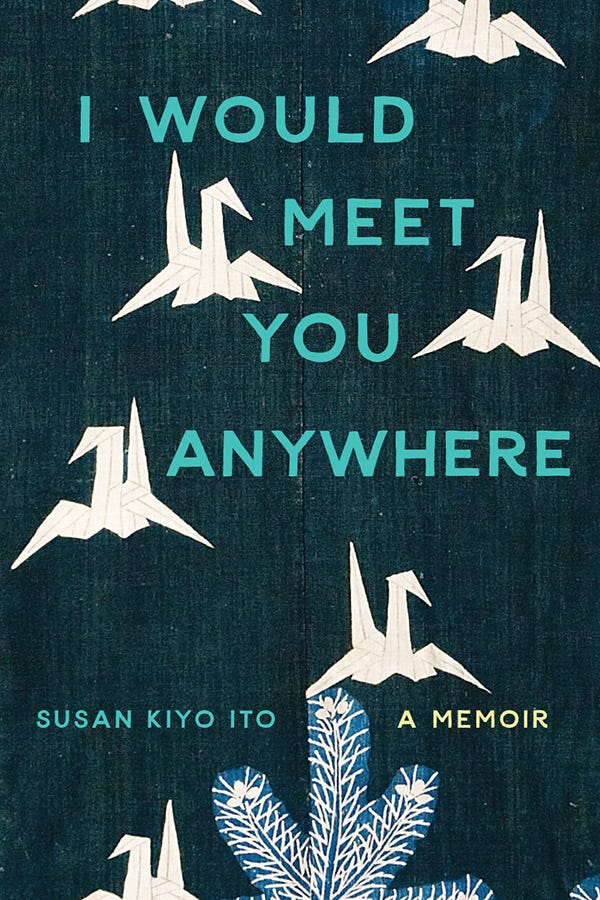
Susan Kiyo Ito’s memoir of her on-again, off-again relationship with her blood mother is a marvel of pacing. Scenes crucial to the narrative are slowed down to the moment-by-moment level of specific gestures, dialogue, interior thoughts, and exterior observations. This strategy allows readers to fully inhabit Susan’s real-time experiences of searching, finding, and accommodating Yumi, the woman who gave birth to her.
Susan’s adoptive parents supported her search for and subsequent relationship with Yumi, and tried to bring everyone in the adoption triad together. What was intended as loving and supportive ironically intensifies questions of family loyalty. During early meetings with Yumi, when Susan is in thrall to the very idea of being near to her own flesh blood, it’s as if she wants their relationship to be private. In aching, honest prose, she describes the awkwardness of feeling pulled toward Yumi and toward her adoptive parents when the four of them meet.
This early, innocent awkwardness is short-lived; it quickly turns into anger, anxiety, and pressure, for Susan’s existence is Yumi’s secret shame. Yumi is married and has two other children who know nothing of Susan. Yumi is anxious to keep the truth from them and everyone in her circle who knows her as a successful wife, mother, and businesswoman. A fragile, intermittent, under-the-radar relationship between Susan and Yumi results from this pressure. Even though Yumi cuts Susan off again and again, Susan keeps welcoming her back when Yumi turns up after years of estrangement as if everything is okay.
Maybe Susan keeps welcoming Yumi back because severing ties is too painful for a woman who who was separated from her mother as an infant. And maybe Yumi cuts Susan off and keeps coming back because it’s too painful for her, too. A survivor of the World War II Japanese internment camps, Yumi was also a survivor of misogynist American culture that shamed unmarried women who became pregnant, and then coerced them into giving up their babies to a predatory adoption industry. Maybe the blood ties between mother and child are so strong they cannot be permanently destroyed, so strong that they can overcome the pressures of culture.
I wouldn’t know. My own mother, fourteen when she became pregnant with me, died one year before my adoption search was successful. I’m childless, too, so the whole mother/child thing is mysterious to me, something I can only learn about from other people’s stories. Susan Kiyo Ito’s memoir I Would Meet You Anywhere is one of those stories: it brims with the contemporary details that translate another’s experiences and embraces the distance needed to interpret those experiences and give them meaning.
Tolstoy knew that on the surface at least, a happy family is one that conforms with societal values, like the Ozzie and Harriet family of the 20th century, and the Instagrammable family of the 21st century. A family that’s cobbled together by another family’s loss and grief — what’s usually the second best choice of adoption — is by definition unconforming and “unhappy in its own ways.” Reading about and listening to the experiences of adopted people, told in their own voices, is the only way to understand those unique experiences. And every one of our stories will be different.
I’ve been intrigued by the connections Summer Brennan makes between prosody and prose in The Essay Series #1: The Essay as Energy. I experimented with some of these connections in a revision of a “5 Things” draft that came out of my participation in her Essay Camp this month.
The questions that fascinated me most are: What happens to prose when short sentences come in a series? When short sentences alternate with sentences of moderate length or sentences that meander like stream of consciousness work? What about repetition in prose? What about actual meter?
The Driveway Writing Retreat
One year ago, I got a popup camper, a 10.5 foot box so tiny I can tow it with my 2012 minivan. It doesn’t have room for anyone but 5 foot 2 inch me and my 15 pound dog. It’s a perfect getaway vehicle for me, even if I don’t go anywhere in it.
Losing my train of thought in reaction to sudden, loud noises is now my default fault. Here’s a word problem: I have two dogs, one husband. Two are loud. I won’t say who. Every month, I take my tiny camper to a state or county park with the quiet dog.
My plan for November is escaping to the camper in the driveway where it’s parked. Today is my first driveway day. And also the next day. Do Catholic priests say, “Peace be with you,” so you’ll say, “And also with you” to the priests? Peace be with you.
Sudden loud noises aren’t my sole distraction. Inside my house, I distract myself. Houseplants need watering. Laundry needs doing. Dinner needs cooking. Bathroom needs cleaning. I’ve loved writing for over fifty years. I’ll do anything to avoid it.
I’ve been a woman for over fifty years, too. In the tiny camper, there’s no houseplants, no laundry, no cooking, no bathroom. No reflex to meet a need. I wish to be as unresponsive as weather. Some much needed rain has fallen in the past two days.
The tiny camper is a triangular aluminum can. The drizzle pings it. The drip from overhanging trees pongs it. The wind throws twigs at it. None of this distracts me. I have wanted to be alone all my life, all my life, all my life. It’s not about the noise.
Repetition is soothing. Looking at an image with a fractal pattern like this photo of a buttonbush in flower is soothing for many people. Listening to music that repeats a rhythm or melody is soothing for many people.
You can also try re-reading a favorite book. Your brain recalls much of what will happen in the book, but not everything, so re-reading is a soothing blend of the familiar with sprinklings of new discoveries. Falling back into the world of a book you’ve already entered can be relaxing, and re-reading can also reveal how you’ve changed since last reading the book.
Here’s an example of that reveal function: I loved all of Jane Austen’s novels as a kid until I got to Emma. It was so horrible, I didn’t believe it was written by the same person. When I revisited it as an adult, I saw why: Emma’s character faults (bossy, know-it all, and yet unperceptive when it came to what was right in front of her) were too much like mine. Re-reading revealed that I’d grown up enough to recognize those character faults.
This week, I extended my re-reading to a new book: the twistily plotted Fingersmith by Sara Waters, which I first read in 2008 or 2009 while living in Idaho. Here’s the set up: An elaborate confidence game brings two young women from different class backgrounds together in 1800’s England, and they fall in love.
The novel’s period details are riveting enough to transport me out of my 21st century world, and on re-reading those details brought me fresh pleasure. Or horror, like this detail: for the convenience of their keepers, the hair of asylum inmates could be shaved off — or it could be braided and sewn to their heads with cotton thread.
This is literary fiction with a plot twist, and another twist, and another twist, with an immersion in England’s 19th century class obsessions and oppressions, and a consuming love story. What did the re-reading reveal to me? That 10+ years of writing prose has made me more attuned to technique than when I first read the book.
Shout out to The Handmaiden, the 2016 South Korean film adaptation of Fingersmith directed, co-written, and co-produced by Park Chan-Wook. It’s a sumptuous, erotic beauty of a film that replaces the book’s British class conflicts with the ethnic status conflicts between Korean and Japanese people in the 19th century.
July, the month when the Americans with Disabilities Act, or ADA, was passed, is Disability Pride Month. Today, it’s not July, but every month is an opportunity to honor the history, achievements, experiences, and struggles of the disability community. Things many of us expect (sort of) now, like accessible public buildings and public transportation, only came about thanks to the tenacious activism of people with disabilities and their allies.
Sandra’s memoir, A Certain Loneliness, published by University of Nebraska, is a classic text about growing up disabled. As an “old polio,” a person who contracted polio during the mid-twentieth century epidemic, growing into her adult identity as a disabled lesbian, she learns how disability can become more complex as we age. With the focus on the body personal and the body politic you might anticipate in a book from Sandra if you’ve read any of her fine essays, this memoir resonates with joy, even as it sometimes burrows into pain and frustration with forces that work against community. It contains some of the most eloquent, visceral descriptions of chronic pain I’ve ever read. Having access to her rendering of her arm and shoulder pain (think of hauling yourself around on crutches for decades) and the deadening fatigue of continuing to work as a book seller through that pain was analgesic for me when I struggled with chronic pain while working a desk job.
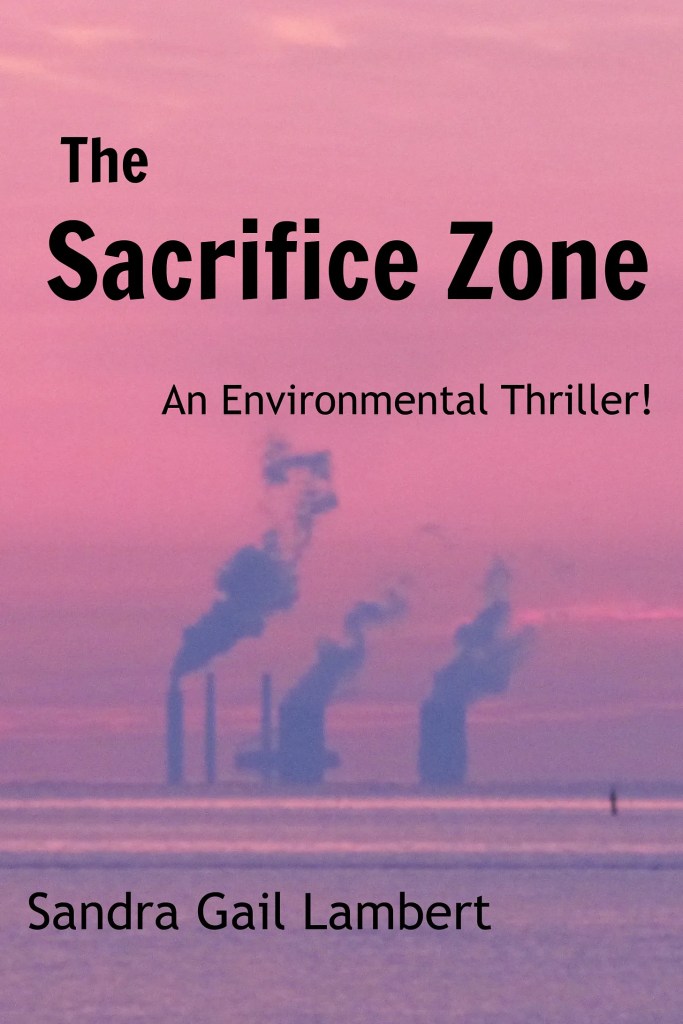
But wait, there’s more! Sandra recently published an environmental thriller on her Substack and as an ebook. The Sacrifice Zoneis a wholly original page-turner that’s kept me up past my bedtime. Set in Georgia and Florida, the main character, Vicky Jean to her family and Vic to others, is a journalist who comes from a family attached to their coastal Florida environment in deep and sometimes disturbing ways. When a nuclear plant near her family home explodes, releasing a deadly toxin, Vic is in Washington DC in her first media job out of college. Told that her whole family has been wiped off the map, she doubles down on investigating the explosion, the toxin, and the chaos that follows. Something isn’t right, and it never was.
And still more! In March, 2024, University of Georgia will publish Sandra’s essay collection, My Withered Legs. The title, in case you’re wondering, is both ironic and sarcastic; it was a phrase tossed at Sandra by a long ago editor who thought she needed to describe how her legs look. The editor didn’t know what Sandra’s legs looked like, but still felt free to offer the phrase “withered legs,” a description the editor imagined on their own. Well, some people think they know what it’s like to be other people without even asking.
Thank the stars for reading, which does allow us to experience at least a smidgen of another person’s life if we can forego varnishing it with our own expectations. My Withered Legs is now available for pre-order from the University of Georgia press, and online outlets including Barnes & Noble and Amazon.
I’m not much of a collector, but for the past twenty years or so I’ve been collecting chronic illnesses on my way to the big dirt nap. As a lifelong asthmatic who spent way too much of the first thirty years of my life hospitalized, I had experience with illness. But then in my forties came hepatitis C, arthritis, kidney disease, and fibromyalgia. So when I had pneumonia twice this winter — it began with a minor cold — I started thinking about how much stuff I wanted to leave behind.
The answer is “Not much.”
Moving from one state to another to another and back has helped keep my stuff quotient low, at least for a middle-class American woman. Now, at 66 years old, I hope to never move again. To make it easier for those who survive me, I need to ditch stuff they wouldn’t want. That’s the point of Swedish Death Cleaning: making things easy for those who survive you.
First, I looked at clothes I was saving for I don’t know what sort of occasion. Weddings and funerals, I guess. One wedding outfit and one funeral outfit seems sufficient, don’t you think? I don’t expect to be attending any big events unless they are outdoors, and who gets dressed up outdoors? And shoes! If I hadn’t worn them recently, I realized, that must be because they hurt my feet. Out with them! Off went a couple of bags of shoes and clothes to the Humane Society thrift store. Soon I’ll turn my fiery gaze to sweaters. I’m still culling.
But what about the greenery? I do collect plants, of both the indoor and outdoor variety, and propagating them is fun. I give many away each year. When Stephen and I were packing up to leave Idaho in 2011, I held a potted plant giveaway. Neighbors and friends snatched them up. Here in Florida, plants thrive, and thrive, and thrive. I think my nieces, friends, and neighbors would like to have the plants. Plus, plants aren’t “stuff,” right? They’re alive.
Okay, I can keep the plants.
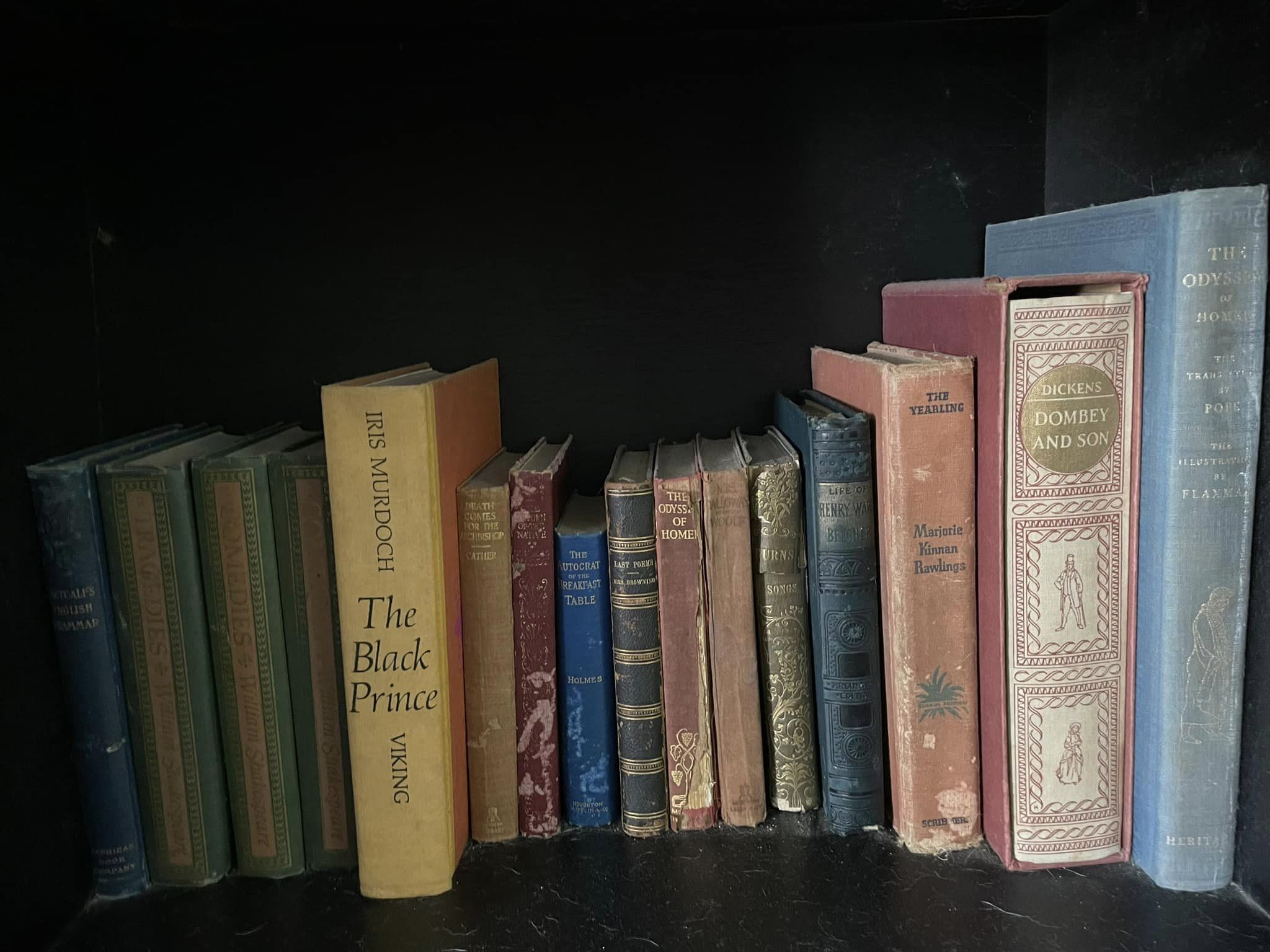
My biggest, heaviest collection has been books. Once electronic readers became available, I thought my book collecting habits would dissipate, and they have, a little. I still buy poetry books because Kindle hasn’t figured out how to keep the line and stanza breaks of a poem intact in an electronic format. So that’s acceptable. Then I found myself buying the same hardcover version of The Idiot I read as a teenager, the one with the engravings. It’s dusty and heavy, and unfortunately the book’s sleeve (or is case the right term?) disintegrated in my hands the day it arrived. The book itself is in pretty good shape. I love to look at it and be reminded of how my [fucked-up] teenage brain worked. So I’m keeping it.
But I also had shelves of old hard cover books, some of them small enough for a small lady’s hand. Small books were fashionable in the 19th and early 20th century. Victorian stuff has always delighted me or annoyed me. I love entering past ways of thinking, and reading these old books gave me that.
But they had to go. I’m in a gifting network, and had a vague memory of someone collecting old books, so I posted a couple of shelves worth of these leather-bound classics. Someone scooped them up that very day.
What made the cut? That hardcover copy of The Idiot, of course, and a few other books that have become artifacts for me, representing a particular time and place. I also kept a couple of shelves of feminist essays, history, and theory, mostly from the 1970’s and 1980’s, plus the collected works of James Baldwin, some Winona Duke, and Ibram Kendi. We say “the internet is forever,” usually in response to a social or sexual gaffe, but anyone who’s studied history knows that nothing is forever. Rebels and their work can get suppressed and disappeared. I felt a moral obligation to keep the sorts of books that are being banned right now in Florida and elsewhere.
What’s next? It should be my poetry shelves that get the Swedish Death Cleaning Treatment. But poetry books are so small! And I keep buying them.
What do you give away? What do you hang on to, for dear life?
Every day is a good day to celebrate and envision equality for all, like my little dog Pilot here. In 2023, our Pride celebrations and activism have urgent significance, so this week I’ve chosen three books that celebrate queer survival and joy.
Didn’t Nobody Give a Shit about Carlotta by James Hannaham is set in and out of an upstate prison and Brooklyn in the 1980’s. The book opens as Carlotta, a trans woman, is about to go for a parole hearing after serving most of a 25-year sentence in a men’s prison. Parole is granted and she heads home on a bus. Arriving at the house where she grew up, she walks into an exuberant party with all the food, music, drinks, and dancing anyone could want. But the party isn’t for her homecoming — it’s for a dead man. Carlotta dismisses this mistake, at least on the surface, just as she dismisses any mention of her dead name as she grabs all the life she can on her first day out.
In a brilliant move, Hannaham ditches conventional punctuation and dialogue tags and blends first person and third person narration, allowing Carlotta’s thoughts and perspective to mesh with the voice of a cagey omniscient narrator.
The story and setting brought me back to my time as a public defender who was so often astonished by my clients’ reckless enthusiasm for life, even when life had shat upon them relentlessly. Carlotta is unforgettable.
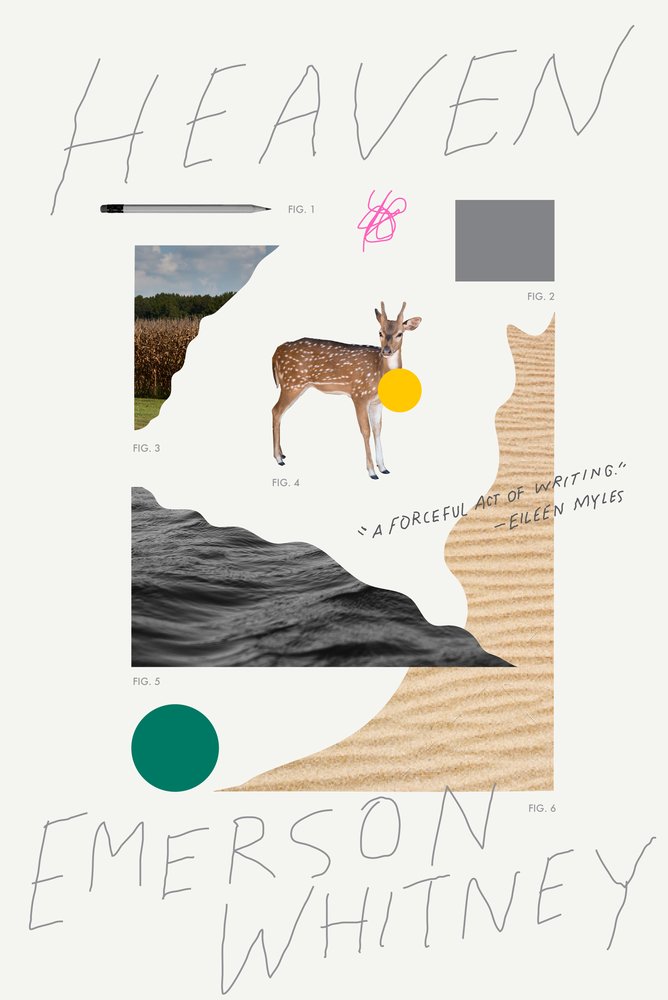
I came to this book because I needed more of Emerson Whitney’s writing after reading an advance review copy of their soon-to-be-published memoir, Daddy Boy, which becomes available June 27, 2023. Both books are from the McSweeney’s imprint, and both are literary excursions that draw on queer theory, art theory, and personal experience.
Heaven diagrams Whitney’s complex relationships with their family’s women. The book opens with Whitney re-remembering a story she’d been told about one of their mother’s near-death experiences of getting sober. The two, mother and child, are estranged, but Whitney isn’t here to judge. On the contrary: “Everything I fear in her lives hot inside of me.” Just look at how “hot,” one little word in a little sentence, opens up meaning. This is a short book, but one where you’ll probably highlight or copy down a zillion phrases or sentences. The writing is that good.
When the beloved grandmother asks “do you think you’re like this because your mother loved your brothers more?” Whitney notes that “No one asks about the root causes of heterosexuality or cisgenderism.” This questioning of underlying assumptions is the sort of thing I live for, along with relentless logic. The book is rich in both.
Saving the best for last — and fessing up, up front, that author Sandra Lambert is my friend — is The Sacrifice Zone, a cli-fi, sci-fi environmental thriller with wholly unique elements, like one family’s sticky bond with the land they live on between the Gulf of Mexico and a nuclear power plant. Some think it’s a jealous, malevolent bond, one that makes it impossible for the family to leave.
A worldwide environmental disaster unfolds as Vic, the main character, is interning at a newsroom. She’s one of the few members of her family who can tolerate being away from home for long, and she’s different from them in other ways, too. A polio survivor, she uses braces and crutches to propel her through the world, and she’s a visibly butch lesbian.
At her newsroom, she hears and feels a siren going off hundreds of miles away. There’s been an explosion at the nuclear plant near her home, where a new device, “World’s Ease,” was being tested. This new technology, touted as civilization’s great energy solution, turns out to be a weapon. Vic leans into the horror that will change her family, her homeland, and the world, as she and her cameraman inch closer and closer to the truth.
Avalailable as an e-book, or the serialized version on Substack. Oh, and I have three FREE (no credit card required) one-month subscriptions to Lambert’s Substack to give out, which means you can read AND listen to The Sacrifice Zone in addition to her other witty and insightful essays about writing, queerness, disability, publishing, and aging. Send me an email if you want one of those free subscriptions: michelejsharpe (at) gmail








 Michele Sharpe