Writing Memoir: Saving Your Life

“A fountain pen on an open journal” by Aaron Burden on Unsplash

You’ve heard it before: Writing saved my life.

If you’ve wondered about the truth of that, I’m happy to report that there’s a boatload of science behind that saying.

In 2005, for example, British researchers found that short periods of “expressive writing” resulted in better physical and psychological health.

Writing about traumatic, stressful or emotional events has been found to result in improvements in both physical and psychological health, in non-clinical and clinical populations.

It makes intuitive sense to me that writing about our tragedies and triumphs can improve our emotional health or bring us peace of mind. But I was surprised at the number of studies showing an impact on physical conditions including rheumatoid arthritisEpstein-Barr virus, and hypertension.

Most of these studies focused on short, guided periods of expressive writing or guided, written disclosures of trauma. The writing practices were standardized as much as possible in order to achieve some measure of reliability for the studies.

But what is meant by “expressive writing”? In an article for Psychology Today, Dr. John F Evans provides a definition:

It is personal and emotional writing without regard to form or other writing conventions, like spelling, punctuation, and verb agreement. Expressive writing pays no attention to propriety: it simply expresses what is on your mind and in your heart.

This, to me, sounds a lot like the “free writing” technique put forth by teachers from New Age guru Natalie Goldberg to university professor Peter Elbow . Not to mention the thousands (or more) college writing teachers like me who advocated free writing in their classrooms.

The idea behind free writing is that inexperienced writers, or writers who’ve been criticized harshly for things like spelling errors, can sometimes be paralyzed by fear of making mistakes. They can be so fearful that their writing muscles cramp up, or they feel they have “writer’s block.”

The free writing technique aims to remove those fears by de-valuing mechanics like spelling, punctuation, and grammar. The goal in free writing is only for the writer to move thoughts from the brain to the page. And that, after all, is the goal of all writing: translating our thoughts into words.

For writers of memoir or personal essays, putting aside fears of being judged can be the first challenge to overcome. Many turn to free writing as a way of silencing the internal editor — at least temporarily.

Expressive writing may be beneficial to psychological and health, but is it more beneficial to brain health than other kinds of writing? Is there a neurobiological reason why translating thoughts into words, in a judgment-free zone, has a therapeutic effect?

Maybe, but it’s probably related to writing by hand as opposed to typing. The studies I referred to at the beginning of this post don’t mention whether the writing was done by hand or by keyboard. Other studies have shown, though, that writing by hand improves memory and other cognitive functions.

And, a recent study based in India demonstrated that adults learning to read and write (by hand) rewired their brains.

By the end of the study, the team saw significant changes in the brains of the people who had learned to read and write. These individuals showed an increase in brain activity in the cortex, the outermost layer of the brain, which is involved in learning.

Learning to read also seemed to change brain regions that aren’t typically involved in reading, writing or learning. Two regions deep in the brain, in particular, appeared more active after training — portions of the thalamus and the brainstem.

These two regions are known to coordinate information from our senses and our movement, among other things. Both areas made stronger connections to the part of the brain that processes vision after learning to read. The most dramatic changes were seen in those people who progressed the most in their reading and writing skills.

I’ve heard many writers say that writing has saved their lives. Maybe it’s even saved mine. But one thing is certain: our brains need exercise to be healthy, and writing provides it.
Writing on Politics: Part 2

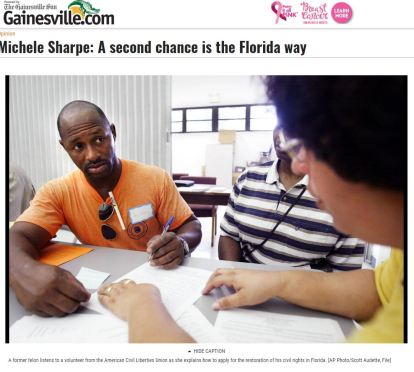
It’s been a political couple of weeks for me in terms of writing. In addition to an op-ed for the Washington Post, I also wrote an op-ed for my local newspaper in support of a proposed amendment to the Florida constitution that would restore voting rights to most Floridaians who’ve been convicted of a felony.
Second Chances for Gville Sun
If you’re interested in writing for your local paper, the good news is that in most smaller markets, local newspapers will print editorials by citizens who write reasoned articles about relevant area issues. The bad news is that most local papers don’t offer payment to writers who aren’t on staff.

For me, writing occasional pieces for my local paper is a way of doing community service. I’m supporting local journalism, and offering perspectives I think are needed. In the past, I’ve written about the shameful history of lynching in our region and the necessity of training older workers for sustainable jobs.

I was motivated to write the current piece because the 21st century’s trend of mass incarceration is a travesty. Today’s criminal “justice” system is far more predatory and punitive than it was when I practiced as a public defender in the 1980’s and 1990’s. But two things have stayed the same: most of the people involved with the system are addicts or alcoholics, and prison doesn’t work.

Family has been another motivator for me. People who’ve been convicted of crimes find it very difficult to start over once their sentences are wrapped up, as I know from watching my brothers, nieces and nephews struggle to stay clean after being in prison.

If you’d like to write for your local newspaper, get in touch with the op-ed editor to find out if they print citizen articles. You can find contact info for the editor by consulting the paper’s masthead, or by simply calling the paper. Ask the editor what he or she is looking for in terms of word count, and if they have other guidelines. Then put your talent and skill in service of local journalism.

Write on.

Writing on Politics

Like many people in America, I’ve been following the Kavanaugh confirmation hearings. We all bring our experience to the table when analyzing the news, and I’ve been looking at the issues raised by these hearings as both a feminist and a former trial attorney.

Sometimes, anger motivates me to write. I want to figure out why I’m angry, what I can do about it, and whether my anger is valid. I mean “valid” in the logical sense.

This article, published last week by the Washington Post, concerns something I’ve been angry about since I was in law school: special terminology that sets alleged sexual assault victims apart from alleged victims of other crimes. As I note in the article, you never hear alleged robbery victims referred to as “the accuser,” and yet, this is the norm for the media in cases of sexual assault.

WaPo 2018-9-27

Writing Memoir: Using Dream Images

“A silhouette of a man holding a smoke bomb on a deserted beach, with a pink sunset sky in the background” by Aziz Acharki on Unsplash

Do dreams have a place in nonfiction?

Since childhood, I’ve had occasional vivid dreams — the kind that are so weird, or colorful, or fantastic that they woke me up. When I started writing poetry (also as a kid), I thought those dreams and their images belonged in poems. They seemed so meaningful to me. So I wrote.

Later, more than one poetry teacher told me to ditch the dream poems — they didn’t mean anything to anyone but me. The teachers were right: without a context, dream images don’t translate very well for an audience. Of course, if you’re writing only for yourself, that’s different.

But dreams can work well for an audience in fiction and in creative nonfiction writing. They work as long as we make clear that they are, in fact dreams, and connect them to our stories and the people in our stories. I’m not a dream-interpreter, but when people reveal their dreams to me in real life, I feel as if I’ve gotten inside their heads a little. I feel I know them better.

Readers of both fiction and nonfiction want to know the people — or characters — in the stories they read. Reading a good book, we actually cravethat knowledge, especially knowledge of a character’s motivations and how those motivations interact with plot. It’s why we stay up past our bedtimes and keep reading. We’re trying to figure out what will happen next.

Some literary theorists believe we read fiction to exercise the part of our brains that guess at motivations, and that our brains have been programmed by evolution to want to guess at motivations.

Lisa Zunshine, in her book, Why We Read Fiction: Theory of Mind and the Novel, applies this idea specifically to novels, although I believe it can apply to any kind of writing that includes characters. She argues that understanding motivations, and then predicting behavior was an adaptive strategy for early humans seeking to survive and reproduce.

Zunshine’s theory is similar to Finnish psychologist Antti Revonsuo’s theory of dreams. Revonsuo believed that dreams were resulted from the brain practicing for flight-or-flight situations. In other words, our dreams are simulations of stressful situations we might face in real life.

Human beings have long believed dreams are powerful, either as predictors of the future, as revelations of past mysteries, as expressions of repressed wishes. They seem to come with a built-in significance.

For a writer of memoir or nonfiction, relating a dream can help to communicate something about motivation, or obsession, or desire. Instead of telling the reader “I felt trapped in my lifestyle,” I can show the reader how it felt by describing a dream related to that trapped feeling. Here’s an excerpt from one of my essays that attempts to do this:

Night after night, I dreamed of walking under streetlights in Boston, after the bars have closed, when the streets are deserted. I have trouble walking, but not the kind of trouble I had in the dreams of my twenties. In those dreams, my feet were as rigid and heavy as flatirons, and I couldn’t lift them to run away. In these new dreams, I’m drunk and wobbling. The busses have stopped running, and I stumble and curse, desperate to find a way out of Boston that will take me to the North Shore. I have to pee badly. I’m under the Southeast Expressway, surrounded by concrete Jersey barriers and I-beam steel, and there is no one to ask for directions, no taxis, no traffic. The city is silent. Should I walk up onto the expressway if I can find a ramp? Can I walk over the Mystic River Bridge because there are no cars? In the dream, I’m angry that the city is so hard to leave, and I never find the bridge.

In the context of the essay, this dream excerpt demonstrates, perhaps more vividly than reality could, how trapped I felt, and how frustrated. The dream itself may sound familiar to you — dreams about being lost and trying to find a way out of somewhere are common, as are dreams of trying to run with heavy feet. Perhaps they signal some common fear we share as human beings of being stuck in place.

What are some of your favorite examples of dreams in fiction or nonfiction? And what do you think about using dreams in your writing?

Writing Memoir: Self-Revelation

Photo by Alex Iby on Unsplash
“ What compels the writer of memoir to bare her soul to unknown readers. Or does she, really? Is the process of strategy and selection in the nature of a matador’s cloak?” This question was asked by Tom Gregg in a recent response to one of my posts.

An excellent question — what does compel us memoirists to share our stories with strangers? And is the self we share our real self, or a mask?

Another, related question, is whether memoirists have any responsibility to communicate some purpose or wisdom through their writing.

Judith Barrington, in her book Writing the Memoir, claims that memoirists have a responsibility to pursue meaning:

“If the charm of memoir is that we, the readers, see the author struggling to understand her past, then we must also see the author trying out opinions she may later shoot down, only to try out others as she takes a position about the meaning of her story. The memoirist need not necessarily know what she thinks about her subject but she must be trying to find out; she may never arrive at a definitive verdict, but she must be willing to share her intellectual and emotional quest for answers. Without this attempt to make a judgment, the voice lacks interest, the stories, becalmed in the doldrums of neutrality, become neither fiction nor memoir, and the reader loses respect for the writer who claims the privilege of being the hero in her own story without meeting her responsibility to pursue meaning. Self revelation without analysis or understanding becomes merely an embarrassment to both reader and writer.”

In some memoirs, the writer’s purpose is clear, as is the meaning he is pursuing. Stephen King could have written a memoir about growing up in Maine, or about getting sober. But instead, he wrote a memoir about his writing life. His purpose, I think, was to inspire new writers and to help them become better writers.

“Writing isn’t about making money, getting famous, getting dates, getting laid, or making friends. In the end, it’s about enriching the lives of those who will read your work, and enriching your own life, as well. It’s about getting up, getting well, and getting over. Getting happy, okay? Getting happy.”
― Stephen KingOn Writing: A Memoir of the Craft

“Two people holding up an old map with directions and X marks drawn with a marker” by N. on Unsplash

Many recovery memoirs — no matter what the author is recovering from — are written to provide other people with a road map: these are the steps I followed, this is what worked for me. My first memoir, Walk Away, is about recovering from family and intimate partner violence. And I did intend it, in part, as a road map for other people who’d suffered violence at the hands of those they loved.

But because both types of violence have been deep dark secrets, I also wanted to bring those secrets out into the light. Brutality flourishes in silence and darkness, as we’ve all learned recently from the #MeToo movement. Bringing the stories out into the light can give courage to others and, perhaps, even prevent future brutalities.

Writing a memoir can also be an integral part of the process of recovery from loss or trauma. The task of writing focuses us on organizing our memories and that can help us to make sense of what happened.

The author Diana Raab wrote an article for Psychology Today in answer to the question “Why should you write your memoir?” She details a number of reasons why people might want to do so:

The memoirists whom I interviewed for my research claimed they had a story to tell and felt they were the only ones who could tell it. Others might have secrets to share, or maybe they want to study or understand certain situations. Additional reasons to write a memoir include preserving a family’s legacy, learning more about one’s ancestors, a search for personal identity, gaining insight into the past, or healing from a traumatic experience. Writer André Aciman believes that people write memoirs because they want a second chance to create another version of their lives.

But I think Tom’s question is more about what compels people to reveal themselves to others.

That, to me, seems a matter of temperament, or maybe even genetics. For some people, diet soda tastes bitter and nasty; for others, it tastes sweet. When I used to teach college writing classes, I always mentioned that different people have different levels of comfort when it comes to self-revelation — not a good or bad difference, just a difference. And like all differences, it needs to be respected.

My best friend (since we were six years old!) is a naturally reserved person. She would no more write a memoir than I would volunteer at a pre-school (the noise!). She’s not comfortable revealing personal details to strangers. Although we’re both introverts, when I meet new people, I’m very open about my checkered past.

Even in casual conversation, telling our stories can be a road map for others in big or small ways. As a teacher, I always revealed that I was a high school dropout, and one reason I did that was to reassure anyone in the class who might have struggled in high school, to tell them in a private way that high school dropouts can become anything, even college professors.

Are the selves in essays and memoirs the writers’ “real” selves? I’d say no. Writing is an art, and while art imitates life, it’s not the same thing. The memoir and essay forms provide us with a scaffolding on which to build stories and meaning.

The scaffolding becomes a part of the voice, and that voice, that self becomes different from the self that meets a friend for coffee. Not a good or bad difference, or even less true. Just a difference. And like all differences, the distinction between the day-to-day self and the self that appears in writing needs to be respected.

Why do you write memoir, or poetry? Why do you reveal your secrets? Or why do you keep them to yourself? Are you the same person on the page as you are in your dreams? I would love to know. And Tom probably would, too.

Writing Memoir: Raising the Stakes

Photo by Mounzer Awad on Unsplash

Memoirs are already written in stone because they are about “what really happened,” right?

Wrong. “What really happened” can be written about in an infinite number of ways.

Art is all about selection, or framing. Think of photography. The photographer selects or frames the view. And by doing so, they deselect other views.

As a memoirist, you are not obligated to present all the views or all the scenes. You are in charge of selection.

And, you have control over how you arrange, and rearrange, the scenes you do select.

If you want your readers to keep reading, you can select and arrange for suspense once you know what is at stake, and how you can raise the stakes through the organization of your story.

I’ve quoted writer Chuck Wendig before. In his craft book Damn Fine Story, Chuck tells us:

The stakes of the story are that which can be won, lost, or otherwise protected. What can be won arguably amounts to the character solving the problem. What would be lost is that the character has failed to solve the problem and must reap the harvest of his failure.:

What are the challenges you are writing about in your memoir? What are you trying to win, or trying not to lose? Are you writing about recovering from an injury or disease in spite of the odds stacked against you, or about succeeding as an artist, a parent, a worker in spite of the roadblocks thrown in your path, or about finding peace or wisdom or identity in spite of your own stubbornness?

It’s the “in spite of” parts that can help you raise the stakes in your memoir manuscript. Consider pacing the memoir so that the odds, the roadblocks, the stubbornness, and other complications appear one at a time. Each time you reveal one of these challenges, you raise the stakes.

You raise the stakes, too, when you reveal what you have to gain on your quest in a piece by piece way. That’s usually how life goes — we start off looking for one thing, thinking there’s one obstacle to overcome, and we end up finding out that there are other things we need to fulfill our quest, other barriers to jump over, other fences to climb.

“Macro view of an urban person’s hand on a chain link fence in De Nieuwe Stad” by Mitchel Lensink on Unsplash

For example, I wanted to go to law school because I wanted to represent people who were caught in the criminal justice system. One obstacle in my way was that I was a high school dropout. I got to law school, but then drugging and drinking became another potential obstacle. In law school, I started to see how having power as a lawyer could help me heal from my own past abuse. But then, it became clear I wasn’t going to get a job because my grades were bad and I didn’t have connections. So I started my own practice. But then, I ended up representing . . . And so on.

As mentioned in a previous post, you, and the other significant people in your memoir, are characters, and in any story, we expect main characters to grow and change. Readers want to know:

  • who you are when the story begins,
  • who you become when the story’s conflicts arise, and
  • who you are when the story ends.

Raising the stakes means keeping the reader’s attention by revealing goals and obstacles through pacing. How does your quest change with the knowledge you gain from overcoming obstacles? What are the stakes at the beginning of your quest, in the middle, at the end?

The quest you want to write about may have already happened, but you control how that story is told. You select which stakes to reveal, and when.

Write on.

Community Adaptation in the Anthropocene

We’re all in this together.

Environmental activist Bill McKibben has said that the safest place to live in a changing climate is a place with a strong community.

In this blog post, Stephen Mulkey gives  some information about how to insure a community’s strength.

via Community Adaptation in the Anthropocene

Writing Memoir: The Heroic Archetype

Photo by Ian Froome on Unsplash

You can be the hero of your own memoir. Maybe you already are.

Joseph Campbell, and other analysts of the hero’s journey, tell us that the hero’s job is to accept a quest, go on a journey, and return with something of value to his or her community.

Often, the hero resists the call to action initially. And often, some taboo is broken in the process.

Bonus points, by the way, if you grew up with one or more substitute parents: adoptive parents, step parents, foster parents. Being raised in a single parent home counts too.

All the best heroes in all of our stories share the substitute parent trope. Think Moses, Jesus, Luke Skywalker, Superman, Batman and Robin and Batgirl, Jane Eyre, and Frodo. All the Marvel characters I can think of. All the young characters in The Force Awakens. And then there’s Harry Potter.

By “best” I don’t mean “nicest.” Think Oedipus, Heathcliff, Darth Vader, Hellboy, Dexter, Loki.

Maybe this trope exists because it’s easier to break taboos, to rebel against a script written by your substitute parents, than it is to break away from a script written by your true and loving parents. And rebellion makes for such an interesting story.

But you don’t need to have substitute parents to be the hero of your own memoir. All you need is a journey and a few monsters to overcome, like Dorothy in The Wizard of Oz or Ulysses in The Odyssey.

Photo by Andrew Dong on Unsplash

The hero’s journey can be external or internal. The most interesting are perhaps both internal and external.

Some recent memoirs that align with the heroic journey archetype are Cheryl Strayed’s Wild, Jill Bolte Taylor’s My Stroke of Insight, and Elizabeth Gilbert’s Eat, Pray, Love.

Similarly, the monsters or obstacles can be internal or external. The late Caroline Knapp’s memoir of recovery from alcoholism, Drinking: A Love Story, is an eloquent inner journey about dealing with internal monsters.

At the end of the heroic journey, the hero comes home — but that can be an internal home. Or it can be a new home if the original home has been blown up, or the story doesn’t take the hero back to his or her original home for another reason.

If you’re looking for a pattern of organization for your memoir, studying the structure of the heroic archetype through careful attention to one or more of your favorite heroic tales might be a fruitful exercise. And, of course, you can Google “Heroic archetype” for much more information.

Meanwhile, here are some writing prompts to help you identify elements of your own heroic memoir:

  • What forces or ideas did you rebel against?
  • What internal or external journeys are part of your story?
  • What thresholds did you cross to begin the journey?
  • What monsters did you face?
  • What barriers did you overcome?
  • Who were your mentors, guides, or allies?
  • What did home look like when you completed your journey?

Write on.