As a former college English teacher, I can tell you there are certain topics students always want to write about. Abortion. Legalizing weed. The death penalty. Gun control.
Teachers who have read a few dozen papers on the same topic often want to stick knives right in their own damn heads. Knowing this, and fearing for my life, I forbade my students from writing on these often-plagiarized topics. But we did sometimes discuss those topics in class.
Whenever the topic of gun control came up in my classroom, I’d ask my students to imagine that I had come to class in a homicidal menopause-induced rage.
“If I had a knife, and I threw it at John there in the back row, and it stuck right in his head, what would y’all do?” I’d ask.
Students would laugh, scream, squeal, or pick at their fingernails, but one would finally say “We’d jump on you.”
“Exactly,” I’d say. “Now imagine I came into class with a semi-automatic weapon and started mowing y’all down in a menopausal moment. What would you do then?”
I wouldn’t make that argument in a classroom today; in fact, I never made it again after Sandy Hook. But there’s another reason teachers shouldn’t have guns besides being driven mad by menopause or by having read too many crappy essays.
Teachers are human beings, and human beings fuck up.
In all the talk about the right to bear arms and the Constitution, this simple fact never seems to come up — that human beings are fallible. We do things we don’t intend to do. We lose our tempers, and we lose our minds. All of us.
If lives weren’t on the line, it would be humorous to watch gun-lovers fuck up. So many of them seem to think they, and other gun-lovers, are free of human fallibility, that their “training” will insure safety, that their “good moral character” will insure that that they use guns responsibly.
They need to read Greek mythology, or modern psychology, or the holy books of all religions, or statistics, or biology. Human beings are fallible.
Should we entrust fallible individuals with killing machines in environments where killing is not the goal? In environments full of vulnerable children? I think not.
Is having armed guards in schools the answer? It wasn’t in Parkland, where the armed guard — a fallible human being like you and me — got scared and ran away. Most of us would. Self-preservation is deeply embedded in human biology.
I used to be a teacher, so I’m biased. But it seems logical that education about how to identify and talk to kids who are acting weird could help preventshootings. I can’t think of a single school shooting that happened out of the blue, without any hint that the perpetrator was behaving in a threatening manner or losing his grip (pardon the pun) on reality.
We need to work on preventing school shootings before they get started, and before we get all gung-ho about reacting to them with more violence. All the talk I hear about “adept shooters” is just making me want to stick a knife right in my head.
In the works – a series of articles with practical, concrete tips on getting your work published in literary journals and magazines. I’ll share them here and on Medium I’m excited about this project, and just realized why – I must miss teaching!
Teaching has a been a part of my life since 1990 when I taught my first college composition class for Salem State College (now University). Then in 1995, I gave up my law practice and started teaching full-time. Up until January, I was engaged in teaching in one form or another so that’s more than 20 years of my life. No wonder I miss it!
Teaching is a very happy job because you get to be around people who are reaching for knowledge and striving to improve themselves. Although I took a leap in January to devote myself full-time to writing, I think it’s okay for me for me to indulge my love for teaching as long as I do it in writing. So here’s my first stab at that. Click on the image to read the full article.
A Sample Cover Letter to Help Get You Published
The cover letter strategies here have worked for me with literary journals including North American Reviewand Catapult, and with more general interest publications including O, the Oprah Magazine, and Guernica. Feel free to adapt the sample for your purposes, or use the outline method explained below.
While it’s important to observe publishing etiquette, you don’t want anxiety over submitting your work to get in the way of why you write in the first place — to express your creativity. I’ve found it best to automate the submission process as much as possible so I can spend more time on creative writing than on administrative writing. Once you have a solid cover letter drafted, you can recycle or adapt it again and again.
Editors are busy folks, too, and in the world of literary journals, many work as volunteers. They will appreciate you making their lives easier with a concise cover letter, and it doesn’t hurt to have an editor read your work while you’ve put them in a good mood. Some things most editors want to know:
Where you heard about their publication
A little about you
Where you’ve been published before
IMHO, one sentence for each of these does the trick. There are exceptions, of course. A few publications don’t want a cover letter at all, and a few want specific information about you. For example, some publications ask about your demographics to help them keep track of how well they are doing with their outreach to writers who aren’t young, hetereosexual cis white men with MFA degrees. My demographic statement is “I’m an old, 97% white lady.” Always read submission guidelines carefully to make sure you are giving the editors what they have asked for.
[Image Description: Moloc, the Canaan god of child sacrifice]
School shootings seem like a 21st century phenomenon, but they are a continuation of the American custom of child sacrifice.
If we Americans think of child sacrifice as the fiery and bloody practice of other, more primitive civilizations, that must be because we don’t know our own history. America has been in the business of sacrificing children’s lives on the altar of capitalism for hundreds of years, blood and fire included. And like those more “primitive” culture, we rationalize those deaths.
Let’s start with poor white children. In the Triangle Shirtwaist Factory fire, 146 people, most of them teenage girls, died on March 25, 1911. That factory was known to also illegally employ children under 14, and although several young children were among the counted dead, speculation continues that other children perished in that fire, too.
In the textile mills of the late 19th and twentieth centuries, death and dismemberment were commonplace. And yet, some rationalized that life in the mills was an improvement for poor white children. One would-be reformer commented that “that to most of these unfortunate people, factory life is a distinct improvement over the log cabin, salt pork, and peach brandy, white-trash and Georgia-cracker type of life from which many of them were sifted out when the mills came.”
The sacrifice of children to capitalist greed was not, of course, limited to white children. Half of all infants of African descent who were born into American slavery died before their first birthdays. The mortality rate for enslaved African-American children was more than twice that of white children in the same time and place. These deaths were often rationalized according to the same faulty logic as the deaths of poor white children — that enslaved children were “better off” in slavery. Similar rationalizations excused the deaths and tortures of Native American children forced into boarding schools, which were often poorly-disguised forced labor camps.
Public outrage at the suffering of poor white children prompted laws to protect children from exploitation and dangerous working conditions, just as public outrage at the suffering of enslaved Africans prompted laws to end slavery. But in spite of these efforts, child sacrifice continues to flourish in America.
By some estimates, there are still 100 work-related deaths of children under 18 each year in America. This number does not include children who die in the sex trade, which is a complex topic for another article. But work-related deaths of children are now eclipsed by gun deaths. In recent years, the average number of children and teens who die by gunshot each year is 2,647.
School shootings and other mass killings with guns are carried out by the capitalists’ minions: white men who worship military-grade weapons that are manufactured to kill people. The god’s name changes, but it’s the same old god: Moloch, the Canaanite god mentioned in the Old Testament, demanded child sacrifice. So has King Cotton. And Free Trade. And Porn. In the twenty-first century, when politicians and others make obeisance to their current god of death, they call their god the N.R.A., and the N.R.A god promises what all gods have promised: prosperity and freedom from harm. Like all gods, the N.R.A. demands a price for that prosperity and freedom: the lives of children and other innocent victims whose flesh is ripped by gun fire, who bleed out in our schools, our streets, our homes.
We are a country that eats its young, and we rationalize that away, as we always have, by appealing to humanities’ basest instincts: greed, fear, and racism. To effect change, we must vote out every elected official who has taken donations from the N.R.A.
A three-page list of federal elected officials who’ve taken that blood money is here.
Another week under my belt using my time tracker and here’s what I’ve learned:
I’m spending too much time on writing projects that will pay me.
That sounds pretty dumbass, but bear with me for a minute.
I’m not against being paid for my writing. Quite the opposite — in 2017, I only submitted my personal essays to literary outlets that paid. There are some fabulous lit mags out there that don’t pay in anything except status, but goddammit, I was sick of giving away my prose for free.
[Poems I still send to non-paying markets. Because poetry. But I’m thinking of re-evaluating that position.]
As someone who’s paid her bills for 40+ years, I get very uncomfortable without an income stream. I suspect that’s why I’m inclined toward paying work. But what about my reason for quitting the day job? What about finishing my memoir of reuniting with my blood family? I’m halfway there, having published about 50,000 words’ worth of stories that can be chapters in that memoir.
Except that they can’t, not as they are written. I need to integrate those stories into a chronology with an eye to how they fit with the memoir’s themes. While I can send those individual stories to paying markets and be pretty sure they’ll make a few bucks, writing a whole book is a risky proposition economically. It’s a boatload of work with a small likelihood of a return.
For the past few weeks, I’ve pushed the hard memoir work aside in favor of easier, simpler, paying projects. Last week, similar to the week before it, I worked 36 hours on writing. But instead of the minimum 15 hours I set as a goal for working on the memoir, I hit a measly 3 hours.
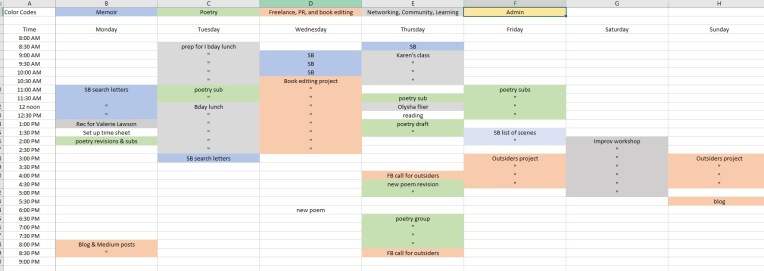
[Image description: color coded spreadsheet tracking time spent writing]
I’m a slow writer. If it took me less than 40 hours to write a ten page story, I’d be very surprised. (Side note: I’ll be able to figure out how much time I really do spend on a story if I stick with the time tracker.) But because of the Law of Circular Logic, I’m likely to paid for new stories because I’ve been paid for my stories before.
A book manuscript is much more work than a story, and there’s no telling if it will ever be published or make dime one, even if you have a long list of short-form publications. It’s a huge gamble to spend valuable time on it.
The time tracker is like a food tracker. It shows you what you’re really eating. Or writing. Want the template? Fill out the contact form below with the comment “spreadsheet” and I’ll send it to you. And thanks for reading! Here’s a cute photo of a groundhog chilling out in a pipe.
[Image description: Groundhog chilling out inside a large metal pipe]
Time doesn’t seem to be on my side, but I keep trying to wrestle it over here as if it’s a new puppy and I can make it behave. Last month, I started working for myself as a writer, something I’ve planned and saved for since I was (much) younger than I am now. I imagined all the time in the world opening up to me if I didn’t have a day job, and all the progress I’d make on my writing projects.
But decades of working day jobs created a habit of writing at odd hours: early mornings, nights, and weekends. Breaking from that pattern has not been easy, even though I expected to have nights and weekends free now that I’m only working one job. Alas, I’ve felt like a failure already — working at odd hours still, and not making enough headway.
Like many people, I squander time on social media, mindless eating, and passive entertainment. When I’ve squandered enough, I get resentful when those I love interrupt my thoughts. As if those people (and dogs) are the cause of my fribbling. Harrumphing at my beloved partner and our pets is no solution. If I keep blaming my darlings, I’ll end up an isolated old lady who still hasn’t learned to manage her time.
So I turned to Auntie Google for info on time management strategies. The strategy I settled on for this month – a time tracker – brought me back to my days as a lawyer keeping track of billable hours. I’m not billing anyone; I’m trying to learn where my time is going. Here’s a screen shot of my time tracker for the week:
Lots of white space, huh? But it adds up to 38 hours of “work” as I’m currently defining it.
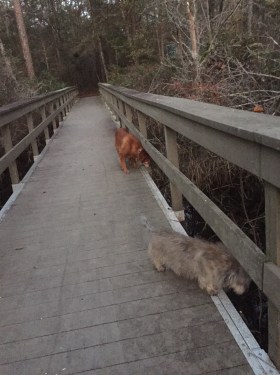
Image description: Two dogs on a walkway in the North Florida woods
And I’m not even trying to track my thinking time, much of which occurs on long, solitary walks in the woods with my dogs.
If that looks like introversion, that’s because it is. I was afraid that working for myself as a writer might make it too easy to isolate myself from my community and even from other writers. So, my 2018 goals included time for community action, taking classes, and networking. I thought these would be the hardest goals for me to hit. Boy was I wrong, at least for last week. Those big gray blocks, 12 hours in all, are the time I spent away from my desk, networking with others.
Knowledge is power, of course, and I’m hoping that after a few weeks I can analyze the data in my spreadsheets to help me understand how and when I work, and whether I need to make any changes.
What’s your favorite time management technique? Inquiring minds want to know.
Last week was my grand-nephew Austin’s birthday. He would have been 19 years old. This is a story about him that was originally published in Issue 10 of the print magazine GRIST.
Compass
When Austin was four years old, we went swimming in Florida’s Ocala National Forest, not far from the springs where the early black-and-white Tarzan films were made, the ones that starred Johnny Weissmuller. Austin’s mother, my niece Theresa, wanted us to go to a place called The Run, which at that time was unregulated, but that meant another ten miles of driving, and I was tired, hot, and able to pay the entrance fee to the Juniper Springs State Park. We parked the car and walked down the shaded path to the spring, under live oaks draped with Spanish moss and resurrection fern, past palmetto thickets. Austin went barefoot on the path’s cool sand, and so did I.
As soon as the water came into view, Austin ran straight to the edge of the limestone rocks and dove in head first. I followed him in a panic because I didn’t know he could already swim. The water was so clear then, the underground cave where the spring rushed forth was visible, and so was Austin, his little stick legs snapping straight and then drawing up in right angles like a frog’s. He was headed down, down, down toward the source, and I held my breath with him as Theresa caught up with us, chatting with two bikers who had walked up the path behind us. Why didn’t I dive in after him? He looked so sure of himself, I suppose, but my lungs were fit to burst when he surfaced and shot over to another ledge. He climbed up onto an outcropping, his limbs shining with water, his little toes grabbing the rough stone, and then he dove back in again, as if the only world that mattered to him was the one below the surface.
“I been to Indiana,” I heard Theresa saying to the bikers, “but it was too damn cold for my blood.” She had called me once from Indiana to tell me someone had taken off with the car I’d given her, a little Saturn sedan with almost 200,000 miles on it that had taken me from Boston to Savannah to North Florida year after year. When Theresa lost custody of Austin for the first time, she was living in the Ocala National Forest, not far from this spring, and the boyfriend who had been driving her around was dead, his guts blown away by an angry man with a shotgun while Austin looked on. That shooting put Austin into foster care, and it put Theresa on the path of trying to get him back. I knew transportation was critical for a teenage woman who was trying to work and trying to stay straight and trying to get her son back. I was getting a new vehicle, and the Saturn was a four-door that would easily accommodate a car seat. It was the right thing to do, but the car didn’t last her very long.
Austin kept diving down toward the mouth of the cave. He was a beautiful child with his mother’s thick blond hair, and the long, slim frame he shared with her that pops up only occasionally in my family. Most of us are compact, built for the long haul on short fuel. I dove into the spring; the water infused my skin with its fresh chill, and I paddled around with Austin, grateful for his squeals of delight when I splashed him, and squealing myself when he pretended to be a shark sneaking up on me. Without asking, it was impossible to know whether he remembered the shooting. He had been at the age when some memories stick forever and others are easily rinsed away. I hoped his memories of days like this, of swimming in the clear water, would drown out the blood and screaming.
A year later, I went to pick Austin up outside of Savannah in Garden City, at a house Theresa was staying in. I had two other young kids with me, Austin’s cousins, and the plan was for them to spend the weekend together. The house had once been a single family bungalow, but it had morphed into a rooming house. The neighborhood was just off of Route 80, a short walk from the restaurant where Theresa had just started as a waitress. Theresa had one room for herself and Austin. Her father, my brother James, had another room, but the three or four remaining rooms were taken by people I didn’t know. The place made me skittish as soon as I walked inside. A bittersweet, burnt odor permeated the house, something I recognized but could not at first identify.
“Okay, Austin,” I said, after giving him and Theresa a hug, “pack up your stuff.” I expected him to be prompt and competent, maybe because I remembered his adult demeanor at the spring, or maybe because I had an idea of him being older than his years, but he whined for his momma to help him, and she did, with a motherly air that seemed out of place in this room where the windows were covered with sheets.
“Smells like crack in here, Theresa,” I said, “like it’s in the walls.” The walls were papered in a style that looked left over from the 1940’s: palm leaves and hibiscus on a beige background. At the ceiling and at the edges, the paper curled and rusted.
Theresa pulled herself up to her full height and arched her back. “What you mean by that, Aunt Michele?”
“I mean it smells like crack in here,” I said, just as someone began tapping on the front door.
A man in a nearby room yelled, “Do not let that motherfucker in the house!” More tapping. Another, louder, “Do not let that motherfucker in the house.” It kept up, like a call and response, the tapping and the cursing.
The kids and I stood in the hallway outside of Theresa’s room. A white man who looked to be in his fifties, wearing a dingy t-shirt, jeans, and flip flops ran past us. Spinning like a sprayed roach, he made a circuit around the kitchen and the hallways, doing his part in the call and response, varying the emphasis on each word. “Do NOT let that motherfucker in the house” shifting to “Do not LET that motherfucker in the house,” shifting to “DO not let that motherfucker in the house.”
“Don’t pay any attention to him,” said Theresa. “He’s just crazy.” She finished packing Austin’s bag. I grabbed it, and herded the kids toward the front door.
Through a window, I saw a handsome young black man on the porch. He wore a Chicago Bulls t-shirt over long shorts, and his neck was hung with gold chains. He was the person who had been tapping on the door. He was the motherfucker. I saw him tap again and lean in as if listening. I scooted the kids behind me and opened the door. The man smiled big and cheesy at me.
“How you doin’?” he asked.
“I’m good,” I said to him.
“No, really,” he said. “How you doin’?”
“No, really,” I said. “I’m good. I got some kids here, and we’re about to leave.”
The man looked behind me at the kids and then stepped back. He wore enormous red and white sneakers, and out of the corner of my eye, I saw Austin and my other nephew appraising them.
“Thank you,” I said to the man. “C’mon, y’all.”
The kids filed out the door in front of me, and I heard the man yell into the house, “How y’all doin’ in there?” as he walked inside. One more “Do not let that motherfucker in the HOUSE” followed us out to the car.
We drove to a water park out by Statesboro, and I splashed around with the kids, wondering all day how I could bear to bring Austin back to that house. Luckily, I had time to think because the plan had been that he’d stay overnight with me and his cousins. As night fell, we drove back east through Savannah on Bay Street, and headed toward my Uncle Charles’ house on Wilmington Island. At a traffic light, Austin crowed from the back seat, pointing to his left. “That’s the way to River Street!” He was right, even though he’d only been there once. Like a lot of us, he was born with a compass in his head that told him when he had arrived somewhere he’d been before.
The next day, I went to the restaurant where Theresa was working to tell her I wasn’t bringing Austin back to the Garden City house. It wasn’t fair to confront her at a job she’d just gotten; the management would have no attachment to keeping her on, so she probably wouldn’t make a scene. From my own waitressing experience, I knew business would be slow at about 3:00 pm, and that Theresa would be doing her sidework, cleaning out coffee pots and filling salt and pepper shakers and ketchup bottles for the dinner crowd. I knew she’d be able to talk to me, but not for too long.
We sat at a table in the back of the restaurant where she was rolling silverware into napkins. The silverware was fresh out of the dishwasher, and still warm. “Honey,” I said, “that house is not a safe place for a kid. We’re keeping Austin until you find a better place to live.” Using the royal “we,” as in our whole family, was unfair, too. She looked at me blankly. She’s drained out, is what I thought. I bent over to hug her, and she didn’t get up out of her chair.
But that night, Theresa came looking for her son. She had lost her afternoon flatness, and she was adamant. “He’s what I live for,” she said. When he ran into her arms, how could I stand between them? I couldn’t. Neither could anyone else.
A month or two later, the house in Garden City spun into a chaos even Theresa couldn’t live with. She had a new man, and when that man beat her, my brother James stabbed him through the left kidney. It is a testament to that man’s reputation for violence that my brother was never charged with the stabbing, and only questioned briefly by the police. Theresa brought Austin back to the Ocala National Forest, where he had been born, where we had swum in Juniper Springs.
The Forest is deep and diverse, colored in every possible shade of green. It contains four National Wilderness areas and is home to otters, armadillos, black bears, white-tailed deer, bobcats, cottonmouths, and alligators. People live there, too, mostly in trailers on rented land. There is plenty of privacy, as most of the land is inaccessible by roads, and there is a long tradition of large-scale marijuana cultivation in The Forest. In the 1970’s and ‘80’s, several of my brothers worked for people who ran pot farms. Later, The Forest became home to people importing cocaine, heroin, pharmaceuticals, and finally to meth labs. In and around the Forest, fifty-seven meetings of Narcotics Anonymous are held per week. In the nearest towns of any size, Silver Springs and Ocala, you can attend meetings of Narcotic Anonymous morning, noon, and night.
About a year later, Austin was removed from Theresa’s care again, after a man she was staying with shot himself in the head. Austin witnessed that, too, and soon after, his father, who’d had little to do with Austin, was murdered in prison. The father’s parents were heartbroken. Austin was all they had left of their only son, and they begged Theresa to let Austin come live with them on their spread in rural central Florida. Eventually, they also talked her into letting them adopt him. “They’re good people,” Theresa told me, “and they can do more for him. He’s in private school. He’s playing football. They live on fifty acres with four-wheelers and everything.”
I saw the photos of him wearing a polo shirt with the school’s logo emblazoned on a pocket, and of him wearing his football uniform, holding his helmet, and another of him with his arms looped around the shoulders of two other boys. In all of the photos, he is smiling broadly, the resilient child who has bounced into a stable living situation.
Theresa stayed in touch with Austin, but mostly what she had left of motherhood was her love for him and his name tattooed on her neck. I was sorry to see another of our family’s children given up, but I also breathed a sigh of relief. Austin was prone to happiness and affection. He would, I was certain, thrive in a steady-state environment. He would be safe.
Whenever someone from my family calls, my gut drops because it’s so often bad news. Five years after Austin moved in with his grandparents, I was on Monhegan Island, off the coast of Maine, getting ready to attend a meeting of people interested in environmental issues. When my phone rang, I took the call, although I don’t always do that. It was my sister. There had been an accident. Austin had been visiting relatives with his grandparents in Colorado. There had been a dirt road, a four-wheeler. Head first. A broken neck.
He was fourteen.
He’s been dead for almost two years now. I’ll be with Theresa soon because I’m back in Florida, making another new life for myself in another new job. Like her, I find the North too cold for my blood.
Today I kayaked down Juniper Run through one of the Forest’s National Wilderness areas. Afterward, I walked down to the spring to rinse the sweat from my skin. The path is broader but still shaded by the live oaks, which are lush with resurrection fern because it’s been a rainy summer. The spring looks changed; the state has built a concrete enclosure around the waters, creating a tame, circular swimming pool. The rough edges of the limestone have been smoothed, but the water is as I recall it: clear and cool and infused with the presence of Austin. I can still see him kicking down toward the mouth of the cave.
Originally published in Issue 10 of Grist: A journal of the literary arts.
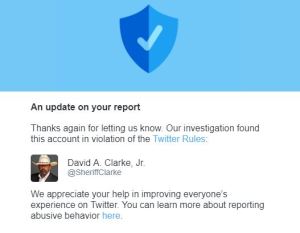
Image description: A notice from Twitter advising that my report against David A. Clarke. “ Our investigation found this account in violation of the Twitter Rules.”
Diverse groups — including women, LGBTQ people, Muslims, African Americans — have been increasingly targeted by online harassment and hate speech. For example, the Anti-Defamation League, one organization that tracks hate speech, found a sharp rise in anti-Semitic online content since the 2016 presidential election. Over the past year, like many other people, I’ve been moved to report hate speech and threats of violence I see on Twitter. In response to an onslaught of such reports, Twitter tightened up its rules. Here’s the current Twitter statement about violence, which went into effect about a month ago.
Violence: You may not make specific threats of violence or wish for the serious physical harm, death, or disease of an individual or group of people. This includes, but is not limited to, threatening or promoting terrorism. You also may not affiliate with organizations that — whether by their own statements or activity both on and off the platform — use or promote violence against civilians to further their causes. We will begin enforcing this rule around affiliation with such organizations on December 18, 2017.
And here’s the rule about what I call hate speech.
Hateful conduct: You may not promote violence against, threaten, or harass other people on the basis of race, ethnicity, national origin, sexual orientation, gender, gender identity, religious affiliation, age, disability, or serious disease. Read more about our hateful conduct policy.
One of the Twitter users I reported was David A. Clarke, the sheriff who’s known for wearing fake military medals and for claiming he’ll be hired by 45 any day now. Clarke’s Twitter account was, in fact, suspended at the beginning of this year, but he was back online after deleting a few offensive tweets. Twitter’s message to me came almost 20 days after they’d reinstated him.
I still believe Clarke’s tweets threatened violence, but now I’m wondering why Twitter chose to sanction him and not (apparently) the other users I reported, who were all white men. Clarke, not surprisingly, has pooh-poohed his sanctioning, inviting readers to visit his web page, which he calls “Twitter censor-proof.”
Should I, or you, continue to report tweets that are hateful or that threaten violence? Do we really need more laws and regulations? Do we have a responsibility to help create community standards for acceptable social media speech?
Winter has been good to my poems, with one little baby out in the world in Stirring, and another out in SWWIM, and two out in Street Light Press. But aside from the fact that all these journals begin with the letter “S,” is some other similarity playing a quiet tune here?
When I get a piece published somewhere, I read the entire issue of the journal. Inevitably, I’ll come across a poet whose work sings to my existing tastes or whose work surprises me. (Check out Carolee’s poem in Stirring, for example!) This, in turn, will often push me to read more work by those poets, in other journals, which, in turn, gives me ideas for new places to send my work.
Submitting work to journals and contests and publishers (lions and tigers and bears) is one big pain in the ass. First, you have to locate journals that are a good match for your work. My go-to spot for that is Trish Hopkinson’s blog, A Selfish Poet.
Then come the tasks like record-keeping and filling out online forms, not to mention opening yourself up to rejections. If you’re like me, and you get lots of rejections, you need to know about lots of journals.
What makes submitting easier? Two things come to mind: a system and some sisters.
New online communities for writers seem to pop up daily. I’m drawn to those that are created by and for women, like Women Who Submit on Twitter, which offers info on open submissions and “submission parties,” both F2F and virtual.
Where do you go for information and strategies on sending out your work? Help us out here, so we can get back to the fun part – the writing.
I’ve dreamed of living a life of reading, learning, and writing since I was a young girl, and this is the year that my dream becomes a reality. Although my jobs over the past 40+ years often allowed me to make use of my writing and research skills, I’ve struggled to make time outside of the workday for creating my own poems, essays, and stories.
I did the getting-up-at-5 am thing, and the hustling-to-complete -a-manuscript-during-academic-breaks marathons, and the-writing-at-night-until-your-eyes-close, all of which were fruitful, but exhausting. I knew, all along, that the only way to have enough time for writing everything I wanted to write was to make it my full-time vocation, and that’s the destination I’ve been working and saving toward all my life.
I mention the working and saving part because I don’t want to give the impression that I’m some daring iconoclast. I’m a sixty-year-old woman with two chronic medical conditions, and I worry about health insurance as much as the next person. But 2018 is the year I stop living in fear, the year I stop trading what could be my writing time for the security of a full-time job working for someone else, the year of now.
Resigning from my position with the Women’s Economic Stability Initiative at Santa Fe College has been a difficult decision, and not just because I’m letting go of the paycheck and benefits. My co-workers there are now friends — some of the kindest, bravest women I know. In helping program participants to achieve their career dreams, I felt good about being one of many people working to change the economic inequities that exist in our community. And, I learned a lot about employment trends and the challenges faced by older workers.
It’s not the first time I’ve jumped into an entrepreneurial role, but my jumping skills are a bit rusty. In 1982, at the age of 23, I started a law practice in the Boston area and financed it at first by part-time bartending. After fifteen years and two more graduate degrees, I left the practice to devote myself to teaching writing and critical thinking skills to college students here in Florida, out West, up North, and in Japan.
As a freelancer, I’ll continue to write memoir, poetry, and researched political articles, but I’ll also be offering concise, accurate, audience-centered content to nonprofits and businesses. Wish me luck! And affordable health care for all!











 created by and for women, like
  Now is the time to write.
 Michele Sharpe