Displaced Homemakers: Then and Now

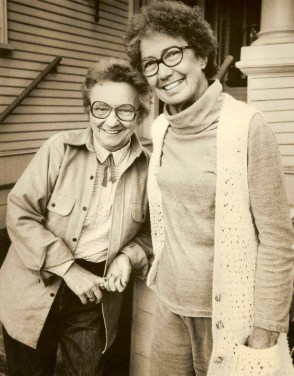
Tish Sommers and Laurie Shields
Laurie Shields (left) and Tish Sommers

In the 1970’s, as the American divorce rate rose, women who performed unpaid work in the home and who relied on husbands for economic security increasingly found themselves displaced. With limited paid work histories, many ended up living in poverty and confusion, struggling to achieve independence in a culture that had dismissed them.

Two extraordinary women, Laurie Shields and Tish Sommers had experienced the “displaced” phenomenon themselves. They put together a national coalition of activists and successfully lobbied 39 states and the federal government to create programs to train and counsel women.

Tish Sommers came up with the term “displaced homemaker” because she saw parallels between the experiences of women who were ousted from the homemaker role they expected to play for life, and the experiences of people who are forcibly exiled from their homes through political upheaval. Women who were displaced as homemakers by death, divorce, desertion, or disablement of a husband could find themselves ineligible for Social Security benefits, for unemployment benefits, and for welfare benefits. With little paid work experience, they could appear unemployable. As Laurie Shields notes in her 1981 book, Displaced Homemakers: Organizing for a new life, “homemakers assumed that retirement benefits, health insurance, and economic security flowed from their marriage.” When marriage ended, or a husband became unable to work, the safety net of marriage came unstrung.

How widespread was this phenomenon? In 1976, the Department of Labor estimated there were 4 million displaced homemakers in America, and that 3 million of those were between the ages of 40 and 64. Statistics like these, and the personal stories of women who’d been displaced, created a public outcry and support for programming. Columnist Ellen Goodman noted that women in these circumstances were caught “between the expectations of one decade and the reality of another.”

The first displaced homemakers program was authorized by the California legislature in 1975. By 1979, approximately 300 programs operated nationwide, but opposition among anti-feminists was strong.

schlafly
Phyllis Schlafly promotion for defeat of the E.R.A.

Phyllis Schlafly, perhaps the most well-known anti-feminist of the time, and, ironically, a “career woman,” was especially suspicious of displaced homemaker programs, calling them “nothing but indoctrination and training centers for women’s lib. The feminists who run such centers use them to push ERA, abortion, federal child care, lesbian privileges, etc.”

Sommers and Shields were puzzled by the level of outrage against displaced homemaker programs. They wondered if some of it was age bias. Nevertheless, they persisted through years of drafting legislation and lobbying in Congress and at the state level. In 1978, President Jimmy Carter signed the revised Comprehensive Employment and Training Act (CETA), which included provisions related specifically to the employment needs of women, providing a method for funding programs for displaced homemakers. In 1984, passage of the Perkins Act, which provided career-development funds for women’s training, further ensured the viability of displaced homemaker programs.

The Displaced Homemakers Network formed by Sommers and Shields evolved into a national organization that hosted annual conferences where program staff from across the country met to exchange strategies for helping displaced women. Some of the challenges faced by women at that time included a high rate of unemployment ascribed to age and a lack of paid work experience, along with limited opportunities for assistance from social security, unemployment compensation, medicaid, and benefit or pension plans arising from the husband’s employment.

Displaced Homemaker Programs (DHPs) provided services across the nation through the end of the twentieth century. With support from state, federal, and private foundation grants, the programs helped women achieve economic independence and personal confidence. The first challenge to their funding arose in 1998 when the Perkins Act was stripped of its gender-equity provisions. In the past ten years, there have also been funding cuts on the state level.

For example, in Florida, Displaced Homemaker Programs drew on a state trust account that was funded by state marriage and divorce fees. The trust was dissolved in 2017 by Governor Rick Scott. Of the seven programs active at that time, only one remains: a program at Santa Fe College where I was lucky enough to collaborate with the DHP staff as part of my work with the Women’s Economic Stability Initiative.

DHP pantsuits

Here we are (at left) in a photograph taken shortly before the 2016 presidential election. The poster image is of the program’s patron saint — Rosie the Riveter. The Santa Fe program survived budget cuts thanks to college president Jackson Sasser’s commitment to the program.

My experience on the fringes of Santa Fe’s DHP proved to me without question that there is still a deep need for programs that help women navigate changes brought on by the loss of financial and emotional support. But who is today’s homemaker, and how likely is it that she will experience some version of being “displaced”?

Although more women today have college degrees than ever before, younger women opting to stay at home to care for children still suffer serious impairment to their overall earning capacity. And as health care costs increase, many older women choose to care for elderly family members at home, giving up or reducing their employment income.

Disagreement exists about the current American divorce rate. Some academics see the divorce rate going down, while others argue it’s holding steady at about 50%. Interestingly, though, at least one group of researchers claims the divorce rate for people aged 55 to 64 “has quadrupled over the past three decades.”

In the ever-changing culture of America, disruption and displacement seems more likely than not. Women, and men, will continue to lose the security of marriage and family. They will need programs like Santa Fe’s that support their employment goals and personal goals. “I’m living proof the program works,” said one participant in an interview with local media. “I can smile again. I have self-confidence. They’re my family.”
Menopausal Moments: One Reason Teachers Don’t Need Guns

woman beside wall by Ursula Madariaga via PexelsStudents often want to write papers about the same old topics. Abortion. Legalizing weed. The death penalty. Gun control.

Read a few dozen of those papers, and you’ll want to stick a knife right in your own damn head. I banned papers on these often-plagiarized topics. But I did sometimes allow class discussion.

If the topic of gun control came up in my classroom, I’d ask my students to imagine I’d come to class in a menopausal rage.

“If I had a knife, and I threw it at John there in the back row, and it stuck right in his head, what would y’all do?” I’d ask.

Students would laugh, scream, squeal, or pick at their fingernails, but one would finally say “We’d jump on you.”

“Exactly,” I’d say. “Now imagine I came into class with a semi-automatic weapon and started mowing y’all down in one magnificent menopausal moment. What would you do then?”

I wouldn’t make that argument in a classroom today; in fact, I never made it again after Sandy Hook. But there’s another reason teachers shouldn’t have guns besides being driven mad by menopause or by having read too many crappy essays.

Teachers are human beings, and human beings fuck up.

In all the talk about the right to bear arms and the Constitution, this simple fact never seems to come up — that human beings are fallible. We do things we don’t intend to do. We lose our tempers, and we lose our minds. All of us.

Yesterday, a teacher and off-duty police officer accidentally fired a gun while teaching a public safety class. As far as I can tell, he isn’t menopausal. Thankfully, there were only minor injuries. . .

You can read the rest of this post (minus the f-word), if you like, on Medium


person Michele Leavitt, three poems

Three new poems up on isacoustic*. Thanks to poet/editor Barton D. Smock and poet/literary citizen Trish Hopkinson.

The first poem in this group is partly a found poem, with lines taken from a scientific paper on rocky beaches, like the one where I grew up.

barton smock's avatarISACOUSTIC*

Michele Leavitt, a poet and essayist, is also a high school dropout, hepatitis C survivor, adoptee, and former trial attorney. Her essays appear in venues including The Rumpus, Guernica, Catapult, and The Sycamore Review. Recent poems can be found in Poet Lore, North American Review, Stirring, and Baltimore Review.

~

Draft for the End of an Age

Bored with pornography
and other self-evidences,
like In sea-ice occurrences, duality is distinguishable
only by presence or absence of perennial ice,
we crave
complexity, the fractal coastline intricacies
that play a vital function
in regime shifts.
We already knew
sediment composition of raised gravel beaches shows a high degree of uniformity.
Although the dominant
clast shape is oblate,
rock outcroppings

still project seaward, and this suggests
some kind of threshold crossing
beyond a groom carrying a bride
over a doorstep.
Stop writing about us. Listen – do
you hear the grating…

View original post 261 more words

Don’t Give Guns to Teachers

Teacher at front of classroom looking frustrated.
As a former college English teacher, I can tell you there are certain topics students always want to write about. Abortion. Legalizing weed. The death penalty. Gun control.

Teachers who have read a few dozen papers on the same topic often want to stick knives right in their own damn heads. Knowing this, and fearing for my life, I forbade my students from writing on these often-plagiarized topics. But we did sometimes discuss those topics in class.

Whenever the topic of gun control came up in my classroom, I’d ask my students to imagine that I had come to class in a homicidal menopause-induced rage.

“If I had a knife, and I threw it at John there in the back row, and it stuck right in his head, what would y’all do?” I’d ask.

Students would laugh, scream, squeal, or pick at their fingernails, but one would finally say “We’d jump on you.”

“Exactly,” I’d say. “Now imagine I came into class with a semi-automatic weapon and started mowing y’all down in a menopausal moment. What would you do then?”

I wouldn’t make that argument in a classroom today; in fact, I never made it again after Sandy Hook. But there’s another reason teachers shouldn’t have guns besides being driven mad by menopause or by having read too many crappy essays.

Teachers are human beings, and human beings fuck up.

In all the talk about the right to bear arms and the Constitution, this simple fact never seems to come up — that human beings are fallible. We do things we don’t intend to do. We lose our tempers, and we lose our minds. All of us.

If lives weren’t on the line, it would be humorous to watch gun-lovers fuck up. So many of them seem to think they, and other gun-lovers, are free of human fallibility, that their “training” will insure safety, that their “good moral character” will insure that that they use guns responsibly.

They need to read Greek mythology, or modern psychology, or the holy books of all religions, or statistics, or biology. Human beings are fallible.

Should we entrust fallible individuals with killing machines in environments where killing is not the goal? In environments full of vulnerable children? I think not.

Also, most teachers don’t want to carry guns in the classroom. They want to teach our children stuff like Greek mythology, or modern psychology, or the holy books of all religions, or statistics, or biology.

Is having armed guards in schools the answer? It wasn’t in Parkland, where the armed guard — a fallible human being like you and me — got scared and ran away. Most of us would. Self-preservation is deeply embedded in human biology.

I used to be a teacher, so I’m biased. But it seems logical that education about how to identify and talk to kids who are acting weird could help preventshootings. I can’t think of a single school shooting that happened out of the blue, without any hint that the perpetrator was behaving in a threatening manner or losing his grip (pardon the pun) on reality.

We need to work on preventing school shootings before they get started, and before we get all gung-ho about reacting to them with more violence. All the talk I hear about “adept shooters” is just making me want to stick a knife right in my head.

I must miss teaching . . .

In the works – a series of articles with practical, concrete tips on getting your work published in literary journals and magazines. I’ll share them here and on Medium  I’m excited about this project, and just realized why – I must miss teaching!

Teaching has a been a part of my life since 1990 when I taught my first college composition class for Salem State College (now University). Then in 1995, I gave up my law practice and started teaching full-time. Up until January, I was engaged in teaching in one form or another so that’s more than 20 years of my life. No wonder I miss it!

Teaching is a very happy job because you get to be around people who are reaching for knowledge and striving to improve themselves. Although I took a leap in January to devote myself full-time to writing, I think it’s okay for me for me to indulge my love for teaching as long as I do it in writing. So here’s my first stab at that. Click on the image to read the full article.

A Sample Cover Letter to Help Get You Published

The cover letter strategies here have worked for me with literary journals including North American Review and Catapult, and with more general interest publications including O, the Oprah Magazine, and Guernica. Feel free to adapt the sample for your purposes, or use the outline method explained below.

While it’s important to observe publishing etiquette, you don’t want anxiety over submitting your work to get in the way of why you write in the first place — to express your creativity. I’ve found it best to automate the submission process as much as possible so I can spend more time on creative writing than on administrative writing. Once you have a solid cover letter drafted, you can recycle or adapt it again and again.

Editors are busy folks, too, and in the world of literary journals, many work as volunteers. They will appreciate you making their lives easier with a concise cover letter, and it doesn’t hurt to have an editor read your work while you’ve put them in a good mood. Some things most editors want to know:

Where you heard about their publication

A little about you

Where you’ve been published before

IMHO, one sentence for each of these does the trick. There are exceptions, of course. A few publications don’t want a cover letter at all, and a few want specific information about you. For example, some publications ask about your demographics to help them keep track of how well they are doing with their outreach to writers who aren’t young, hetereosexual cis white men with MFA degrees. My demographic statement is “I’m an old, 97% white lady.” Always read submission guidelines carefully to make sure you are giving the editors what they have asked for.

So, how do you write that “a little about you”?

Click here for the full article. And happy writing!